
Microservices and Scaling Patterns for Growing Real Estate Platforms
Blog

Microservices and Scaling Patterns for Growing Real Estate Platforms

The microservices conversation in real estate software development usually gets started by one of three specific production problems. The MLS sync pipeline is running hourly batch jobs that are taking so long to complete that they’re overlapping with the next scheduled run, and the queue is backing up. The investor portal’s quarterly report generation – a computation-heavy process that aggregates capital account histories, applies waterfall logic, and renders PDF statements for hundreds of LPs – is visibly slowing down the interactive pages that other LPs are using at the same time. Or the commission calculation service, which runs on every transaction close, is consuming enough database connections that the brokerage’s agent-facing CRM is timing out during peak afternoon hours when both closes and new lead activity are highest. These are not theoretical scaling problems. They’re the specific production symptoms that tell an engineering team that the application’s current architecture is no longer matched to its workload profile. And they’re the right moment to have the
Read More »
Architecture Patterns for Real Estate Platforms
Blog

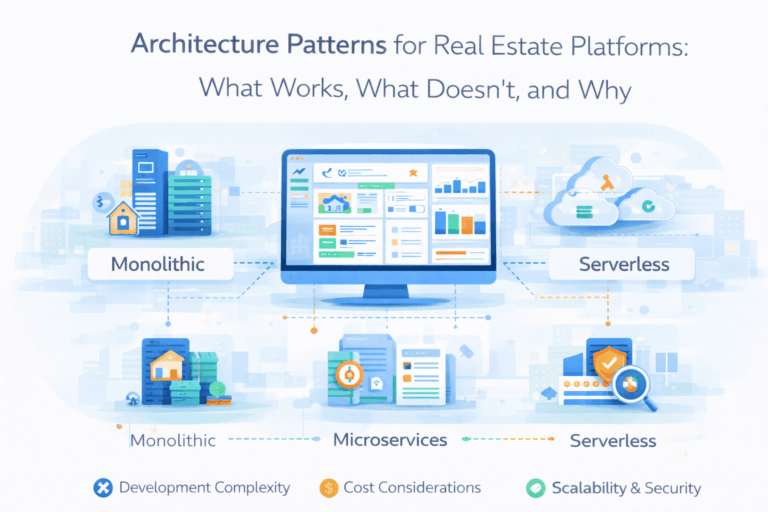
Architecture Patterns for Real Estate Platforms: What Works, What Doesn’t, and Why

Architecture conversations in software development have a tendency to become abstract quickly – patterns discussed as intellectual frameworks rather than as decisions with specific consequences for specific problems. That abstraction is a luxury that real estate platform architects can’t afford, because the wrong architecture decision in a real estate system doesn’t just slow down feature development. It produces trust accounting reconciliation failures, MLS sync inconsistencies that agents notice in two hours, commission calculations that are wrong on settlement day, or investor portals that show different capital account balances than the fund administrator’s records. This post is about the architectural patterns that work in real estate platforms – not generically, but specifically. Every pattern discussed here is examined in terms of the real estate domain problem it solves, the implementation considerations that are specific to real estate, and the failure modes it prevents or introduces. The goal is not a survey of software architecture but a practical guide to the decisions that distinguish a real estate

Read More »
Modernizing Legacy Real Estate Systems
Blog

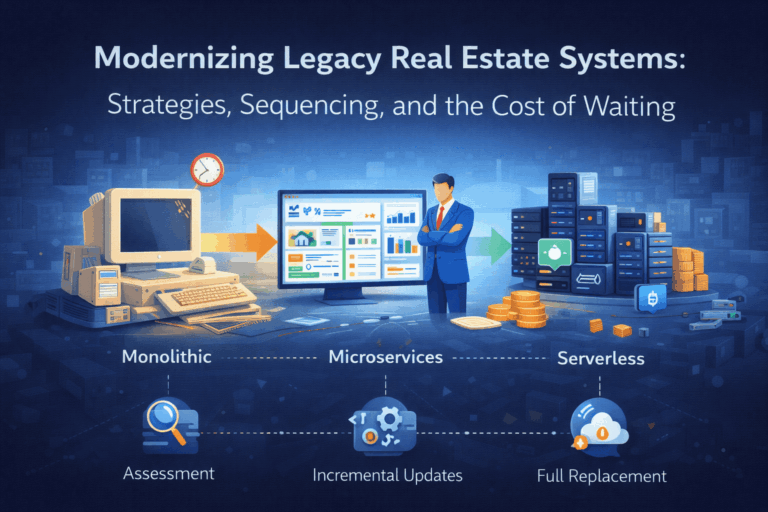
Modernizing Legacy Real Estate Systems: Strategies, Sequencing, and the Cost of Waiting

Legacy real estate systems don’t announce their obsolescence. They don’t fail dramatically or produce a clear moment where the organization decides to act. What happens instead is a slow accumulation of friction that becomes normalized over years until the friction is just how things work. The Yardi implementation from 2014 that nobody fully understands anymore. The commission tracking spreadsheet that only one person in the organization knows how to update correctly, and that person has been here so long everyone assumes they’ll always be here. The custom property management application built on a framework that hasn’t had a security patch in three years. The MLS integration that was built for a single market and now struggles with five, kept alive by configuration hacks that the original developer added before they left. None of these systems failed. They worked well enough, for long enough, that replacing them stopped feeling urgent. And now they’re load-bearing – the organization has adapted its workflows around their limitations, has trained

Read More »
Advanced Search and Discovery for Real Estate Marketplaces
Blog

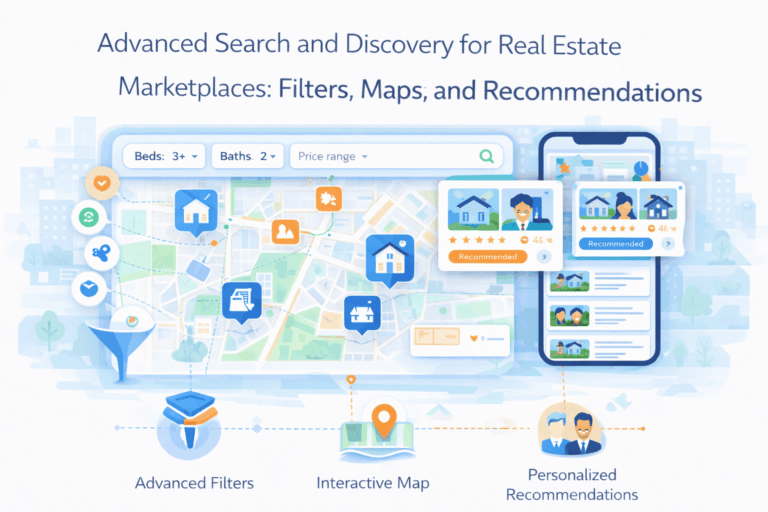
Advanced Search and Discovery for Real Estate Marketplaces: Filters, Maps, and Recommendations

Search is the product in a real estate marketplace. Not the listing detail page, not the saved search email, not the agent profile – the search experience. The moment a user types a neighborhood name, adjusts a price slider, or draws a boundary on a map, the platform’s search architecture is either working for them or against them. Working means results in under 200 milliseconds, filters that narrow meaningfully, a map that responds to every pan without lag, and a relevance ranking that surfaces the listings most likely to match what the user actually wants. Against means results that load slowly, filters that return zero results because the logic is too strict, a map that repaints with noticeable delay, and a relevance model that surfaces recently updated listings instead of the most relevant ones. The gap between these two experiences is not primarily a UX design gap. It’s an architecture gap. The search features a real estate marketplace user experiences are the surface expression of

Read More »
Payments and Escrow in Real Estate Platforms
Blog

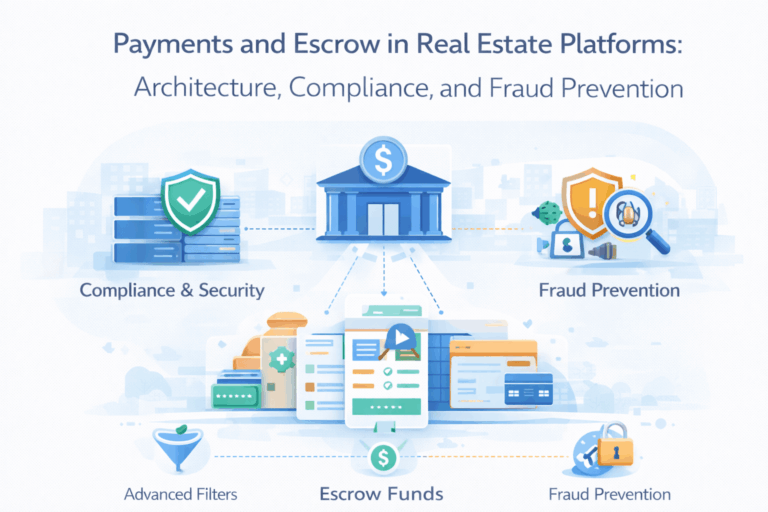
Payments and Escrow in Real Estate Platforms: Architecture, Compliance, and Fraud Prevention

Real estate transactions move more money than almost any other consumer context. An earnest money deposit on a median-priced home is $5,000 to $15,000 – wired or transferred in a single transaction, often under time pressure, by a buyer who has never done this before and whose primary concern is not missing the contract deadline. A commission disbursement at closing moves $15,000 to $30,000 to an agent who is watching for the confirmation. A capital call on a real estate syndication moves hundreds of thousands from investor accounts to a fund’s operating account on a defined timeline that has legal consequences if it slips. Every one of these transactions is a moment where the platform either earns the user’s trust permanently or loses it in a way that’s hard to recover from. A payment that fails silently, a disbursement that takes three days longer than the user expected, a wire instruction that turns out to be fraudulent – these are not edge cases. They’re the

Read More »
Analytics and Dashboards for Real Estate Platforms
Blog

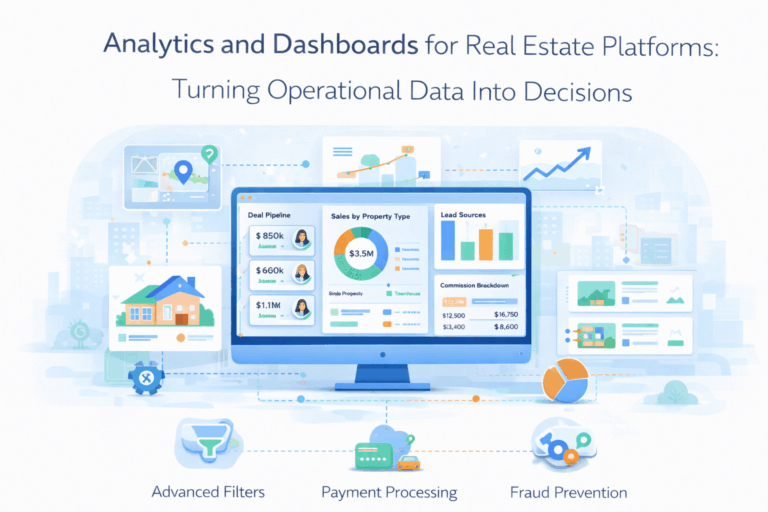
Analytics and Dashboards for Real Estate Platforms: Turning Operational Data Into Decisions

Most real estate platforms have more data than they use. The property management system knows the maintenance cost per unit, the average days to fill a vacancy, the on-time payment rate by building, and which vendors close work orders fastest. The investment platform knows which deal sourcing channels produce the best IRR, which markets are performing ahead of underwriting, and which investors fund capital calls within 48 hours versus those who routinely wait until the last day. The brokerage CRM knows which lead sources close at the highest rate, which agents convert fastest, and which price ranges are sitting longest on the active list. What most platforms don’t have is the layer that makes this data visible, comparable, and actionable – in real time, to the people who can act on it, without requiring an analyst to pull a report every time someone needs an answer. That layer is the analytics and dashboard infrastructure, and it’s the feature that converts a system of record into

Read More »