Custom Real Estate Software vs Off-the-Shelf Tools: When to Build, Buy, or Hybridize
Blog

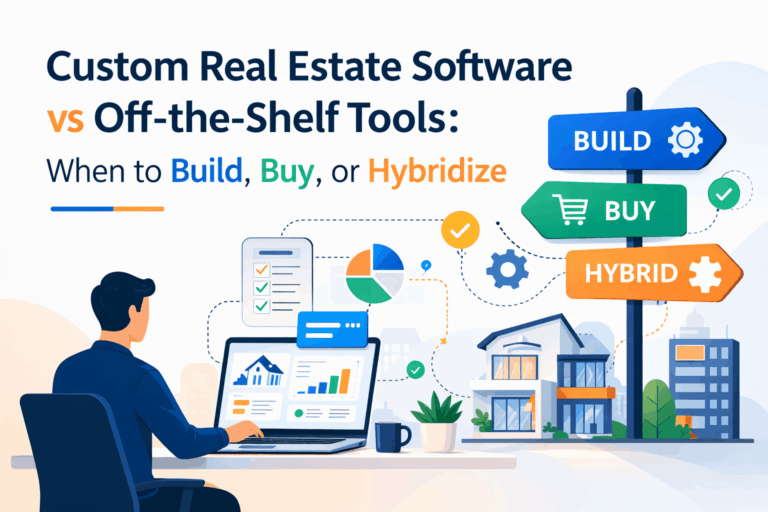
Custom Real Estate Software vs Off-the-Shelf Tools: When to Build, Buy, or Hybridize

The most useful thing we can say about the build vs buy decision in real estate software is also the least satisfying: it depends. Not on how large you are, not on how much budget you have, and not on how complex your business sounds when you describe it. It depends on where the friction in your operation actually lives, what that friction is costing you, and whether the constraint is genuinely architectural – something no off-the-shelf product can solve – or operational, something a better configuration of existing tools could address. Most firms that come to us convinced they need custom software need it. But some don’t, and being honest about which situation you’re in before spending development budget is worth the discomfort. The worst outcome in real estate technology isn’t failing to build the right system. It’s spending twelve months and significant capital building something that a $500-per-month SaaS product would have handled adequately – while the operational problems you actually needed to
Read More »
Centralizing Communication Between Tenants
Blog

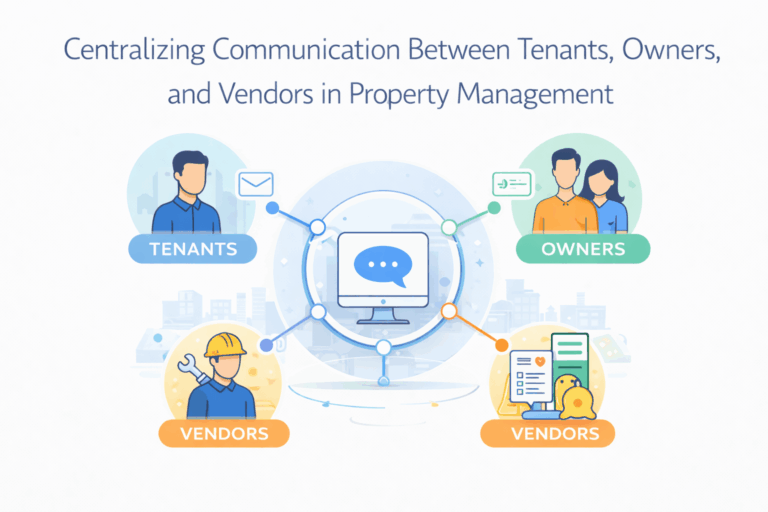
Centralizing Communication Between Tenants, Owners, and Vendors in Property Management

Property management runs on communication. Not on software, not on spreadsheets, not on systems – on the exchange of information between people who all have different stakes in the same physical asset. A tenant needs their heater fixed. A vendor needs access to the unit and a purchase order. The owner needs to know the repair is happening and what it’s going to cost. The property manager is in the middle of all three conversations simultaneously, using three different channels, with no single place where the full picture exists. At twenty units, a good property manager can hold this in their head. They know which tenant texted about the heater, which vendor they called, and which owner they emailed. At two hundred units, that’s no longer possible – not because the property manager isn’t skilled, but because the cognitive load of maintaining dozens of parallel communication threads across email, text, WhatsApp, voicemail, and the occasional sticky note is not a human-scale problem. It’s a systems

Read More »
Designing Real Estate Systems with Observabilitypng
Blog

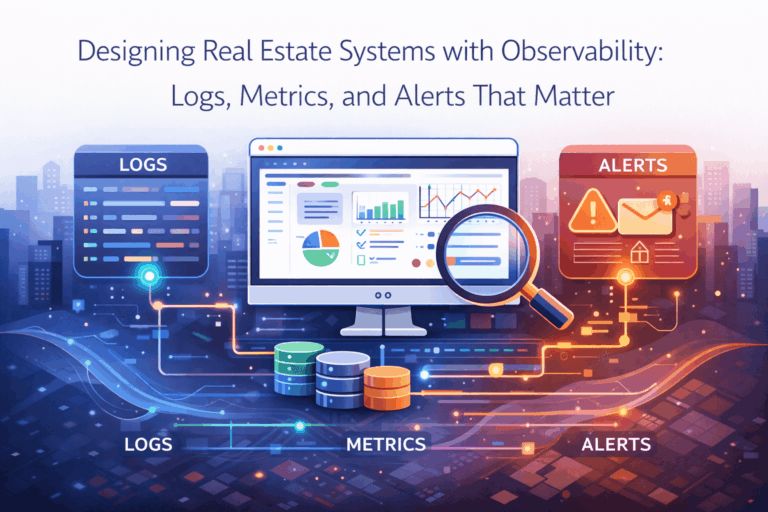
Designing Real Estate Systems with Observability: Logs, Metrics, and Alerts That Matter

Real estate platforms don’t usually fail dramatically. There’s rarely a moment where everything goes down at once and an error page greets every user simultaneously. What happens instead is quieter and more damaging: a nightly MLS import job finishes with a 200 status code, logs zero errors, and silently skips 340 listings because a board changed a required field name three days ago. Agents spend the next week wondering why new listings aren’t appearing. Some of them stop trusting the platform. A few switch to checking Zillow instead. Or a payment webhook from Stripe stops firing because a TLS certificate on a middleware service expired overnight. Rent payments start failing on the tenant portal. Tenants assume they paid successfully – the UI didn’t show an error – but the funds never moved. The property manager discovers the problem four days later when a rent roll shows unexpected vacancies. By then there are already tense calls with tenants who are certain they paid on time. These

Read More »
Automating Investor Reporting and Compliance in Real Estate Platforms
Blog

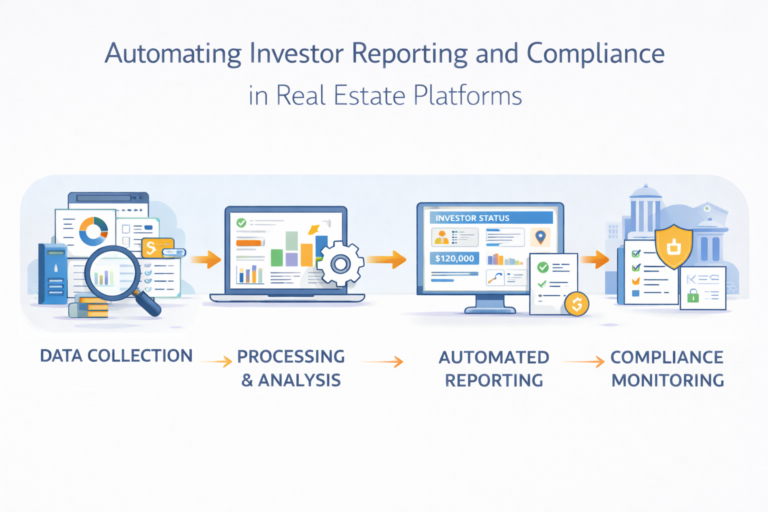
Automating Investor Reporting and Compliance in Real Estate Platforms

Ask anyone who runs operations at a real estate investment firm what happens in the two weeks before quarterly reports go out. You’ll hear the same story every time. The accounting team starts pulling data from three different systems. The asset management team is reconciling their performance numbers against what accounting has. The fund administrator is building the distribution calculations in a spreadsheet, checking it twice, and then checking it again because a single error on a distribution statement is the kind of mistake that doesn’t disappear from an LP’s memory. Someone is hunting through Dropbox for the signed subscription agreements to confirm ownership percentages. And the person responsible for getting everything into the report template is copying and pasting numbers from one document into another, manually, hoping nothing shifts in the source file between when they copy it and when they send it. That process – repeated every quarter, for every fund, for every investor class – is not just inefficient. It’s a compliance

Read More »
Building a Single Source of
Blog

Building a Single Source of Truth for Property Data Across Your Organization

Here’s a scenario that happens in real estate organizations more often than anyone wants to admit. A senior asset manager asks a simple question: what’s the current occupancy rate across our portfolio? The operations team pulls a number from the property management system. The accounting team produces a slightly different number from the general ledger. The acquisitions team has a third figure from the underwriting model they updated last quarter. Nobody is wrong exactly – they’re each pulling from the system they own – but nobody is right either, because no single system holds the authoritative answer. That’s not a reporting problem. It’s a data architecture problem. And it’s one of the most pervasive, most quietly expensive problems in real estate operations at scale. The cause is structural. Real estate organizations accumulate systems the way properties accumulate deferred maintenance – one tool at a time, each solving an immediate problem, none of them designed to coexist cleanly with the others. A property management platform handles

Read More »
From Spreadsheets to Systemspng
Blog

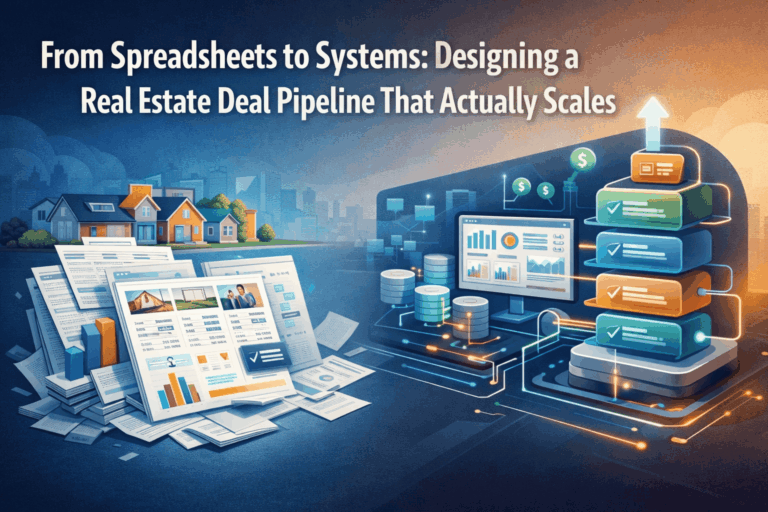
From Spreadsheets to Systems: Designing a Real Estate Deal Pipeline That Actually Scales

Every real estate firm we’ve worked with has a spreadsheet story. It’s usually the same story told with different details. The firm built a deal tracker in Google Sheets or Excel early on – maybe a sophisticated one, with color coding, conditional formatting, and a tab per quarter. It worked well for the first year. Then the team grew, the deal volume grew, and the spreadsheet started to fracture. Different analysts were maintaining their own versions. The “source of truth” was updated inconsistently. Someone changed a formula in column K and broke every calculation downstream without realizing it for three weeks. A deal moved from underwriting to LOI without anyone updating the tracker. Leadership asked for a pipeline summary before a board meeting and the operations team spent two days manually reconciling four different versions of the same data. The problem isn’t the spreadsheet. It’s that the spreadsheet was doing a job it was never designed to do – serve as a multi-user, real-time, historically

Read More »