Fixing MLS Data Chaos
Blog

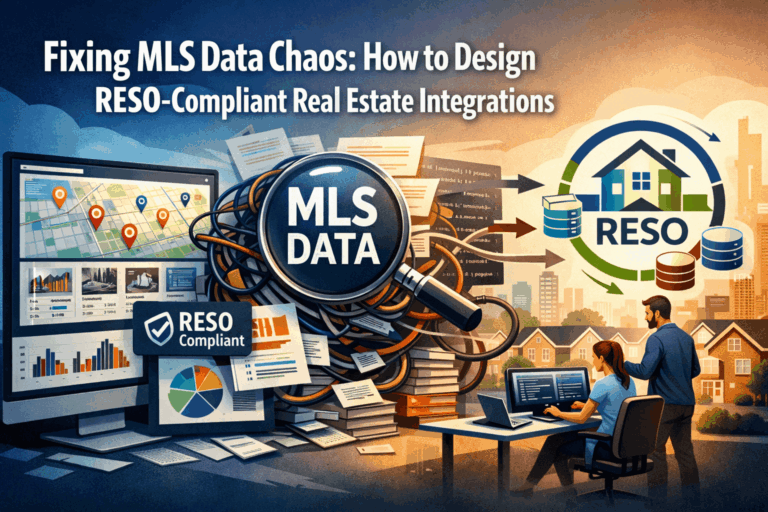
Fixing MLS Data Chaos: How to Design RESO-Compliant Real Estate Integrations

Your MLS integration works perfectly in staging. Listings are syncing, photos are loading, statuses are updating in near real-time. You launch to production. For the first week, everything looks fine. Then, on a Tuesday morning, a broker calls: a listing that went active yesterday still shows as “Coming Soon” on the platform. An agent refreshes repeatedly. The status doesn’t change. Nobody on the engineering team got an alert. The import job ran, returned a 200, and logged zero errors – but forty listings across two MLS boards silently failed to update because a field mapping broke when one board deployed a schema change at 2am. This is the scenario that every development team building on MLS data eventually encounters. And it’s almost never a dramatic failure – no 500 errors, no database crashes, no obvious moment of breakage. It’s a quiet, invisible degradation of data accuracy that agents experience as “the system doesn’t work” and that leads to exactly the kind of trust erosion that

Read More »
Real Estate Marketplace Development
Blog

Real Estate Marketplace Development: Architecture, Search, and Monetization Models

Building a real estate marketplace is a different problem than building a real estate tool. A tool serves one user type – agents, property managers, investors. A marketplace has to simultaneously serve at least two: the supply side (whoever lists inventory) and the demand side (whoever consumes it). Both sides need to find the platform valuable independently before the marketplace effect kicks in, which means you’re solving two product problems at once, with two different data models, two different UX requirements, and two different monetization relationships – and those three things all need to be designed coherently before the first line of code is written. This is why real estate marketplace development projects fail more often than other real estate software projects. Not because the technology is harder – though some of it is – but because the platform design decisions that look architectural are actually business model decisions, and making them wrong early creates technical debt that’s expensive to unwind once the platform has

Read More »
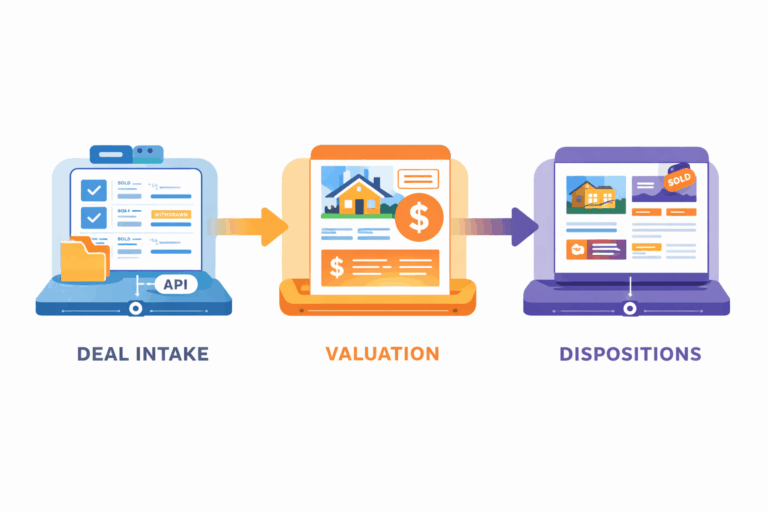
How iBuyer and Acquisition Firms Can Automate Deal Intake, Valuation, and Dispositions
Blog

How iBuyer and Acquisition Firms Can Automate Deal Intake, Valuation, and Dispositions

The economics of high-volume property acquisition are brutally simple: you make money on the spread between what you pay and what you sell for, minus every cost in between. Acquisition cost, rehab cost, carrying cost, disposition cost. Every day a property sits in your inventory costs money. Every deal you evaluate but don’t pursue costs time. Every offer that comes in wrong – too high because the AVM was optimistic, or too low because the underwriting was slow – costs you either margin or volume. At low volume, all of this is manageable manually. When you’re acquiring five or ten properties a month, a spreadsheet, a phone, and a tight team can hold the operation together. The problem is that five to ten properties a month isn’t a business – it’s a start. The firms that actually scale in this space to fifty, a hundred, two hundred acquisitions monthly don’t do it by hiring proportionally more people to do the same manual work. They do

Read More »
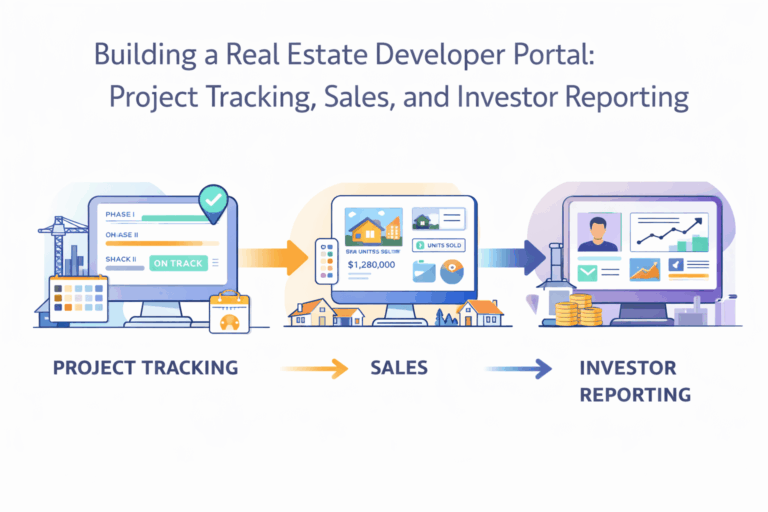
Building a Real Estate Developer Portal: Project Tracking, Sales, and Investor Reporting
Blog

Building a Real Estate Developer Portal: Project Tracking, Sales, and Investor Reporting

Real estate development is a business that runs on confidence. Buyers need confidence that the project will deliver what was promised, on time, to the quality they paid for. Investors need confidence that their capital is being deployed against the plan, that risks are being managed, and that they’ll hear about problems before they read about them. Contractors need confidence that they’ll be paid on schedule. Internal teams need confidence that what’s been sold matches what’s being built and that no one is making commitments the project can’t fulfill. Most of that confidence is manufactured manually – through update emails, PDF reports, WhatsApp threads, and site visit calls – until a developer gets large enough, or busy enough with concurrent projects, that the manual approach stops working. At two active projects, the founder can hold the state of both in their head. At five concurrent projects across different asset classes, geographies, and investor groups, that’s no longer possible. The information starts to fragment, the updates

Read More »
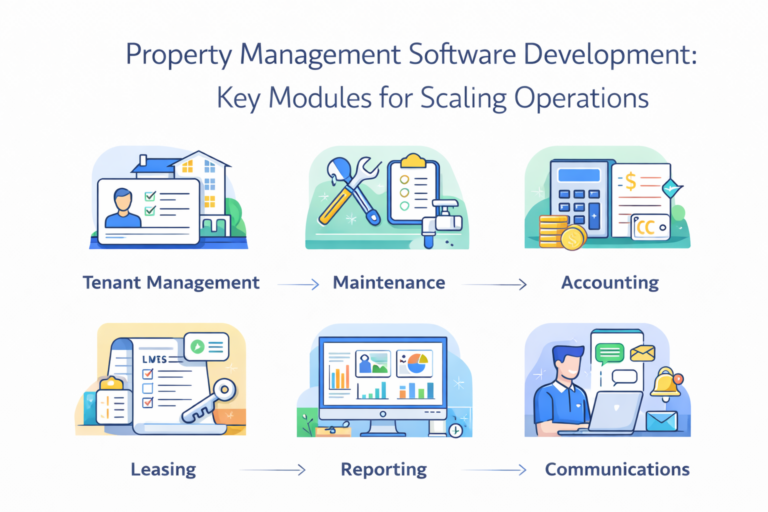
Property Management Software Development: Key Modules for Scaling Operations
Blog

Property Management Software Development: Key Modules for Scaling Operations

Property management is an operations business. Not a sales business, not a relationship business – though it involves both – but fundamentally an operations business. The quality of the product you deliver to owners is almost entirely determined by how well you run the day-to-day: how fast you respond to maintenance requests, how accurately you collect and disburse rent, how cleanly you turn a unit, how clearly you communicate with every party in the chain. That’s not a people problem. At any meaningful scale, it’s a systems problem. Most property management companies figure this out the hard way. They start with a single property manager handling twenty units manually – calls, texts, spreadsheets, bank transfers – and it works. Then they grow to two hundred units across multiple properties and suddenly the thing that worked at twenty is causing daily fires at two hundred. By five hundred units, they’re either running a patched-together mess of five or six different tools, or they’ve bought one of

Read More »
How to Build a Real Estate Investment Platform_ From Deal Pipeline to Investor Portal
Blog

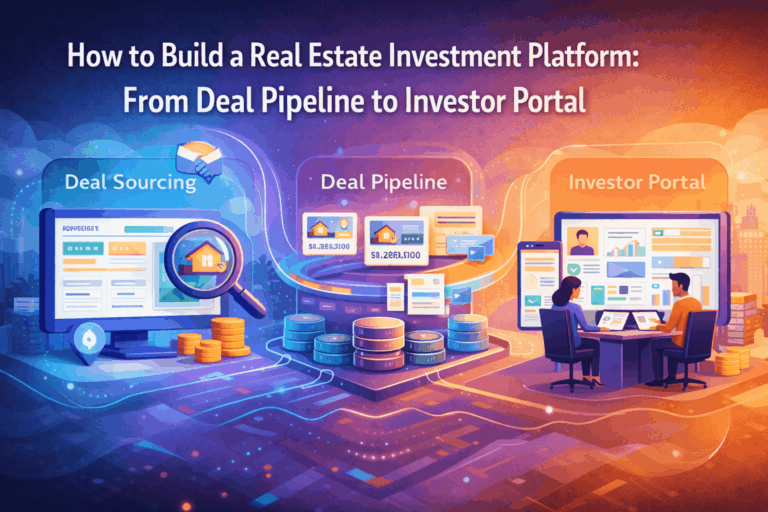
How to Build a Real Estate Investment Platform: From Deal Pipeline to Investor Portal

Here’s a scenario we see often. A real estate investment firm is growing – managing three or four active syndications, twenty or thirty LPs per deal, maybe $80–100M in assets under management. They’re still running on a combination of Excel models, Dropbox folders, DocuSign, and a shared inbox. The partners know they need a platform. What they’re not sure about is what “a platform” actually means for a firm at their stage, or what it would need to do on day one versus year two. The answer isn’t a single system. Real estate investment platform development is really the work of connecting several distinct operational domains – deal pipeline, investor relations, capital management, compliance, and reporting – into something that feels like one coherent tool. Each domain has its own data model, its own users, and its own failure modes. Getting them right individually is necessary but not sufficient. The integration between them is where the real value lives. This post walks through what each

Read More »