Centralizing Communication Between Tenants, Owners, and Vendors in Property Management
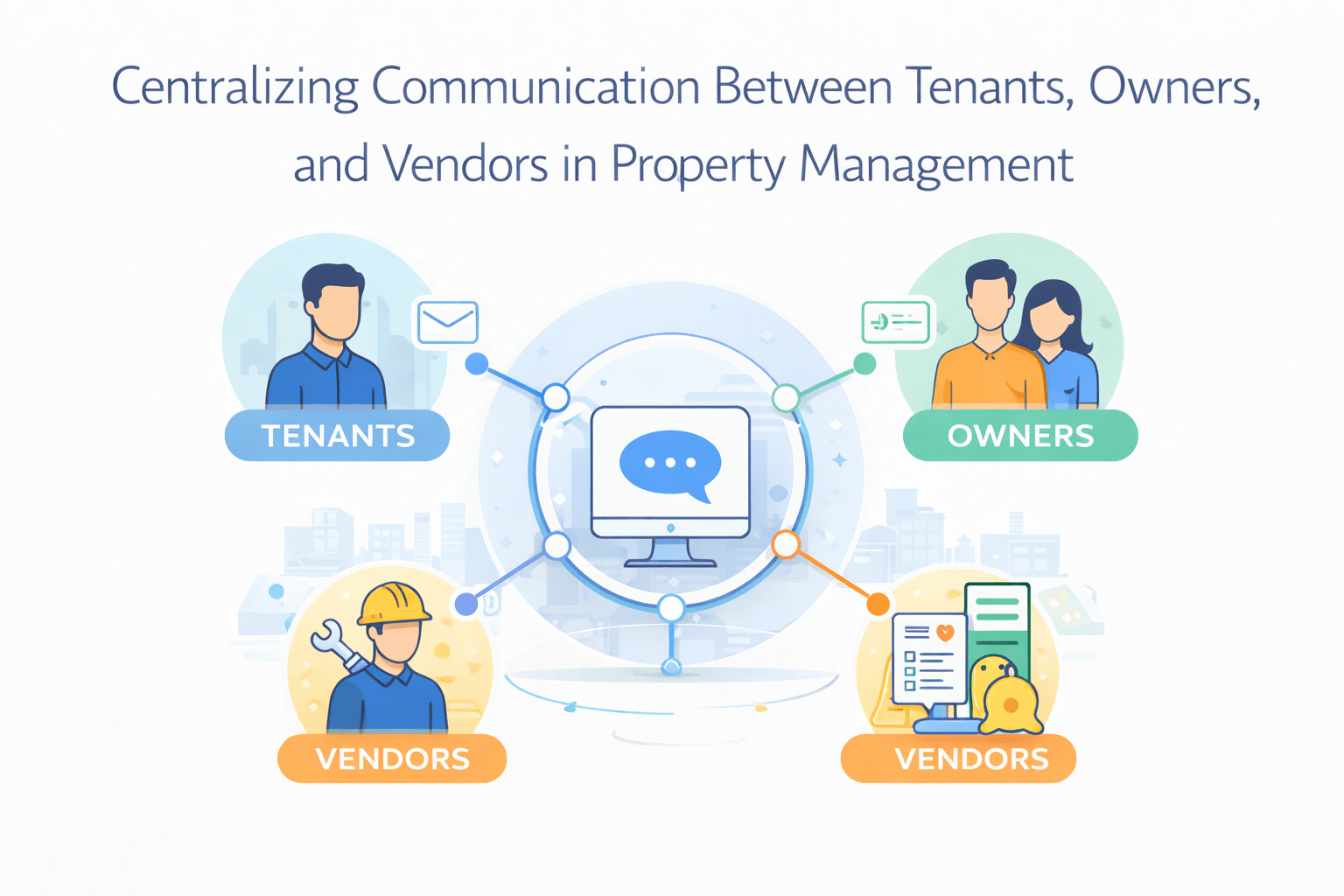
Property management runs on communication. Not on software, not on spreadsheets, not on systems - on the exchange of information between people who all have different stakes in the same physical asset. A tenant needs their heater fixed. A vendor needs access to the unit and a purchase order. The owner needs to know the repair is happening and what it’s going to cost. The property manager is in the middle of all three conversations simultaneously, using three different channels, with no single place where the full picture exists.
At twenty units, a good property manager can hold this in their head. They know which tenant texted about the heater, which vendor they called, and which owner they emailed. At two hundred units, that’s no longer possible - not because the property manager isn’t skilled, but because the cognitive load of maintaining dozens of parallel communication threads across email, text, WhatsApp, voicemail, and the occasional sticky note is not a human-scale problem. It’s a systems problem.
The consequences of fragmented communication compound quietly but predictably. Maintenance requests fall through the cracks when a text goes unanswered during a busy afternoon. Owner relationships erode when they hear about a repair from the tenant before they hear about it from the property manager. Vendor coordination fails when the work order exists in an email thread that nobody else on the team can see. And when something goes wrong - a habitability complaint, a fair housing dispute, an eviction proceeding - the absence of a documented communication trail is the liability that turns a manageable situation into a legal exposure.
This post is about what it actually takes to centralize communication in a property management operation - not as a feature checklist, but as an operational architecture that makes every communication touchpoint faster, more consistent, and defensible.
The Three-Party Communication Problem
What makes property management communication structurally harder than most business communication is that there are three distinct parties - tenants, owners, and vendors - each with different information needs, different communication preferences, and different relationships with the property manager. Most communication tools are designed for two-party relationships: a business and its customers. Property management has at minimum a three-party relationship on every active maintenance event, and often more when you factor in multiple tenants in the same building, co-owners on a single property, or multiple vendors working a single complex repair.
The tenant needs timely acknowledgment that their request was received, transparency about when the repair will happen, and notification when it’s complete. Their primary concern is the lived experience of their home - response time and resolution quality are the two metrics that determine whether they renew or leave.
The owner needs a different set of information: that the repair is warranted, what it’s going to cost, whether owner approval is required before proceeding, and what the impact is on the property’s operating expenses for the period. Their concern is financial and legal - they’re worried about costs they didn’t authorize, liability they didn’t know about, and surprises in the monthly statement.
The vendor needs a work order with clear scope, access arrangements, and payment expectations. Their concern is operational - they need enough information to show up and do the job without spending forty-five minutes calling the property manager for details that should have been in the original work order.
A communication system that serves all three of these parties well doesn’t route the same message to all three - it routes the right information to each party through the right channel at the right time. Getting that architecture right is the design challenge that most property management platforms either oversimplify or underspecify.
Channel Fragmentation: Why It Happens and Why It Persists
The reason property management communication is fragmented across email, SMS, WhatsApp, voicemail, and tenant portals isn’t carelessness - it’s that each channel exists because it’s genuinely preferred by a subset of the people the property manager works with. Older tenants prefer email. Younger tenants prefer text. Vendors prefer a call to confirm and then a text with the details. Owners of high-value assets prefer email with documentation attached. Owners of single-family rentals want a quick text.
The problem isn’t the existence of multiple channels. The problem is when the conversation history for a single maintenance event is split across four of them - an initial text from the tenant, an email exchange with the vendor, a WhatsApp message to the owner, and a voicemail the tenant left when they hadn’t heard back - and none of those threads are connected to each other or to the work order that was eventually created.
The 2025 Fair Housing Trends Report found that disability discrimination accounts for 54.6% of all fair housing complaints - and maintenance delays are one of the most frequently cited triggers. What’s notable about that statistic in a communication context is that many of the disputes it reflects didn’t involve intentional discrimination. They involved situations where the property manager genuinely believed they had communicated with the tenant, but the documentation of that communication either didn’t exist in a usable form or showed response times that didn’t meet habitability standards. The channel fragmentation problem is not just an operational inconvenience - at scale, it’s a compliance liability.
What a Centralized Communication Architecture Actually Requires
Centralizing property management communication doesn’t mean forcing everyone onto a single channel. It means building a system where every communication touchpoint - regardless of the channel it originated on - is captured, associated with the correct property and tenant or owner, timestamped, and made searchable. The channel is the delivery mechanism. The work order or the lease record is the system of record.
The architectural requirement this imposes is an inbox layer that aggregates messages from multiple channels into a single interface, with each conversation associated with a contact and a property. When a tenant texts the property management company’s shared number about a maintenance issue, that text should appear in the same inbox as their email from last week about the lease renewal - both associated with their tenant record and their unit. When the property manager responds, they can choose to reply via SMS or email based on the tenant’s preference, without leaving the interface and without losing the conversation history.
Shared phone numbers - where a property management company operates a single business number that multiple staff members can see and respond to - are the operational foundation of this architecture. Tools like DoorLoop, which provides a dedicated number separate from personal cell phones, and SMS platforms like Clerk Chat, which connects directly into Microsoft Teams for team visibility, both solve the problem of communication living on individual staff phones rather than in a shared system. When a property manager is sick, on vacation, or leaves the company, a conversation that existed only on their personal phone number is a conversation the organization has lost. A conversation that existed on a shared business number is a conversation the organization still owns.
The owner communication layer has a different design requirement than tenant communication. Owners need structured updates, not reactive responses. The ideal communication flow for a maintenance event from the owner’s perspective is: an automated notification when the work order is created (including the issue description and initial cost estimate if available), a notification when owner approval is required before proceeding with a repair above a defined dollar threshold, a notification when the repair is complete (including the final cost and any receipts), and a monthly summary that aggregates all maintenance events with their costs. This cadence - proactive, structured, and anchored to the financial events they care about - is what owner relationships are built on. Owners who receive this kind of communication don’t call the property manager asking “what’s happening with my property.” They already know.
Work Orders as the Communication Hub
The work order is the operational object where tenant communication, vendor coordination, and owner notification converge. It’s not just a task record - it’s the communication thread that connects all three parties to a single maintenance event throughout its lifecycle.
A work order that functions as a communication hub carries the full history of every touchpoint associated with that event: the original tenant submission (with the text they sent or the portal message they submitted), the property manager’s initial triage note, the vendor assignment and the work order sent to the vendor, the vendor’s acceptance confirmation, the scheduled access time communicated to the tenant, the vendor’s check-in and check-out timestamps, the completion photos, and the final invoice. Every one of these should be accessible from the work order record itself, not scattered across the property manager’s inbox.
The SLA tracking layer sits on top of the work order’s timeline. State habitability laws impose response time requirements that vary by issue type and jurisdiction - in California, certain issues (heat, hot water, sewage) trigger a 72-hour mandatory response window that starts the moment the request is received, regardless of when the property manager reads it. The Lula platform, which Renters Warehouse uses across 7,000+ single-family rental doors, embeds these jurisdictional SLA clocks directly into the intake workflow - so when a California tenant reports a refrigerator not cooling, the system flags it as a habitability priority under AB 628 and starts the compliance clock immediately, without requiring the coordinator to manually classify the urgency.
That kind of automated urgency classification matters at scale in a way it doesn’t at twenty units. At twenty units, an experienced property manager knows the relevant habitability thresholds in their market. At 2,000 units across multiple states, no coordinator can be expected to carry the distinct habitability trigger logic for every jurisdiction in their head. The system has to enforce it.
Vendor Communication: The Most Underdesigned Leg of the Triangle
Of the three communication relationships in property management, vendor communication is the one that most consistently receives the least design attention. Tenant portals get investment because tenants are customers. Owner portals get investment because owners are clients. Vendor communication gets a phone call and an email because vendors are contractors and the assumption is that they’ll figure it out.
The problem with this assumption is that vendor coordination failures are the primary cause of maintenance resolution delays - which directly affect tenant satisfaction, which directly affects renewal rates. A vendor who doesn’t receive a clear work order, can’t confirm access arrangements without calling the property manager three times, and doesn’t have a way to upload completion photos without sending an email with six attachments is a vendor who takes longer to complete jobs than one who receives a structured work order, books their own access window through a scheduling link, and submits completion documentation through a portal that routes it directly to the work order record.
The vendor-facing communication layer doesn’t need to be a sophisticated portal - it needs to be functional and frictionless. Vendors should receive work orders with enough detail to scope the job without a follow-up call (property address, unit number, access instructions, issue description, any known constraints, the property manager’s contact for emergencies only). They should have a simple mechanism to confirm acceptance, update their expected arrival time, and submit completion documentation. That mechanism should work on mobile without requiring a vendor to download an app - a web-based form linked from the work order notification is sufficient for most vendors, with the full vendor portal available for established contractors who are doing recurring work.
The compliance dimension of vendor communication is the one most operators underinvest in until they have a problem. When a vendor causes damage to a property during a job - water damage from a plumbing repair gone wrong, an electrical fault from an unlicensed subcontractor - the liability question is immediate: was the vendor’s insurance verified before they were dispatched? NetVendor’s compliance data shows that vendors with automated document tracking and renewal reminders maintain continuous compliance without property manager intervention. Without that automation, insurance lapses go undetected until after an incident. Quarterly vendor audits - formalized reviews of vendor performance, compliance status, and cost benchmarks - have been shown to reduce vendor-related overspending meaningfully, but audits only produce useful data if the performance and compliance records are being captured systematically across every job, not reconstructed manually from memory before a review session.
The Audit Log as Operational Infrastructure
Every communication touchpoint in property management has a second function beyond conveying information: it creates a record. The tenant who texts about a repair at 9pm on a Thursday is creating a timestamped record of when notice was given. The property manager who responds at 9am the next morning is creating a timestamped record of response time. The vendor who checks in at the property at 2pm on Monday is creating a timestamped record of when the repair began. These records, taken together, reconstruct the full lifecycle of a maintenance event - and in a dispute, an eviction proceeding, or a fair housing complaint, that reconstruction is often the difference between a defensible position and an indefensible one.
The audit log should be immutable and comprehensive. Messages sent and received, work order status changes, owner approval requests and responses, vendor assignment and completion events - all timestamped, all linked to the relevant tenant record, property record, and work order. The property manager should never have to search through email threads, scroll back through text conversations, or piece together a timeline from memory to answer the question “when did we know about this issue and what did we do?”
This is the framing that separates communication platforms that property management companies adopt seriously from ones they use superficially. The business case for centralizing communication isn’t just efficiency - though the efficiency gains are real. It’s that every conversation that happens in the system is automatically a record that the organization owns, and every conversation that happens outside the system is a record that may not exist when it’s needed. At small scale, that distinction is manageable. At portfolio scale, it determines the organization’s legal exposure in ways that are invisible until something goes wrong.
Where Communication Centralization Projects Fail
The most common failure is treating channel consolidation as the goal rather than communication continuity. Property management companies invest in a unified inbox platform, train the team on it, and then discover that half their tenants still text the property manager’s personal number and half their vendors still email a shared Gmail inbox that nobody has connected to the new system. Adoption is the hard problem, not the technology. Getting tenants to use the portal for maintenance requests - rather than texting - requires active enrollment at lease signing, consistent reminders, and a portal experience good enough that using it is genuinely easier than texting. Getting vendors to submit completion documentation through a platform rather than emailing photos requires that the platform works on their phone without friction. Technology that requires users to change their behavior without making the new behavior easier than the old one will not be adopted.
The second failure is building the communication system separately from the work order and maintenance system. When messages arrive in a unified inbox but work orders live in a separate system, the property manager is back to maintaining two systems simultaneously - copying information from the inbox to the work order, updating the inbox when the work order status changes. The integration between communication and operational workflow needs to be native, not a workaround. A tenant message should be convertible to a work order in one tap. A work order status change should trigger the appropriate tenant and owner notifications automatically. These aren’t advanced features - they’re the baseline behavior that makes centralized communication actually reduce the property manager’s workload rather than add to it.
The third failure is neglecting the owner communication design in favor of the tenant experience. Tenant communication gets the most attention because tenants are the loudest stakeholders when something isn’t working. Owner communication gets treated as periodic reports and reactive emails. Owner relationships, at scale, are built on the consistent delivery of the information owners need without them having to ask for it. A property management platform that sends owners a monthly statement but doesn’t proactively notify them when a repair above their approval threshold is needed, or when a tenant has given notice, or when a habitability complaint has been filed - is a platform that creates a reactive owner relationship rather than a confident one. Owner retention is as much a function of communication design as it is of operational performance.
If you’re managing a property portfolio where tenant requests are being dropped because they came in on a channel nobody was watching, where vendor coordination is eating hours that should be going to leasing and owner relationships, or where a fair housing complaint just revealed how thin your communication documentation actually is - the property management software architecture decisions that enable centralized communication are the ones we work through in every engagement. We’ve built communication infrastructure for operators managing a few hundred units and for firms managing tens of thousands. Let’s talk about where your current communication model is creating risk and where it’s costing you time.
Related Reading
- Property Management Software Development: Key Modules for Scaling Operations
- Building a Single Source of Truth for Property Data Across Your Organization
Building a real estate platform?
From MLS integrations to investor portals, we've shipped the systems real estate operators actually run on.
Platform architecture, data pipelines, and delivery.
Discuss your platformA technical conversation, not a sales pitch.