
AI for Commercial Real Estate Operations: Where Institutional Scale Changes the Equation
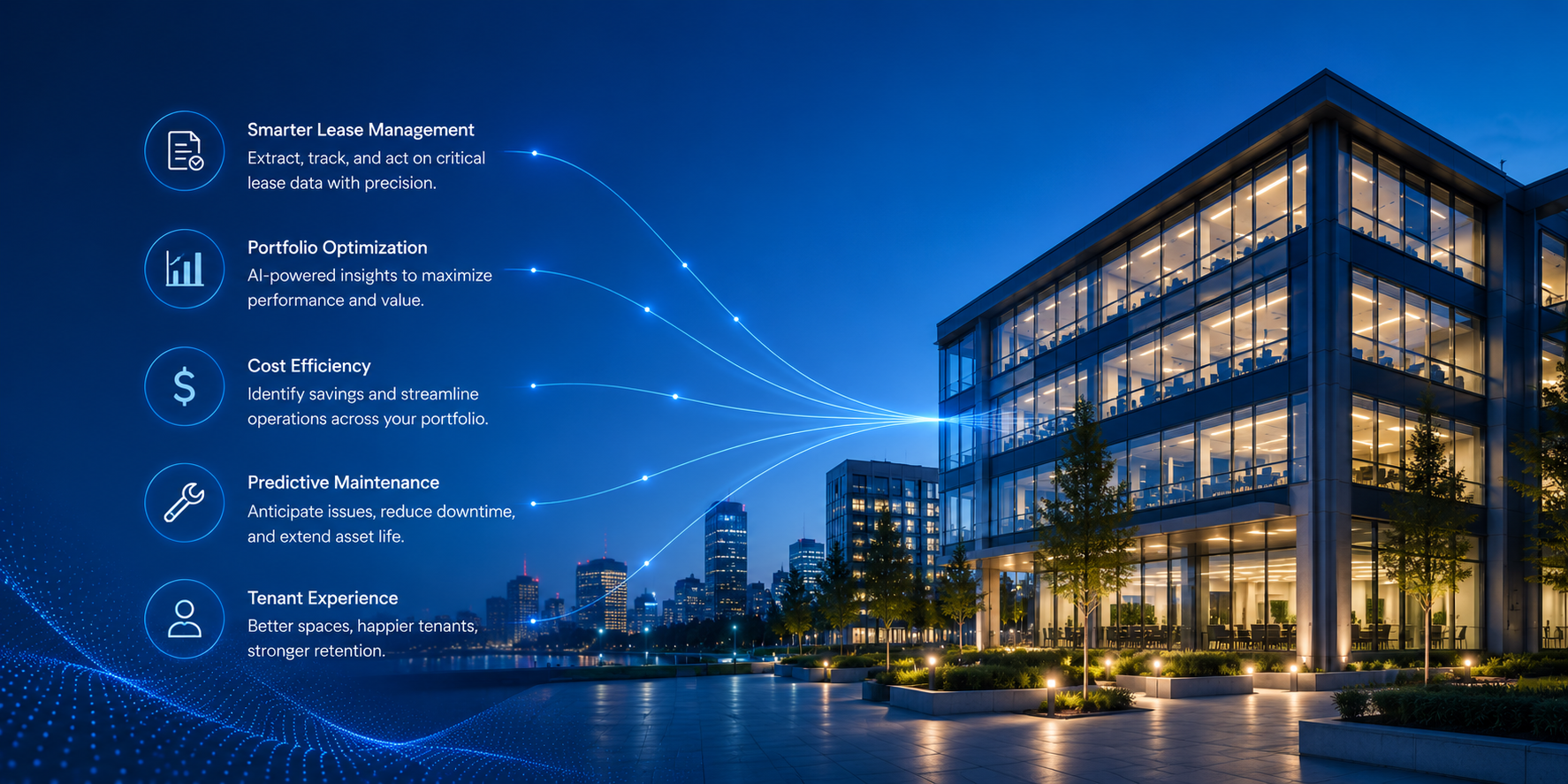
Commercial real estate operations exist at a scale that makes the data problem simultaneously worse and more worth solving than in any other segment. A single institutional CRE portfolio may include thousands of leases, hundreds of assets across multiple markets, millions of square feet of space with complex building systems, and tenant relationships that each carry their own lease terms, escalation schedules, option windows, and service obligations. When we design AI integration for CRE operations platforms, this is the complexity we’re working against — and the reason that the data infrastructure layer almost always needs to come before the AI feature layer.
That scale is also why the institutional CRE firms are investing in AI infrastructure more seriously than any other real estate segment. CBRE has been preparing for the future of AI for years and is now helping clients create real, tangible value with it. CBRE’s Ellis AI platform won Forrester’s 2025 Technology Strategy Impact Award. JLL’s Lease Navigator is operating as a multi-agent AI system across global CRE portfolios. Colliers’ Chris Zlocki reports that what used to take a lease administration team five to seven days now takes minutes with AI document processing. These are institutional deployments at scale — not pilots, not press releases, but production infrastructure running across billions of square feet of commercial space.
The gap between what institutional CRE firms are deploying and what mid-market and smaller CRE operators have access to is the most significant structural divide in the CRE AI landscape right now. The tools exist. The use cases are proven. The data infrastructure required to make them work reliably is where most of the implementation challenge sits for organizations that aren’t running at CBRE or JLL scale.
This post maps the CRE operations workflows where AI is producing documented results, where the implementation requirements are most demanding, and where the open problems remain for builders who want to serve this segment.
Lease Administration: The Workflow Where AI Has Already Won
Lease administration is the CRE operations workflow where AI has produced the most consistent, most documented productivity gains — and where the business case is clearest regardless of portfolio size.
The core problem is volume and variability. A 50-asset commercial portfolio might include 500 active leases. Each lease is a dense legal document with variable clause structures, non-standard terminology, and interconnected provisions that affect each other in ways that require reading the whole document to understand. The critical dates — rent commencement, expiration, option exercise windows, rent escalation triggers, insurance certificate renewal requirements, HVAC maintenance obligations — are scattered throughout the document, often in sections that don’t have obvious labels, and must be tracked continuously across the entire portfolio to avoid missed obligations and lost options.
Portfolio AI’s assessment led to a recommendation that a client change up to 40% of its office portfolio planning decisions to reach optimal performance, using AI to assess the client’s real estate footprint across different financial, real estate, and operational scenarios. That kind of portfolio-level insight — which leases represent the most exposure, which options should be exercised or waived, which renewals should be prioritized — is impossible to develop reliably when the underlying lease data lives in partially extracted spreadsheets and PDF files that nobody has fully read.
JLL’s Lease Navigator is a multi-agent AI solution designed to help companies manage their entire portfolio of real estate leases, acting as the central nervous system for their leased properties. The system uses specialized agents — retrieval, analyst, portfolio advisor, and action coordinator — that work in concert to analyze both unstructured lease documents and structured databases, providing support across lease administration, lease accounting and compliance, data analytics and reporting, and portfolio optimization. The architecture is agentic in the sense we defined in Blog 3: not just extracting data but reasoning about what the extracted data implies and coordinating the actions it recommends.
Dealpath launched AI Studio in 2024 with an AI Extract module that abstracts offering memorandum data in under one minute with 95% stated accuracy. Prophia processes over 215 CRE data terms with 99% accuracy backed by human review, has processed over 100,000 documents representing more than 1 billion square feet of commercial space, and handles documents up to 30 years old including poor-quality scans and handwritten annotations. The human-in-the-loop architecture — AI extraction with human validation for low-confidence outputs — is the production standard that produces those accuracy figures, not fully automated extraction.
The implementation reality for mid-market CRE operators: the tools are available and the pricing is accessible (Prophia’s self-service tier for basic lease data starts at $20–25 per document for exports). The barrier is data readiness — specifically, whether the leases are in a digital format that can be uploaded to an AI extraction tool, or whether they exist as paper originals in filing cabinets or low-quality scans in a shared drive that hasn’t been organized in ten years. Organizations that haven’t digitized their lease portfolio can’t begin AI lease abstraction until they’ve completed that prior step. For many mid-market CRE operators, the lease digitization project is the prerequisite that needs to happen before the AI project can start.
Portfolio Analytics and Asset Management: From Reporting to Insight
The asset management function in institutional CRE has historically been data-rich and insight-poor — not because the data doesn’t exist, but because the data is distributed across systems that don’t talk to each other, in formats that require manual assembly before analysis is possible.
AI-driven dashboards provide real-time monitoring of asset performance, tracking everything from occupancy rates and rental income to operating expenses and market trends. These systems can run predictive analytics to forecast future performance and identify optimal times to buy, sell, or refinance. McKinsey highlights that real estate organizations using machine learning have successfully enhanced their Net Operating Income by up to 10%.
The NOI improvement claim is worth unpacking because “up to 10%” can mean anything. The mechanisms by which AI improves NOI in CRE asset management are specific: more precise rent optimization based on market data and comparable lease activity (avoiding both underpricing that leaves money on the table and overpricing that produces vacancy), earlier identification of tenant credit deterioration signals (allowing proactive lease restructuring or lease-up planning before a tenant defaults), and more accurate capital expenditure forecasting (preventing both emergency spending that is more expensive than planned spending and deferred maintenance that reduces asset value).
Coyote Software, acquired by InvestorFlow in April 2024, is a cloud-based CRE CRM and asset management platform used by over 50 institutional firms. Three of the top five real estate investors in Europe use Coyote to manage their front office, integrating data from Yardi, MRI, Infabode, and WiredScore into a single consolidated dashboard across 80,000 assets and 500 million square feet of real estate. The Cherre platform connects over 3.3 billion addresses into a real estate knowledge graph and powers more than $3.3 trillion in assets under management globally. These are the data infrastructure platforms that enable the portfolio analytics applications — the AI works because the data layer was built to support it.
The portfolio rebalancing application is one of the most sophisticated CRE AI deployments: AI-powered risk engines use natural language processing, machine learning, and external data ingestion to quantify location risk, tenant creditworthiness, and macroeconomic stress on assets. These tools help asset managers rebalance holdings and adjust strategies based on data — not gut instinct. These models pull from structured sources like rent rolls and cash flows, but also unstructured ones like news reports, economic forecasts, and ESG disclosures.
The climate risk overlay is a specific and increasingly important application: one regional REIT avoided over $2M in potential losses by preemptively reviewing leases in flood-prone areas flagged by AI alongside climate data. AI overlaying geospatial flood zone data, climate forecast models, and FEMA flood map updates against a portfolio’s asset locations — and then connecting those risk flags to the specific lease terms (who bears repair costs, what the force majeure provisions say, what the insurance requirements are) — is a capability that exists today and that institutional investors are beginning to treat as a baseline expectation for sophisticated asset management rather than an advanced feature.
Building Operations: Smart Buildings and the IoT Data Layer
Commercial building operations is where AI’s dependency on physical infrastructure is most explicit. The predictive maintenance applications that deliver the documented 20–30% repair cost reductions require sensor data — continuous streams of equipment performance metrics that only exist if the building has the IoT sensor layer installed. For Class A commercial properties built or renovated in the last decade, that infrastructure often exists. For older properties without building management systems, the sensor installation is the capital investment that precedes the AI application.
A 2024 McKinsey report found that 40% of CRE firms are using AI for predictive maintenance or tenant engagement, with another 30% planning implementation by 2025. Early adopters report repair cost reductions of up to 25% and maintenance downtime cut by nearly half.
Prologis uses AI to process drone imagery for roof inspections, cutting potential repair costs by up to 30%. The drone inspection application is notable because it replaces an inherently manual, periodic process (a human inspector walking a roof once a year) with a continuous monitoring capability that produces structured data at a fraction of the cost of manual inspection. The AI layer processes the imagery, identifies anomalies that match known failure patterns, and prioritizes the maintenance interventions by estimated risk and cost. For an industrial REIT managing millions of square feet of warehouse roof, that capability has direct NOI implications.
Energy optimization is the building operations AI application with the fastest payback period: AI continuously monitors and adjusts building systems like HVAC and lighting based on occupancy and weather, saving money and helping meet sustainability goals. Building management systems with AI optimization layers — Siemens Enlighted, BuildingIQ, Andeo — reduce energy costs in commercial buildings by analyzing occupancy patterns, weather forecasts, utility rate structures, and equipment efficiency data to optimize the operating schedule of HVAC, lighting, and plug load systems. A 10–20% reduction in energy costs for a large commercial office building is a meaningful NOI contribution that compounds annually.
The tenant experience application is connecting building operations AI to the commercial leasing value proposition: a mixed-use complex introduced an AI tenant app that increased tenant ratings by 18% and reduced turnover by 8%, boosting net operating income and reputation. Tenant retention in commercial real estate has direct NOI implications — the cost of tenant turnover, including buildout, lease-up period vacancy, and leasing commission, is typically 15–25% of annual rent. An 8% reduction in turnover achieved through improved tenant experience represents a significant NOI contribution that AI-enabled building management is beginning to capture.
ESG Reporting and Climate Compliance: The Emerging Obligation
ESG reporting has moved from institutional investor preference to regulatory obligation for a growing class of CRE operators. The EU’s Corporate Sustainability Reporting Directive (CSRD), California’s climate disclosure laws (SB 253 and SB 261 effective 2026), and SEC climate disclosure rules are creating structured reporting requirements that apply to commercial real estate firms above defined revenue thresholds.
AI aggregates and analyzes data on a property’s environmental, social, and governance performance, simplifying compliance with stringent reporting requirements. The specific data collection challenge for CRE ESG reporting is significant: energy consumption data from utility providers (often in incompatible formats), embodied carbon data from construction and renovation projects, Scope 3 emissions from tenant operations, and social impact metrics from community and workforce programs — all of it needs to be collected, normalized, and reported in the formats that specific regulatory frameworks require.
AI is reducing the manual overhead of this data collection and normalization, but the implementation requires connecting the AI processing layer to the actual data sources — utility APIs, building management systems, project management platforms, and supply chain records. Organizations that haven’t built those connections can’t produce reliable ESG reports regardless of how sophisticated their AI layer is. The AI processes the data. Someone still has to ensure the data exists in a machine-readable form before the AI can process it.
The GRESB reporting framework — the standard benchmark for real estate ESG performance used by institutional investors globally — has developed AI-assisted submission tools that help CRE firms collect, validate, and submit the data the benchmark requires. For firms with GRESB reporting obligations to institutional LP stakeholders, the AI layer that reduces the annual GRESB submission process from weeks of manual data collection to days of reviewed AI output is a direct operational efficiency gain with a hard deadline attached.
Tenant Experience and Leasing Technology in CRE
Commercial tenant experience technology has historically lagged residential multifamily — where EliseAI and similar platforms have automated the leasing workflow — because commercial leasing involves more complex negotiation, longer timelines, and relationship-driven broker transactions that don’t fit the high-volume automation model. But the tenant experience layer during the lease term is catching up.
AI chatbots that answer leasing inquiries, schedule tours, and handle maintenance requests reduce response time from hours to minutes. Smart building apps deliver contextual alerts — like parking updates or amenity availability — to occupants, improving satisfaction. The commercial context adds complexity that multifamily doesn’t have: a commercial tenant’s facilities manager has different needs than a multifamily resident, and the service requests are correspondingly more complex. AI handles the high-volume, structured requests — HVAC temperature complaints, access credential issues, parking allocation questions — and routes the complex, judgment-requiring requests to the appropriate facilities team member with the conversation history intact.
CBRE’s Ellis AI is helping analysts focus more time on value-add activities and less time hunting for documents. Lease administrators can save time by automatically extracting key information from complex lease documents. AI is freeing brokers’ time to focus on what’s important — the consultative and advisory piece. The CBRE framing — AI as capacity liberator rather than headcount reducer — is consistent with every institutional deployment that has produced documented operational results in CRE. The AI handles the document processing, the data retrieval, the routine communication. The human professional handles the relationship, the judgment, and the strategic advice.
Site Selection and Location Intelligence: AI for Occupiers
CRE site selection — the process of evaluating potential locations for corporate real estate needs — is an application where AI is producing measurable results for occupier-side advisors and corporate real estate teams.
AI is also expected to have significant impact on warehouse and third-party logistics. EY’s January 2024 report identifies demand forecasting, risk management, and logistic network design as sectors where AI will bring value to supply chains. Warehouse users will be able to make more informed space-related decisions for both their short- and long-term needs.
Placer.ai’s foot traffic analytics for retail site selection, GrowthFactor’s AI-powered retail expansion analytics, and similar platforms are reducing the time required to evaluate potential locations from weeks of manual market research to hours of AI-synthesized analysis. The documented case: Cavender’s opened 27 locations in 2025 using AI-driven site selection, compared to 9 locations in 2024. That three-times acceleration in store opening velocity is not a marginal efficiency gain — it’s a fundamentally different pace of market expansion enabled by the ability to evaluate and validate sites faster than previously possible.
The corporate real estate application is similar: a technology company evaluating twenty potential office locations across five metropolitan areas previously required weeks of broker-assembled market analyses, lease comps, commute accessibility studies, and labor market assessments. AI-powered location intelligence tools compress that analysis timeline significantly, though the final site recommendation still requires experienced broker judgment about the market dynamics that data alone doesn’t capture.
The Data Infrastructure Requirement: More Demanding Than Residential
The data infrastructure requirement for CRE AI is more demanding than for residential or multifamily — not because the AI is more complex, but because commercial real estate data is more heterogeneous, more institution-specific, and more legally sensitive than residential data.
A commercial lease is not a standardized document. A residential lease in most markets follows a relatively standard format with standard clauses. A 20-year office lease for a Fortune 500 anchor tenant is a bespoke legal document negotiated over months, with provisions that are specific to that tenant, that building, and that relationship. AI extraction of standard clause types in institutional-grade leases is highly accurate. AI extraction of the unusual, negotiated provisions that are most likely to affect asset value is where human review remains essential and where the extraction accuracy claims need to be validated against the specific document population in a given portfolio.
The cross-system data integration challenge is also more complex in CRE than in residential. A multifamily property management operation might run primarily on one platform — AppFolio or Yardi — with a relatively clean data model. An institutional CRE operator runs Yardi or MRI for property management, Argus for asset management, a separate fund accounting platform, a CRM for tenant and broker relationships, a capital markets platform for debt and equity tracking, and a document management system for legal and compliance records. Connecting those systems through a coherent data layer — the prerequisite for any AI application that needs to reason across multiple data sources — is a significant integration project that precedes any AI deployment.
Cherre built a Universal Data Model that standardizes disparate real estate data sources into a coherent knowledge graph, connecting over 3.3 billion addresses. AI-powered data ingestion automates collection, routing, and validation processes. Agent.STUDIO, Cherre’s AI-powered platform launching in 2025, provides next-generation analytics and automation capabilities with over 100 pre-built connectors to major data providers. Cherre’s approach — solving the data layer first, building the AI applications on top of a unified, governed data foundation — is the architecture that produces AI results at institutional scale, and it’s the architecture that mid-market CRE operators need to work toward before expecting reliable AI outputs.
The Open Problems in CRE Operations AI
Several significant CRE operational pain points remain poorly served by current AI tools.
Construction draw review and lien waiver processing — one of the most document-intensive workflows in CRE development — has no purpose-built AI solution. Each monthly draw package for an active construction loan includes hundreds of pages of subcontractor invoices, lien waivers, stored material certifications, and completion certifications that a construction lender or developer reviews manually for compliance with the construction loan budget and the draw request requirements. The documents are structured enough for AI processing. The stakes are high enough to create demand. No platform has built this well.
Debt covenant monitoring across an institutional CRE loan portfolio — tracking DSCR thresholds, occupancy covenants, operating expense caps, and lockbox trigger conditions from loan agreements and producing automated alerts when performance is approaching trigger levels — is currently done through manual review of periodic borrower reports. AI extraction of covenant terms at loan origination and automated monitoring against portfolio performance data would reduce both the manual overhead and the response latency when covenants are approaching breach.
Tenant credit monitoring — continuous assessment of commercial tenants’ financial health using public financial disclosures, credit agency data, news sentiment, and lease payment patterns — is a capability that exists in fragmented form across multiple data providers but hasn’t been integrated into a commercial lease management platform as a native feature. The ability to flag a tenant whose credit profile is deteriorating six months before they start missing rent payments — with specific data supporting the risk assessment — is a genuine asset management tool that CRE operators would pay for.
Cross-lease conflict detection — identifying when a new lease being negotiated would conflict with an existing tenant’s exclusivity clause, co-tenancy requirement, or radius restriction — is a workflow that legal teams currently handle through manual review of existing leases before negotiating new ones. We’ve designed this as an AI feature for retail portfolio platforms: a continuously updated index of all exclusivity provisions, co-tenancy triggers, and radius restrictions across the portfolio, with automated conflict flagging when new lease terms are proposed. The capability exists. The packaged product for mid-market operators doesn’t yet.
The Institutional vs Mid-Market Divide
The most important structural observation about AI in CRE operations is the divide between what institutional operators have deployed and what mid-market operators have access to. CBRE, JLL, Prologis, and their institutional peers have invested in AI infrastructure at a scale that produces compounding data advantages — more data, better-trained models, more integration depth — that mid-market operators can’t replicate with the same resources.
The mid-market opportunity isn’t to match institutional AI investment. It’s to use purpose-built tools that have emerged specifically for mid-market CRE operators — Prophia’s self-service lease abstraction, Dealpath’s pipeline management with AI Studio, HelloData’s multifamily comp intelligence, Reonomy’s property research — to close the operational gap that institutional firms have spent years widening.
The critical success factor is the same one that holds across the industry: data readiness before tool selection. Lease administration is almost always the right starting point — the pain is acute, the process is well-defined, the benefits are immediately measurable, and the data requirement is a prerequisite the digitization project addresses cleanly before AI extraction begins.
How GTC Approaches AI Integration for CRE Operations Platforms
When we build AI capabilities into a CRE operations platform, the integration architecture is the part that determines whether the AI delivers operational value or just operational complexity. Most CRE operators run across four or five disconnected systems — Yardi or MRI for property management, Argus for asset management, a separate fund accounting platform, a CRM for tenant and broker relationships, document management for legal and compliance. Any AI application that needs to reason across those systems requires a coherent data layer underneath it.
The first thing we build is usually not the AI. It’s the entity resolution layer that gives every property, every lease, and every tenant a canonical identifier that maps consistently across all the source systems. Without that, cross-system AI queries produce outputs that don’t reconcile, and the investment team stops trusting them quickly.
With the data layer in place, the lease administration AI integration is typically the first production feature: extracting critical dates and key terms from executed leases, feeding those into a monitoring pipeline that alerts on upcoming triggers, and connecting the extracted data to the PMS so the management team has a single authoritative source for lease terms. The cross-document comparison layer — flagging discrepancies between the rent roll and the underlying leases — often surfaces the most immediately valuable findings in the first portfolio pass.
From there, the portfolio analytics layer builds on the same data foundation: asset-level dashboards drawing from the normalized data across all source systems, scenario modeling that runs against live portfolio data rather than quarterly snapshots, and the climate risk overlay that institutional investors are increasingly treating as a baseline expectation rather than an advanced feature.
In the next post in this series we go deep on AI for multifamily leasing. If you’re building a commercial real estate platform or evaluating AI tools for a CRE portfolio, let’s talk through the specific operational workflows in your CRE portfolio where AI would deliver the most value given your current data infrastructure.