
AI Doesn't Fix Broken Workflows. It Just Makes the Mess Faster.
The pattern playing out everywhere right now
A team has a process that does not work well. Handoffs get dropped. Information lives in five places. Approvals stall. Nobody is quite sure who owns what. The process limps along because people compensate for it through effort and memory.
Then AI arrives. The team adds a writing assistant, a meeting summarizer, a code generator, a chatbot, a research tool. Each one is genuinely capable. Each one does its narrow job well.
Six months later, the process still does not work well. The handoffs still get dropped, just with better-formatted documents attached. The information still lives in five places, except now three of those places are AI tools that each hold a slightly different version of the truth. The approvals still stall, but the requests pile up faster because everyone is generating more of everything.
The team did not fix the workflow. They accelerated it. And accelerating a broken process does not produce a working process. It produces the same broken process running at higher speed, generating more output, more confusion, and more cleanup.
This is the most common AI mistake we see organizations make right now. Not picking the wrong tool. Picking tools to solve a problem that was never a tooling problem in the first place.
Why more tools makes it worse, not better
There is an intuition that more capability should mean better outcomes. Add a powerful tool, get a better result. For a well-designed process, that intuition holds. For a broken one, it inverts.
A broken workflow has a specific characteristic: the problem is not the speed of any individual step. The problem is the structure. Work flows in the wrong order, or through the wrong hands, or without clear ownership, or with information scattered where the next person cannot find it. The bottleneck is not that people work too slowly. It is that the design of the process creates friction, rework, and dropped balls.
AI tools speed up individual steps. That is what they are good at. A writing assistant makes the writing step faster. A summarizer makes the reading step faster. A code generator makes the coding step faster.
But when you speed up individual steps inside a badly structured process, you do not fix the structure. You feed it faster. More drafts arrive at a review step that was already a bottleneck. More documents flow into a storage system that was already disorganized. More requests hit an approval process that was already stalled. Each tool optimizes its own step while the structural problem, which lives in the connections between steps, gets worse because there is more volume moving through the broken connections.
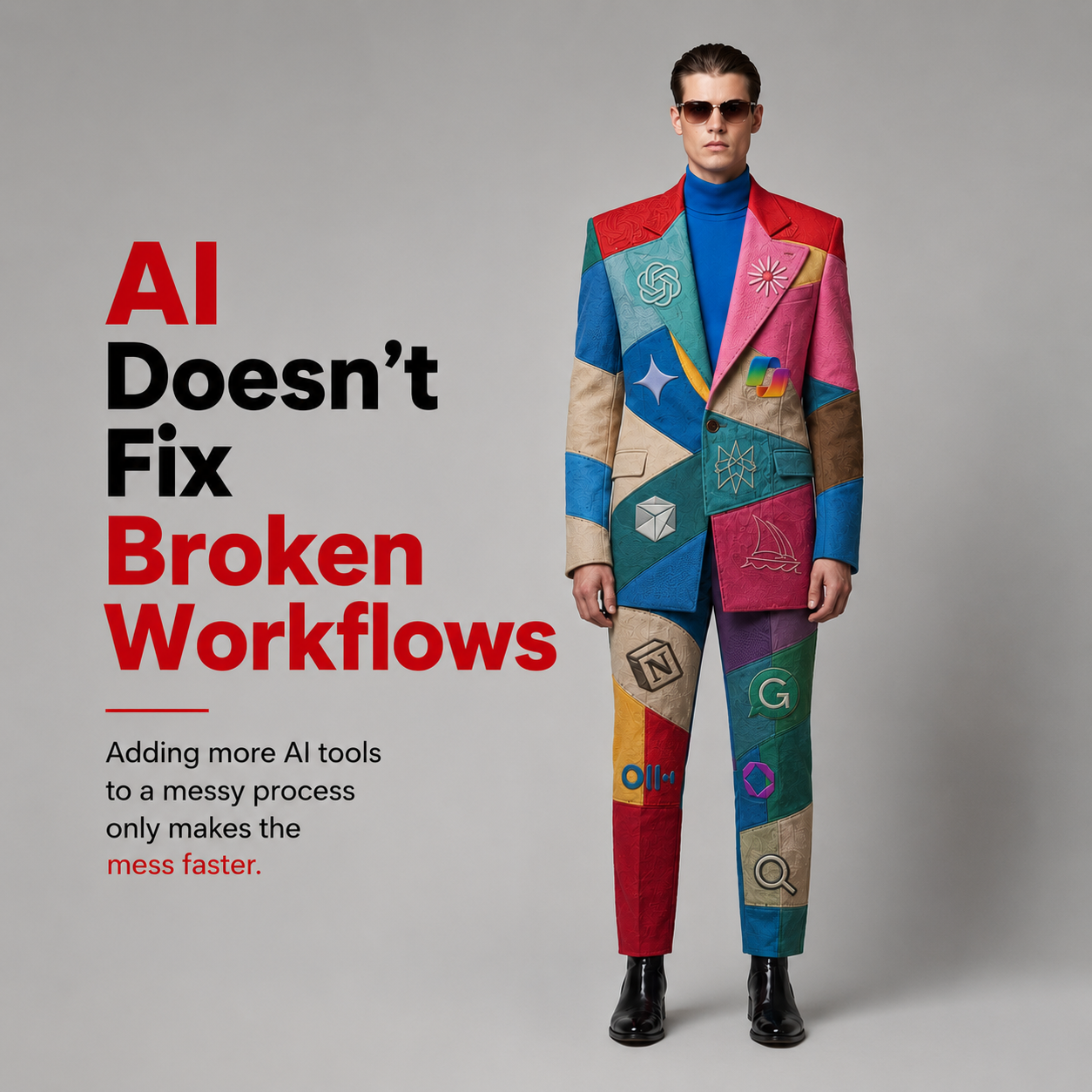
The patchwork is the right image. A different tool stitched onto each part of the process, every patch doing its own thing, no coherence across the whole. The result is not a system. It is a collection of fast parts connected by the same broken seams that were there before.
Tool sprawl is its own problem
There is a second cost that compounds the first.
Every AI tool added to a process is another place where information lives, another login, another interface, another set of outputs in another format, another thing to learn, another subscription, another integration that may or may not talk to the others. The tools rarely share a source of truth. Each one holds its own slice of context, and none of them holds the whole picture.
So the team that added seven AI tools to fix a messy process now has the original messy process plus seven new tools to manage, reconcile, and stitch together. The summarizer does not know what the writing assistant produced. The chatbot answers from one knowledge source while the actual decisions live in another. People spend time moving information between tools that should have been connected, which is a new category of work that did not exist before.
This is how organizations end up feeling busier and more equipped while getting less done. The tools are real. The capability is real. But the capability is distributed across a fragmented landscape with no coherent design holding it together, and fragmentation has a cost that grows with every tool added.
The thing that actually has to happen first
The fix is not a better tool. It is fixing the workflow before the tools touch it.
That means doing the unglamorous work that AI cannot do for you. Mapping how the process actually flows, not how it is supposed to flow. Finding where work gets dropped, where it stalls, where information goes missing, where ownership is unclear. Redesigning the process so the structure is sound: clear ownership, work flowing in a sensible order, a single source of truth for the information that matters, defined handoffs that do not depend on someone remembering.
This is design work, and it is human work. It requires understanding the actual goals of the process, the people doing it, the real constraints, and the points where the current design fails. No AI tool does this for you, because the problem is not a lack of capability at any step. It is a flaw in how the steps connect, and seeing that requires understanding the whole rather than optimizing the parts.
Only after the workflow is structurally sound does adding AI make sense. At that point, AI is genuinely transformative, because now you are accelerating a process that actually works. Speed applied to a good design compounds. Speed applied to a bad design multiplies the damage. Same tools, opposite outcomes, and the only difference is whether the structure underneath was fixed first.
What good sequencing looks like
The right order is simple to state and frequently ignored.
First, understand the current process honestly. Map it as it really runs, including the workarounds and the informal steps that people have built to compensate for its flaws. The workarounds are signals. They show you exactly where the design is failing.
Second, redesign the process for how it should work. Clear ownership at each stage. A logical flow. A single source of truth. Handoffs that are explicit rather than assumed. This is where the actual improvement happens, and it often involves removing steps rather than speeding them up. Many broken processes are broken because they have steps that should not exist at all, and no tool fixes a step that should be deleted. When we reworked the end-to-end workflow for a pet grooming business, a meaningful part of the gain came from automating away coordination steps entirely, not making them faster.
Third, identify where AI genuinely helps within the redesigned process. Not everywhere. The specific steps where AI capability matches a real need, where speeding up that step improves the whole rather than just flooding the next step with more volume.
Fourth, integrate AI into those specific points, with attention to how the tools connect to each other and to the single source of truth. The goal is a coherent system, not a collection of fast parts.
The organizations that get value from AI are the ones that do the first two steps before reaching for tools. The ones that skip to step four, which is most of them right now, get the patchwork suit: capable in every individual piece, incoherent as a whole, faster at producing the same mess.
Where AI fits once the workflow is sound
None of this is an argument against AI. It is an argument about sequence.
A well-designed workflow with AI integrated thoughtfully is a genuinely powerful thing. The pattern that works is always the same: the workflow is mapped and fixed first, then AI is placed at the specific points where a better decision or a removed step changes the outcome. A few real examples make this concrete.
For a pet grooming business, the workflow was the whole engagement, not a single task. We reworked it end to end and placed AI where it actually changed results. Groomer selection stopped being arbitrary and became a match driven by historical data, the specific pet, and the owner’s profile, so the right groomer is paired with the right animal. The steps that followed, the routine coordination work between booking and service, were automated so staff stopped spending time on them. The AI was not bolted onto a broken process. The process was redesigned, and AI was placed at the one decision that mattered most and the steps that were pure overhead.
For a real estate platform, the high-value decision was matching a home seller with the right agent. Instead of assigning agents by availability or rotation, the workflow was rebuilt around fit: matching the seller to the agent most likely to close successfully given the seller’s intent and situation. The AI sits at the single point in the process where the match determines the outcome, which is exactly where intelligence earns its place.
For an education platform, student assessment had run on a fixed, predefined algorithm: a set sequence of questions scored the same way for everyone. We redesigned the assessment itself around the data they already had. Every question carried a known difficulty, and the system used how a student responded, including how long they took relative to the expected time for that difficulty, to assess their level with the minimum number of questions. The result is a faster, more accurate assessment that adapts to the student rather than marching everyone through the same fixed list. The improvement came from redesigning the assessment logic, with AI making the per-student judgment the old fixed algorithm could not.
The same principle extends to property analysis, where AI generates distressed-property scores from the underlying data to support faster, better-informed decisions, and to content operations, where a structured content base lets AI surface internal linking opportunities and missing-content gaps across a large library that no person could hold in their head.
In every one of these, the tool did not fix the workflow. The workflow was fixed, and then AI was placed where it changed the result. That is the version of AI adoption that delivers on the promise. It looks calm rather than frantic. Fewer tools, better connected, applied to a process that works.
The difference between this and the patchwork is not the tools. The same AI capability produces both outcomes. The difference is entirely whether the workflow underneath was designed before the tools were added.
The takeaway
AI is a multiplier. That is precisely why it is dangerous to add to a broken process. A multiplier applied to a positive number grows it. A multiplier applied to a mess grows the mess.
If your process works, AI will make it work better and faster. If your process is broken, AI will make it break faster, at higher volume, across more tools, with more cleanup at the end.
So the question to ask before adding any AI tool is not which tool is best. It is whether the workflow it is being added to is actually sound. If the honest answer is no, the tool is not the next step. Fixing the workflow is. Get that right, and AI becomes the multiplier you wanted. Skip it, and you have bought a faster mess in a very expensive suit.
Thinking about adding AI to a process that isn't working?
We map and redesign the workflow first — removing steps that shouldn't exist — then place AI only where a better decision changes the outcome.
The same AI capability produces a working system or a faster mess. The difference is the design underneath.
Talk through your workflowA technical conversation, not a sales pitch.