AI for Lease Abstraction: Tools, Accuracy, Workflow Integration, and What to Watch For
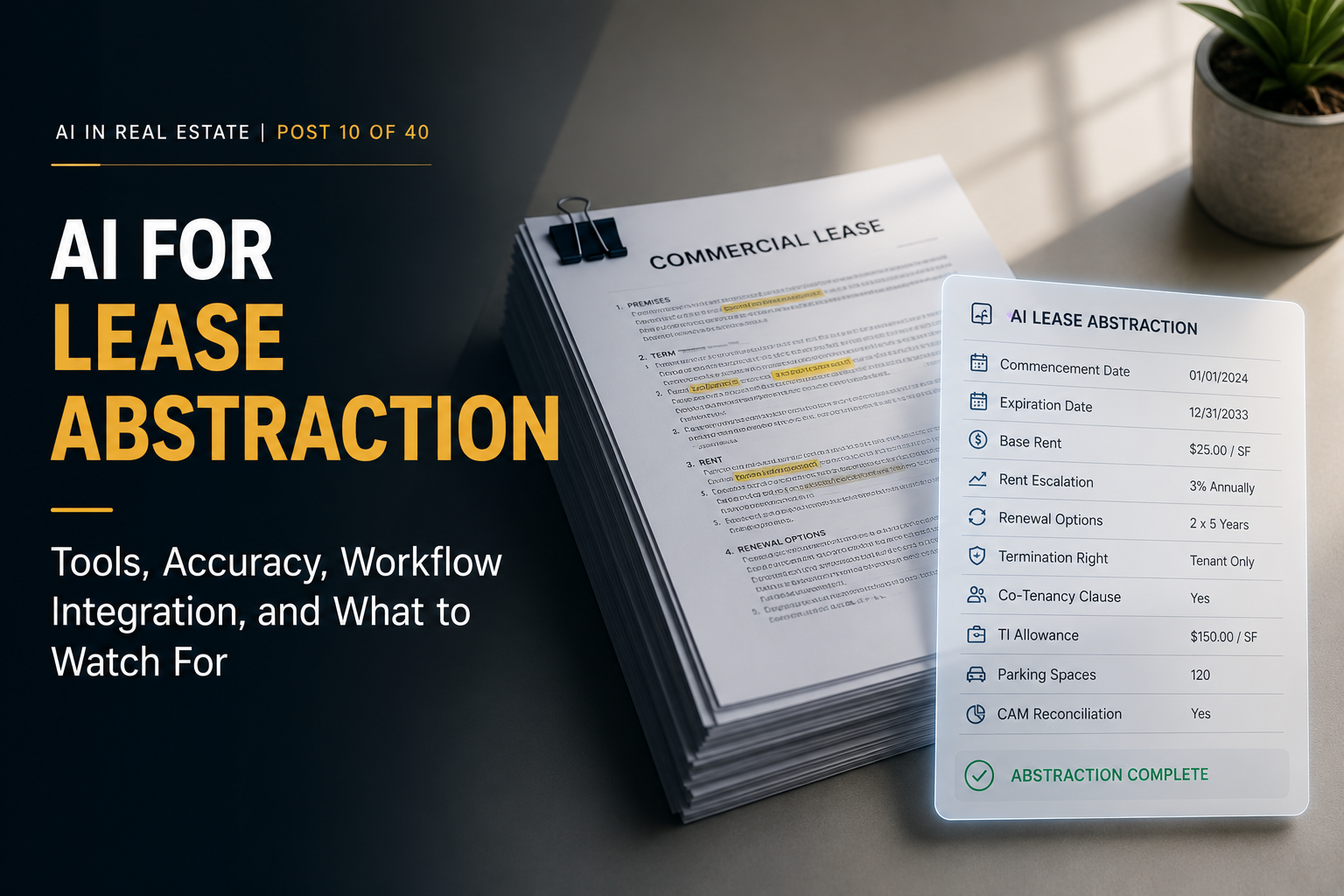
A single commercial lease for an anchor retail tenant can run 120 pages. It contains the rent commencement date somewhere in section 3. The annual escalation schedule is in exhibit B. The renewal option is in section 17 but modified by an amendment executed two years after the original lease. The co-tenancy clause — which gives the tenant the right to reduce rent or terminate if a named anchor vacates — is in section 22. The HVAC maintenance obligation that shifts a recurring cost from the landlord to the tenant is buried in exhibit D.
A lease administrator working manually through that document extracts the key terms, enters them into a spreadsheet, and hopes they caught everything. The documented error rate for manual commercial lease abstraction is approximately 10%. At a portfolio of 200 leases, that’s twenty leases with material errors. Each error is a risk event waiting to materialize. When clients bring us in to build a lease management system, the audit of existing manual abstracts almost always confirms the same pattern — the errors are there, and they’ve been accumulating silently.
JLL discovered $1 million in missed lease clauses after implementing AI lease review across a commercial portfolio. That figure — one real organization, one portfolio review — captures the business case for AI lease abstraction more directly than any efficiency metric. The ROI of AI abstraction often exceeds platform costs within the first deal not because the tool saves time (though it does), but because it catches the things that manual review misses at scale.
This post is the comprehensive guide to AI lease abstraction: what the technology actually does, which tools are production-ready and for which use cases, what accuracy claims mean in practice, how to integrate AI extraction into existing lease management workflows, and what the human review layer needs to look like to make the numbers work.
What AI Lease Abstraction Actually Does
AI lease abstraction uses a combination of natural language processing, named entity recognition, and document structure analysis to extract defined data points from commercial lease documents and organize them into structured outputs — abstracts, databases, spreadsheet exports, or direct platform population.
The extraction targets are the data points that drive lease administration decisions: commencement and expiration dates, base rent and escalation schedules, renewal and termination options with their exercise windows and conditions, tenant improvement allowances and their reimbursement triggers, CAM reconciliation provisions and expense caps, parking allocations, permitted use definitions, assignment and subletting restrictions, insurance requirements, HVAC and maintenance obligations, and any co-tenancy or kick-out provisions that affect the lease’s enforceability under changed circumstances.
The technology works through two distinct mechanisms depending on the document structure. For standard commercial lease clauses — the provisions that appear in most leases in recognizable form — machine learning models trained on thousands of commercial leases identify the relevant clause type, locate it in the document regardless of where it appears or how it’s labeled, and extract the key terms with high confidence. For unusual or negotiated provisions — the provisions that are specific to this tenant or this deal — the model may identify the clause location but produce a lower-confidence extraction that requires human review before it’s relied upon.
The document processing pipeline handles more than the base lease. Amendments, addenda, side letters, and exhibits all modify the base terms, sometimes substantially. A lease abstraction tool that processes only the base lease and ignores the amendment history produces an abstract that reflects what the parties agreed to in year one rather than what the lease actually says today. Enterprise platforms like Kira and Prophia are designed to process complete lease packages — base lease plus all modifications in chronological order — as a unified document set, with the AI understanding that later documents modify earlier ones and the abstract reflecting the cumulative state of the lease as executed and amended.
The Accuracy Question: What the Numbers Actually Mean
Every AI lease abstraction vendor publishes accuracy figures. Prophia Essentials claims 99% accuracy with expert human oversight. Kira Systems reports 93–97% accuracy on standard lease terms. Dealpath AI Extract states 95% accuracy on offering memorandum data and lease terms. These figures are real but require interpretation to be useful.
The relevant question is not “what is the tool’s average accuracy” but “what is the tool’s accuracy on the specific clause types that matter most for my use case, on the specific document quality and format variability in my portfolio.”
Accuracy varies significantly by clause type. Standard financial provisions — base rent amounts, commencement dates, expiration dates, renewal option terms — are extracted with higher accuracy than complex negotiated provisions like co-tenancy triggers, percentage rent calculations, and non-standard maintenance allocations. A tool that claims 97% overall accuracy may be at 99.5% on rent commencement dates and 85% on unusual termination for convenience provisions. The clause types that drive the largest financial consequences — the co-tenancy clause that allows a major tenant to terminate if occupancy falls below a threshold, the HVAC maintenance provision that shifts a six-figure annual cost — are often the provisions where AI accuracy is lowest, precisely because they’re the provisions that are most heavily negotiated and most variable in how they’re written.
Accuracy also varies significantly by document quality. Prophia has processed nearly 150,000 lease documents representing more than 370 million square feet of CRE, including documents up to 30 years old and poor-quality scans. That breadth of training data gives Prophia models better performance on degraded documents than tools trained exclusively on clean digital PDFs. For portfolios with legacy paper leases that have been scanned at varying quality levels, this difference matters operationally.
The human-in-the-loop architecture is what converts the raw AI extraction accuracy into the production accuracy figures vendors publish. Prophia Essentials combines AI with expert human oversight and delivers 99% accuracy. The AI processes the document and produces the extraction with confidence scores for each field. An experienced lease administrator reviews the low-confidence extractions — the fields where the model was uncertain — and corrects them before the abstract is finalized. The 99% figure reflects the combined output of AI extraction and human validation, not pure AI output. Understanding this is important for implementation planning: the human review component is not an optional add-on to AI lease abstraction. It’s the component that produces the accuracy numbers the business case depends on.
For teams evaluating accuracy claims in the context of their specific portfolio, the right evaluation methodology is a pilot run on a sample of twenty to thirty leases from their actual portfolio — including the most complex, the oldest, and the most unusual documents in the collection — and a comparison of the AI output against a manually prepared abstract for each document. That comparison produces an accuracy figure that reflects the tool’s actual performance on the firm’s specific document population, not the vendor’s benchmark dataset.
The Tool Landscape: Matching Platform to Use Case
The lease abstraction tool landscape is fragmented across three distinct tiers, each serving different organizational needs and carrying different cost and implementation requirements.
Enterprise platforms with institutional depth are designed for institutional CRE portfolios with complex lease structures, integration requirements with existing property management systems, and ongoing portfolio management needs beyond initial abstraction.
Kira Systems is one of the most established enterprise-grade AI contract review platforms. Originally developed for law firms and investment banks, Kira is now widely used by institutional CRE investors for due diligence lease review. Kira’s machine learning model identifies over 1,000 different contract provisions with a reported accuracy of 93–97% on standard lease terms. The platform supports bulk upload of lease packages and delivers structured extraction reports with confidence scores for each extracted field. Pricing starts at approximately $2,500 per month for small teams and scales to enterprise pricing for institutional portfolios. Kira is the strongest choice for investors with complex portfolios involving multiple lease types, international assets, or regulatory compliance requirements.
Prophia is the market leader specifically for CRE lease abstraction and portfolio management. Its customer roster includes industry giants like Nuveen, Spear Street Capital, RXR, Harrison Street, Related, and Rudin. Prophia Abstract delivers instant abstracts in 5–10 minutes at $20 per document for standalone abstraction needs. Prophia Essentials — the full portfolio management tier — integrates the abstracts into dynamic stacking plans, portfolio dashboards, and critical date monitoring with Yardi and MRI integration. Prophia does not support residential or multifamily leases — its models are trained on commercial documents and its feature set is designed for commercial portfolio management. For CRE owners and operators focused on retail, office, and industrial portfolios, Prophia’s combination of extraction accuracy, source-document traceability, and PMS integration makes it the strongest choice in this tier.
Leverton is a Berlin-based enterprise platform with institutional partnerships including JLL and MRI Software. Its strength is multilingual extraction — important for firms with international portfolios — and its deep integration with MRI Software’s lease administration module, which makes it the default choice for MRI-centric organizations.
Acquisition-workflow tools are purpose-built for the due diligence use case — extracting key terms quickly during the acquisition process — rather than for ongoing portfolio management.
Dealpath’s AI Extract module, part of the Dealpath AI Studio launched in 2024, is purpose-built for acquisition due diligence workflows. It abstracts offering memorandum data and lease terms in under one minute, with a stated accuracy rate of 95%. Unlike general document AI tools, Dealpath AI Extract feeds directly into the Dealpath deal pipeline, automatically populating underwriting fields with extracted lease data. This integration eliminates the manual data transfer step that creates errors in many workflows. Dealpath AI Extract is the strongest choice for institutional acquisition teams already operating on the Dealpath platform.
Primer is a specialized platform for commercial real estate document intelligence with a focus on template mapping — learning a firm’s specific abstraction format and extracting lease data into that exact structure. For firms with established abstraction templates that downstream systems expect, Primer’s ability to train on those templates and produce outputs in the firm’s specific format reduces the post-extraction reformatting overhead.
General-purpose document AI tools — including Claude, GPT-based implementations, and platforms like DocSumo — can perform lease abstraction at lower cost for simpler portfolios or one-off needs, but require more configuration and carry lower accuracy on complex commercial provisions without the domain-specific training that purpose-built platforms provide. General-purpose AI tools require more careful manual management of multi-document lease packages and produce more variable results on unusual clause structures. For small portfolios evaluating whether AI lease abstraction is worth investing in before committing to a purpose-built platform, a general-purpose tool with a well-structured extraction prompt is a credible starting point — with the understanding that migration to a purpose-built platform will be necessary as portfolio complexity grows.
The Implementation Sequence That Produces Reliable Results
The implementation failures in AI lease abstraction are consistent and predictable. They don’t come from the AI performing poorly on standard documents. They come from teams treating AI output as final when it isn’t, from deploying without establishing the human review workflow, or from failing to account for the document preparation work that must precede AI processing.
Document preparation is the prerequisite that most teams underestimate. AI extraction requires that documents be in a machine-readable digital format. Leases that exist as paper originals in filing cabinets need to be scanned before AI can process them. Scans need to be at sufficient resolution for OCR to work reliably — 300 DPI minimum, 600 DPI for documents with small font sizes or degraded print quality. Lease packages need to be assembled in order — base lease first, then amendments chronologically — because the AI needs to understand the document sequence to apply modifications correctly. For a portfolio with fifty legacy leases in paper format or low-quality scans, the document preparation project is a prerequisite that takes weeks, not days. We scope this as a separate workstream before the AI implementation begins, because compressing it is the planning decision that most consistently delays project timelines when it surfaces as a surprise in week three.
Template configuration determines output usability. Every AI lease abstraction platform allows configuration of the extraction template — which fields are extracted, in what format, and mapped to which output fields. The template configuration step is where the firm’s specific data requirements are translated into the AI’s extraction targets. A firm that needs the CAM reconciliation provisions in a specific format for its Yardi import requires different template configuration than a firm that needs the same provisions for a standalone lease administration database. Investing in template configuration before processing a large portfolio — rather than processing first and reformatting after — is the sequencing decision that prevents the most common implementation frustration.
The human review workflow needs to be operational before AI processing begins. This is the implementation step that most teams defer and most teams regret deferring. The workflow for reviewing low-confidence AI extractions — who reviews them, in what system, on what timeline, with what escalation path for clauses requiring legal interpretation — needs to be designed and operational before the AI starts producing outputs that need review. A team that processes 100 leases and produces 100 abstracts without a review workflow has produced 100 abstracts with uncorrected AI errors. Establishing the review workflow first, even if it initially operates on a small pilot batch, ensures that the production process is clean before it runs at scale.
Accuracy validation against existing manual abstractions is the quality gate. For portfolios where manual abstracts already exist, running the AI extraction against a sample of those leases and comparing the output to the existing abstract produces a direct accuracy measurement for the firm’s specific document population. Any discrepancies between the AI output and the existing abstract require resolution — either the AI was wrong (training the review workflow to catch similar errors) or the existing abstract was wrong (which is not uncommon at the 10% manual error rate). This validation step also builds the team’s confidence in the tool before it’s deployed on leases without existing abstracts.
For enterprise platforms, expect 4 to 8 weeks for implementation including system integration, template configuration, and team training. For institutional investors replacing a manual process across an existing portfolio, plan 2 to 3 months for a full portfolio migration, including accuracy validation against existing manual abstractions. These timelines reflect the work involved in doing the implementation correctly — not as obstacles to be compressed, but as the stages that produce reliable outputs rather than fast outputs that need to be corrected later.
Integration: Connecting AI Abstraction to the Lease Management Workflow
The business value of AI lease abstraction is not primarily in the abstract itself. It’s in what the abstract enables downstream — the critical date alerts that prevent missed renewal windows, the portfolio analytics that identify concentration risk, the tenant data that informs leasing strategy, and the acquisition due diligence that catches the clause that would have cost $1 million if it had been missed.
Those downstream benefits require that the extracted data flow into the systems where those decisions are made — not sit in a PDF abstract that someone has to open and read manually when a question arises.
PMS integration is the most important connection for ongoing portfolio management. Prophia’s Yardi and MRI integrations allow extracted lease data to populate the property management system directly, replacing the manual data entry that introduces errors and delays. When a lease is renewed or amended, the updated abstract flows to the PMS automatically rather than requiring a coordinator to enter the changes in two systems. The operational impact is both time savings and data consistency — the PMS always reflects the current state of the lease rather than the state it was in when someone last remembered to update it.
Critical date monitoring converts static lease data into active portfolio management. A lease database that flags the renewal option exercise window ninety days before it opens, the annual rent escalation trigger thirty days before the calculation date, and the insurance certificate renewal requirement sixty days before the current certificate expires is a lease database that operates as a risk management tool rather than a reference document. Most enterprise AI abstraction platforms include critical date monitoring natively. For platforms that don’t, the extracted data can feed a separate date monitoring tool or a rules-based automation layer that handles the calendar triggers.
Deal pipeline integration for acquisition teams is the use case where integration with the deal workflow produces the most immediate ROI. When AI-extracted lease data from a due diligence review flows directly into the acquisition team’s underwriting model — populating rent roll inputs, flagging co-tenancy clauses that affect the underwriting assumptions, surfacing termination rights that affect the lease’s value contribution — the underwriting process starts from a more complete data foundation and the errors that come from manual data transfer are eliminated.
What AI Lease Abstraction Doesn’t Do
Clarity about what AI lease abstraction cannot reliably handle is as important as understanding what it does well — because deploying the tool on problems it’s not suited for produces the accuracy failures that erode trust.
Legal interpretation is not extraction. An AI tool can identify that a lease contains a co-tenancy clause and extract its stated conditions. It cannot interpret whether those conditions have been met in a specific factual scenario, whether the clause’s interaction with another provision modifies its application, or whether the clause has been effectively modified by course of dealing between the parties. Clauses that require legal judgment — not just reading and extraction — still require attorney review. AI accelerates the identification of which clauses require that review. It doesn’t replace the review itself.
Handwritten annotations and physical modifications are problematic for AI extraction even with sophisticated OCR. Lease documents with handwritten notes in the margins, initialed modifications to typed text, or physical alterations to original terms need human review regardless of the AI platform’s capabilities. These document conditions should be flagged during the document preparation stage and routed to human review rather than processed through the AI extraction workflow.
Cross-document logical interpretation — understanding that a side letter from 2019 effectively overrides the termination provision in the base lease even though it doesn’t explicitly say so — requires the kind of legal document interpretation that AI extracts poorly. Purpose-built enterprise platforms handle explicit amendments and addenda well. Implicit modifications through conduct, course of dealing, or indirectly referenced documents are where AI extraction produces errors that the human review workflow needs to catch.
Highly negotiated provisions in complex institutional leases — the kind written by sophisticated tenant counsel and extensively negotiated before execution — often use language that is unusual enough to reduce AI confidence below the threshold for reliable extraction. For institutional investors acquiring trophy assets with complex anchor tenant leases, the AI abstraction tool reduces the time required for review but doesn’t eliminate the experienced lease administrator’s role in validating the complex provisions.
Building the Business Case: The ROI Framework
The business case for AI lease abstraction is strongest when it’s built on specific, measurable outcomes rather than generic efficiency claims.
The direct time savings argument is straightforward: if manual abstraction takes four to eight hours per lease and AI abstraction with human review takes one hour, a portfolio of 200 leases represents 600 to 1,400 hours of recovered capacity. At a lease administrator’s fully loaded cost, that figure converts directly to the dollar value of the time saved — typically $30,000 to $75,000 for a mid-sized portfolio migration, before accounting for the ongoing time savings from automated critical date monitoring and PMS integration.
The risk reduction argument is often larger and harder to quantify until it materializes. The JLL $1 million missed clause discovery is the most concrete published example. For a portfolio manager evaluating AI lease abstraction, the honest question is: what is the probability that our current manual process has missed a material clause in one or more of our leases, and what is the expected cost of that miss when it surfaces? At a 10% manual error rate across a 100-lease portfolio, there are statistically ten leases with material errors. The expected value of the risk exposure depends on the portfolio’s specific lease types and the consequences of the specific error categories most likely to be missed — co-tenancy triggers, renewal window expirations, and maintenance obligation allocations being the highest-consequence categories.
The acquisition acceleration argument applies specifically to acquisition teams: if AI-powered due diligence reduces the time from offer acceptance to closing from four weeks to two weeks, and faster closings win competitive processes where speed matters, the AI investment produces a direct competitive advantage in deal execution. That argument is harder to quantify but easier to demonstrate through the experience of the first acquisition where the AI-accelerated timeline was the deciding factor in closing a deal a competitor was also pursuing.
The Bottom Line: Where to Start
For a CRE operator or investment firm evaluating AI lease abstraction for the first time, the starting point that produces the most reliable results is a focused pilot on a specific, bounded use case rather than a portfolio-wide deployment.
The ideal pilot is a current or recent acquisition where the due diligence lease review either occurred manually or hasn’t yet occurred — running AI extraction on the lease package and comparing the output to the manual review or using it as the primary review with human validation. That pilot produces three outputs: a direct accuracy measurement on the firm’s specific document types, a time comparison against the manual baseline, and the operational experience needed to design the human review workflow before it’s deployed at scale.
From the pilot, the decision about which platform tier is appropriate — Prophia Abstract for ongoing portfolio work, Dealpath AI Extract for acquisition pipeline integration, Kira for complex multi-asset institutional portfolios — follows naturally from the use case the pilot revealed as the highest priority.
The one thing the pilot will almost certainly confirm is the one thing JLL’s experience already demonstrated: there are clauses in the portfolio that the manual process missed. Finding them before they become liability events is the business case that no vendor needs to construct artificially — the portfolio will construct it on its own.
How GTC Integrates Lease Abstraction AI Into Real Estate Platforms
When we integrate AI lease abstraction into a real estate platform, the three integration points that determine whether the feature delivers operational value are the document ingestion pipeline, the PMS data connection, and the monitoring layer.
The document ingestion pipeline handles the preprocessing work that most off-the-shelf tools skip: OCR preprocessing for low-quality scans, assembly of base lease plus amendments in chronological order, and quality flagging for documents that will need human review before AI extraction can be reliable. This preprocessing step is what makes the extraction accuracy consistent across a real portfolio — which includes documents from the last thirty years in varying states of legibility — rather than just on the clean digital PDFs in the vendor’s demo.
The PMS connection is where extracted data becomes operational rather than archival. When a lease is executed or amended, the updated terms flow into the property management system directly rather than requiring a coordinator to update two systems. The critical date monitoring pipeline connects to the same PMS fields, so the alerts are firing against data that’s actually current rather than against a spreadsheet someone updated last quarter.
The human review workflow is the component we build most carefully, because it’s the one that determines whether the 99% accuracy figure is achievable in production or just in the vendor’s benchmark. We design the review interface for the specific team that will use it — surfacing the low-confidence extractions with the source document context visible alongside them, routing complex clause types to the appropriate reviewer automatically, and logging every correction as training feedback for the model’s ongoing improvement.
If you’re building a CRE platform and working through how AI lease abstraction should fit into your lease management or acquisition workflow, let’s talk through your specific lease portfolio and the integration layer that would deliver the most value from AI extraction.