
AI for Multifamily Leasing: The Clearest Proof Point in Real Estate AI
Every segment covered in this series so far has required careful qualification. AI for investment: promising in document processing, oversold on prediction. AI for residential brokerages: wide adoption, shallow impact. AI for commercial operations: institutional firms making progress, mid-market lagging significantly. The honest assessment in each case — and the one we give clients before scoping an AI engagement in those segments — is that AI is doing real work in specific, bounded applications and falling short of the broader promises being made in its name.
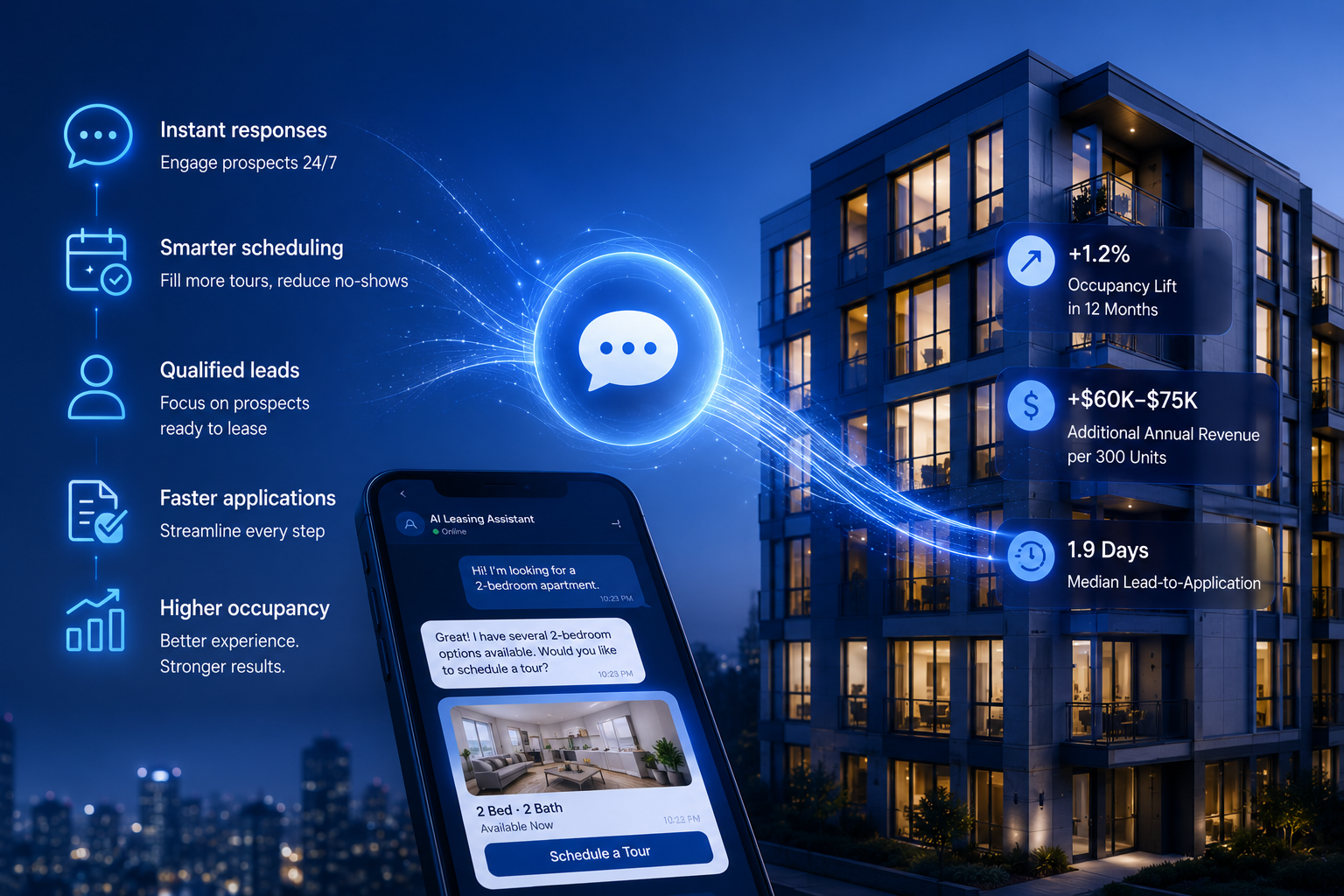
Multifamily leasing is different. It’s the one segment where the proof is not anecdotal, not projected, and not dependent on how generously you define results. EliseAI, in partnership with ALN Apartment Data, studied 3,763 multifamily communities that adopted AI between 2022 and 2024. Before AI rollout, these properties were showing an average occupancy decline of approximately 1% per year — in line with their local market trends. Within twelve months of AI deployment, the same properties were outperforming their local markets by an average of two percentage points. That’s a 3% swing in occupancy performance relative to trend, measured at scale, with market-level benchmarking, across multiple cohorts and geographies.
At a 300-unit property with market rents, a 1.2 percentage point occupancy lift translates to approximately $60,000–$75,000 in incremental annual rental revenue per property. For an operator managing 5,000 units across twenty properties, that math is significant enough to change how AI is positioned in the business case — from operational efficiency tool to direct NOI driver.
Understanding why multifamily is the segment where AI works best, what specifically the technology is doing, and what operators and builders need to know to replicate these results is the subject of this post.
Why Multifamily Is the Ideal Conditions for AI
The results in multifamily aren’t accidental. The segment has characteristics that make it the most AI-friendly environment in all of real estate, and understanding those characteristics explains why the results are so much stronger here than in CRE or residential brokerage.
High volume with bounded complexity. A large multifamily operator managing 10,000 units handles thousands of prospect inquiries, tour requests, maintenance submissions, and renewal conversations monthly. The volume is high enough that AI can deliver meaningful scale benefits. The complexity of each individual interaction is bounded — a prospect asking about a two-bedroom availability, a resident requesting maintenance, a tenant asking about their renewal terms — which means the AI can handle them reliably without the judgment ambiguity that makes AI less reliable in more complex contexts.
Standardized workflows. Multifamily leasing follows a defined sequence: inquiry → qualification → tour → application → screening → lease → move-in. The transitions between stages are well-defined and the criteria for moving through each stage are consistent across the portfolio. That standardization is what allows AI to handle the entire prospect lifecycle rather than just individual touchpoints — because the workflow logic is clear enough to encode reliably.
Structured, accessible data. Property management platforms — Entrata, Yardi, RealPage, AppFolio — store multifamily operational data in relatively consistent schemas. Unit availability, pricing, lease terms, maintenance history — all of this is accessible to an AI system through standard platform integrations. The data availability that makes AI reliable in multifamily is specifically what’s missing in CRE, where the equivalent data is in PDFs and spreadsheets rather than structured databases.
After-hours as a competitive advantage. The most striking operational finding in EliseAI’s 2025 data: 47.5% of all leasing messages were handled after hours — 61.7 million messages fielded outside business hours across the year. A prospect who decides they want to rent an apartment at 10pm on a Saturday doesn’t want to wait until Monday morning to get a response. A leasing team that responds in two minutes at 10pm on Saturday converts at a materially higher rate than one that responds the next business day. AI makes 24/7 response economically viable at the portfolio level in a way that staffing solutions cannot.
Speed as a primary conversion driver. The 1.9 days median lead-to-application figure from EliseAI’s 2025 data is the metric that most directly illustrates what AI is doing for leasing conversion. Faster lead-to-app reduces the window in which a prospect is also touring competitor properties and choosing between options. It also signals operational quality to the prospect — a building that responds instantly and processes applications quickly is one that signals attentive management, which matters to renters making a two-year housing commitment.
What Elise Actually Does: The Full Lifecycle, Not Just the Chatbot
The most common mischaracterization of AI leasing technology is describing it as a “chatbot.” A chatbot answers questions. EliseAI and similar platforms manage the entire prospect-to-resident lifecycle — a meaningfully different capability that explains why the occupancy results are what they are rather than what a question-answering tool would produce.
Prospect engagement and qualification starts the moment a lead arrives through any channel — email, text, phone, ILS listing inquiry, or website form. The AI responds within minutes, acknowledges the inquiry, asks qualifying questions (desired unit type, move-in timeline, budget, must-have features), and matches the prospect to available inventory based on the responses. This initial qualification filters the lead pool before human leasing staff are involved, ensuring that the conversations that reach onsite teams are with prospects who have been confirmed as relevant matches for available units.
Tour scheduling and management is fully automated. The AI proposes available tour times based on the prospect’s schedule, confirms the appointment, sends reminders, handles rescheduling requests, and conducts follow-up after the tour. AI-Guided Tours — EliseAI’s self-guided tour product — allowed over 20,000 prospective renters in 2025 to tour properties on their own schedule with AI providing guidance through the experience. Self-guided tours convert at higher rates than agent-led tours in some markets because they allow prospects to move at their own pace and revisit spaces without feeling the social pressure of a leasing agent waiting for a reaction.
Application processing and follow-up — nudging prospects who have scheduled a tour but not yet applied, following up on incomplete applications, answering questions about the screening process — keeps the pipeline moving without requiring leasing coordinator attention on each individual touchpoint. Approval-to-lease cycles shortened by up to 70% versus manual processes for operators using fully integrated digital leasing workflows including e-signatures.
Resident communication during tenancy extends the AI’s role beyond the leasing transaction. Maintenance request intake and routing, payment reminders and follow-up on outstanding balances, delinquency management workflows, and renewal outreach are all handled through the same platform. This continuity — the AI knowing the full history of a resident’s tenure, not just their leasing inquiry — is what enables the personalized communication at scale that drives the resident satisfaction improvements the data shows.
Renewal management is the AI application with the highest retention ROI. The AI tracks upcoming lease expirations, initiates renewal conversations at the optimal window for the operator’s retention strategy, generates renewal offers based on market data and the resident’s history, and handles the questions and objections that come up during renewal negotiations. Improved renewal rates were reported by 77% of operators using AI in EliseAI’s 2025 survey — and renewal improvement is a compounding NOI benefit because it reduces the turnover costs (make-ready, vacancy loss, leasing commission) that make turnover disproportionately expensive relative to the rent delta between renewal and new lease.
The 2025 State of AI in Multifamily: The Numbers That Matter
EliseAI’s October 2025 survey of 280 multifamily executives at operators with 200+ employees — covering 38 of the NMHC Top 50 operators — is the most comprehensive current dataset on AI adoption and outcomes in multifamily. The findings are worth examining specifically rather than in aggregate.
85% of operators using AI report measurable improvements in lead-to-lease conversion rates, with 56% reporting moderate uplift and nearly 30% reporting significant increase. 77% report moderate to significant reductions in operating expenses. 85% report improved resident satisfaction scores, with faster maintenance resolution cited by 76% and improved renewal rates by 77%.
The competitive displacement finding is the most commercially significant: 78% of respondents admitted they have already lost new business opportunities to AI-enabled competitors. That figure — not a projection, but a reported experience from operators who have observed it — shifts the AI adoption question from “can we improve operations?” to “are we losing ground if we don’t?” The operators who have not yet deployed AI are not in a neutral competitive position. They’re in a position where the operators who have deployed it are systematically outperforming them on the metrics that determine occupancy, renewal rates, and operating margins.
67% of surveyed executives believe early AI adopters will maintain a permanent competitive advantage — not just a current lead, but a durable one. The logic behind that belief is the compounding effect of the data advantage: an AI system trained on five years of a specific portfolio’s leasing patterns, prospect behavior, and conversion outcomes is more accurate and more effective than one just deployed on a new portfolio. The operators who started early are building a data advantage that late adopters can’t replicate quickly.
The workforce evolution finding is the most sensitive: 82% expect AI to replace several traditional roles by 2026, while 60% have already created dedicated AI positions. The more nuanced framing — which the data supports — is that AI is changing which roles are needed rather than eliminating the headcount category. Centralized leasing models, where a small team of AI-augmented leasing specialists handles the portfolio rather than onsite leasing staff at each property, are producing better outcomes than traditional onsite staffing models while reducing the total headcount required per unit. That’s a structural change in how multifamily operations are staffed, not just an efficiency improvement within the existing model.
The Centralization Effect: Why Operating Model Matters as Much as Technology
The most important finding from the most recent EliseAI/ALN research is the one that distinguishes between AI adoption and AI effectiveness: the centralization effect.
ALN’s analysis of 775 properties using EliseAI found that centralized properties — those where leasing, renewals, and resident services are handled by a centralized specialist team rather than onsite staff managing multiple functions simultaneously — achieved approximately 1.2 percentage points higher occupancy than non-centralized properties using the same AI platform. At a 300-unit property, 1.2 percentage points equates to roughly $60,000–$75,000 in incremental annual rental revenue.
The mechanism is straightforward. AI surfaces opportunities — a lead that needs follow-up, a prospect who toured but hasn’t applied, a resident whose lease is expiring — and creates tasks that require human action. A centralized team that specializes in leasing resolution processes those tasks faster and more consistently than an onsite team that is simultaneously handling resident services, administrative work, and physical property management. Across EliseAI’s customer base, centralized portfolios resolve approximately 76% of AI handoffs — situations where the AI requires human intervention — versus a lower rate for non-centralized operations.
The implication for operators is that AI deployment without operating model redesign captures a portion of the available value. AI deployment combined with the centralized staffing model that lets the technology work at its designed throughput captures significantly more. This is the distinction that separates operators who deploy AI as a tool from operators who deploy AI as part of a deliberate operational transformation.
For builders and platform designers, the centralization finding signals that the workflow design of the AI system needs to account for how the operator’s team is structured. When we design the handoff layer between AI and human operators, the centralization model the operator is running determines everything about how that handoff should work — the queue design, the alert prioritization, the escalation thresholds. A system designed for a centralized team with dedicated leasing specialists will underperform in a non-centralized operation if the handoff volume exceeds what generalist staff can process. We design for the operator’s actual structure, not the structure the vendor assumes.
The Competitive Landscape: EliseAI and What’s Emerging
EliseAI is the dominant platform in AI multifamily leasing — 38 of the NMHC Top 50 operators, 1,389,995 messages on its busiest single day (September 3, 2025), 10.8 million staff hours saved in 2025 alone. Its position is built on depth of workflow integration — the platform handles the entire prospect-to-resident lifecycle rather than specific touchpoints — and on the training data advantage that comes from operating at that scale for multiple years.
The competitive dynamic in this space is evolving. Knock CRM, Funnel Leasing, and RealPage’s AI leasing tools each address portions of the leasing workflow. The differentiator for operators evaluating platforms is the depth of workflow integration: a tool that handles inquiry and tour scheduling but not renewal management and delinquency follow-up requires supplementation, while a platform that handles the full lifecycle from first touch through lease renewal provides a more coherent operational layer. The integration quality with the property management system — how deeply the AI reads from and writes to the PMS rather than operating as a parallel system — is the technical differentiator that determines whether the platform produces the occupancy results the research documents or operates as a communication tool with limited operational impact.
Yardi’s AI capabilities built natively into Yardi Voyager represent a different architectural approach: AI embedded in the existing property management system rather than a standalone platform integrating with it. The trade-off is between the depth and focus of a purpose-built leasing AI and the integration simplicity of AI native to the platform the portfolio is already running on. For operators with large Yardi footprints, the native AI layer reduces the integration complexity that purpose-built platforms require while potentially trading some of the depth and responsiveness that platforms built specifically for the leasing AI use case have optimized for.
What Builders Need to Know: The Design Decisions That Drive Results
For teams building multifamily leasing AI or evaluating it as a platform feature, the design decisions that determine whether the system produces documented occupancy results or underperforms are specific and learnable from the existing deployments.
Response latency is the single most important performance parameter. The AI needs to respond to inbound inquiries within two to five minutes around the clock to capture the conversion benefit. A system that responds within business hours and queues messages overnight is not producing the after-hours conversion advantage that drives the occupancy results.
PMS integration depth determines AI accuracy. An AI that tells a prospect a unit is available when it was leased yesterday erodes trust at the highest-intent moment in the leasing cycle. Real-time reads from the property management system — not a nightly sync or a cached dataset — is the integration standard that makes the AI trustworthy.
Conversation quality determines qualification accuracy. The AI’s qualification conversation needs to capture move-in timeline, unit preference, budget, pet policy questions, and specific must-haves in a natural, conversational tone. If the qualification is too scripted, prospects drop off before completing it.
Handoff design is where most implementations lose value. The transition from AI to human needs to happen smoothly, with the full conversation history and qualification context surfaced to the leasing specialist in a format they can act on immediately. A handoff that requires the human to re-ask questions the AI already collected signals poor operational integration.
Compliance is a non-negotiable design constraint. The Fair Housing Act applies to AI leasing communications. AI systems deployed in leasing contexts need to be audited for disparate impact patterns continuously, not just at deployment.
How GTC Builds Multifamily Leasing AI
When we integrate AI leasing capabilities into a multifamily platform, the PMS integration is the first build and the most technically demanding one. The AI leasing agent is only as trustworthy as the data it’s reading — and the gap between what the AI tells a prospect and what’s actually in the property management system is the gap that kills adoption faster than any other factor. We build the real-time sync layer before we build the conversational layer.
The handoff design is the second build we spend serious time on. The threshold at which a conversation routes from AI to human — and what the human sees when it arrives — needs to be designed explicitly rather than discovered in production. We map the conversation scenarios that exceed the AI’s reliable scope, design the routing trigger for each, and build the handoff interface that surfaces the full conversation context to the leasing specialist without requiring them to read a wall of text before they can respond. That interface design is where most off-the-shelf leasing AI implementations fall short.
The compliance audit layer is a third component we build as standard on any leasing AI integration: a monitoring pipeline that analyzes conversation patterns for disparate treatment signals — response length, wait time, information completeness, follow-up rate — across different prospect demographic profiles. This isn’t a one-time audit at launch. It’s a continuous monitoring system that alerts when statistical anomalies emerge before they become liability events.
In the next post in this series we go deep on AI for real estate developers and construction workflows. If you’re building a multifamily platform and working through where AI belongs in your leasing and resident management workflows, let’s talk through your specific portfolio and operating model to identify where AI would have the highest impact.