
AI for Real Estate Developers and Construction: From Site Selection to Handover
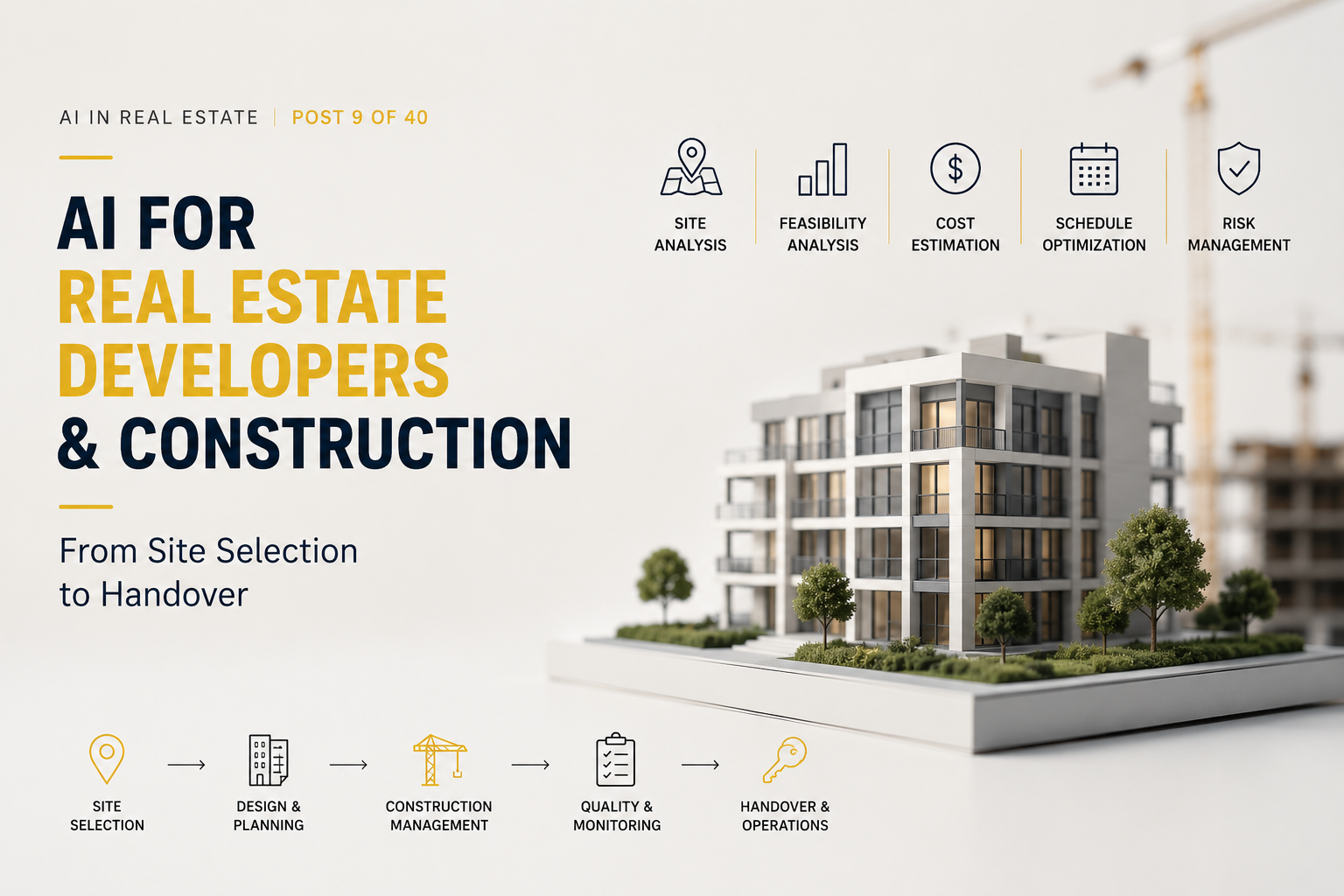
Real estate development is the segment where the cost of a wrong decision is highest, the decision timeline is longest, and the data needed to make good decisions is most fragmented. A developer who commits capital to a site based on faulty entitlement assumptions, or who proceeds with a construction budget that doesn’t account for the risk factors embedded in the project’s specific conditions, faces losses that compound across a three-to-five year development cycle. The margin for error is structurally thin — which is why when we build software for development teams, the first design question is always about decision support rather than automation.
That risk profile is what makes AI genuinely valuable for developers — and what makes the implementation discipline more consequential here than in any other segment. The developer who uses AI to evaluate five times more sites before committing capital is reducing risk through breadth. The one who uses AI to model construction cost scenarios under different material and labor assumptions is reducing risk through analytical depth. The one who deploys AI in construction monitoring to catch schedule deviations before they cascade into delay claims is protecting margin at the execution stage where most development profits are ultimately lost.
The AI in construction market is projected to grow from $3.93 billion in 2024 to $22.68 billion by 2032 — a five-times increase that reflects both the scale of the opportunity and the pace at which purpose-built tools are reaching production readiness. But the tools are at very different maturity levels depending on where they sit in the development lifecycle. Pre-development AI — site selection, feasibility analysis, entitlement risk — is early-stage but moving fast. Construction execution AI — site monitoring, schedule optimization, cost tracking — is more mature and producing documented results. Post-construction AI — buyer portal management, handover documentation, defect tracking — is almost entirely unbuilt.
This post maps the development lifecycle and examines what AI is doing at each stage, what the tools actually deliver, and where the open problems remain.
Pre-Development: Site Selection and Feasibility Analysis
The earliest stage of the development cycle — identifying viable sites and determining whether a project pencils out — is where the most interesting new AI tools are emerging, and where the dollar value of better decisions is highest. A developer who avoids committing to a site that ultimately doesn’t receive entitlement has saved the entire cost of the failed project. The cost of discovering an entitlement problem six months into a process that takes two years is multiples of what it would cost to identify the same problem in week one.
AI-powered site screening is compressing what was a weeks-long research process to hours. GrowthFactor’s AI Agent Waldo enables development teams to evaluate five times more sites using AI-driven market analysis — covering demographic data, competitive inventory, traffic patterns, zoning parameters, and financial projections in a single analysis rather than across multiple manual research streams. For retail developers, homebuilders, and multifamily developers who evaluate dozens of potential sites before selecting one, the ability to run a credible first-pass analysis on every candidate site — rather than a handful — changes the quality of the selection decision fundamentally.
TestFit generates multiple site design configurations in seconds, allowing developers to test how different unit mix assumptions, parking configurations, and building footprints affect the pro forma before engaging an architect. Zenerate does the same with greater focus on unit-level floor plan generation alongside the site plan and pro forma, specifically for multifamily and mixed-use development. The time compression these tools produce — from weeks of architect engagement to seconds of generative computation — doesn’t replace the architect. It changes when the architect’s time is engaged: at a point where the developer already knows which configurations pencil out, rather than paying for design work on configurations that will be discarded when the pro forma doesn’t work.
Entitlement risk analysis is the application where AI is beginning to address the most expensive and least predictable risk in development. Acres AI specifically targets the land acquisition stage with zoning intelligence tools that integrate public-meeting data, rezoning precedents, and sentiment signals to surface entitlement risks that historically appear too late in the development cycle. As Acres’ CEO put it directly: when developers face busted deals and write-offs, it often comes down to buying something they believed they could execute — and later, public opposition or bureaucratic change prevents it. AI that integrates the signals of local regulatory posture before capital is committed changes the risk profile of that decision from uncertain to informed.
LandLogic addresses the same problem from a zoning data perspective — covering 82 municipalities with standardized parcel-level data that answers the questions developers need answered before committing to a site: what’s permitted on this parcel, what are the setback and height constraints, what’s the FAR, are there environmental encumbrances. The traditional path to those answers was hours of bylaw research or a phone call to a land use attorney. AI-standardized zoning data answers the same questions in minutes, enabling faster go/no-go decisions at the screening stage.
Feasibility studies — the comprehensive market and financial analysis that determines whether a development project is viable before design commences — have historically taken four to twelve weeks and $50,000 or more for complex commercial projects. Feasibly, launched December 2025 with $1 million in pre-seed funding, delivers bank-ready feasibility studies in an average of three days at $10,000 per study, using a multi-agent AI system with human expert review at every output stage. The platform covers six project types at launch — multifamily, retail, hotel, office, sports/entertainment, and mixed-use — with each study including demographics and socioeconomics, comparable development trends, competitive benchmarking, market demand analysis, and cash flow projections ready for lender submission. The human-in-the-loop architecture — dedicated AI agents handling data retrieval and narrative synthesis, with Feasibly’s analysts reviewing every output — is the same approach that produces reliable accuracy at production scale throughout this series.
Deepblocks’ feasibility AI illustrates what AI-enabled scenario testing looks like in practice: a developer modeling a mixed-use site enters the desired program and the AI checks zoning compliance, FAR constraints, and parking requirements simultaneously, flagging in real time when the proposed program exceeds what the site permits. The example from their published case study — a developer’s proposed 12-story building at 11.80 FAR reduced to 7 stories and 23 units when modeled against the site’s 6.25 FAR limit — is the kind of early correction that saves months of design work on a program that was never going to receive approval.
Construction Execution: Where AI Is Most Mature
Construction execution — the translation of approved plans into a completed building — is the development stage where AI has the most mature tooling and the most documented operational results. The workflows are complex, time-sensitive, and expensive when they go wrong, which creates the conditions for AI investment that produces measurable returns.
Construction site monitoring using 360-degree imaging and computer vision has moved from innovation to production infrastructure at scale. OpenSpace has captured over 24 billion square feet across more than 33,000 projects globally. The platform attaches a 360-degree camera to a hard hat and automatically maps captured images to project plans as the site walk progresses — eliminating the manual effort of photo documentation while producing a fully navigable, timestamped visual record of site conditions at every point in the construction process. BIM Compare lets project managers overlay the captured reality against the BIM model and identify discrepancies — work that was built differently from what was specified, areas that are ahead of or behind schedule — without a dedicated site inspector conducting manual measurements.
Construction teams lose 35% of productive time to inadequate project monitoring. AI-powered monitoring addresses this specifically by making the documentation automatic rather than manual, which means the monitoring happens consistently rather than when someone remembers to do it. The consistency is what makes the data useful: a site walk record that exists for every week of construction tells a different story than a site walk record that exists for the weeks when the superintendent had time to document.
Schedule optimization is where AI is delivering the most direct ROI in complex construction projects. ALICE Technologies uses AI to optimize Primavera P6 schedules, running “what-if” simulations that test how different resource allocations, sequencing decisions, and procurement strategies affect the overall project completion date. The ability to simulate hundreds of scheduling scenarios before committing to one — identifying the configurations that compress the schedule, the resource allocations that reduce the critical path, and the procurement decisions that reduce material delivery risk — is the pre-construction intelligence that separates projects that finish on time from projects that accumulate delay claims. Foresight, another AI scheduling platform, provides deep insights into schedule quality, milestone delay predictions, and historical trends from past projects that inform current scheduling assumptions.
Cost estimation and budget management have historically been among the highest-risk components of the development workflow, with cost overruns being the norm rather than the exception on complex projects. AI-powered cost estimation achieves 97% accuracy when analyzing past project data. That accuracy figure requires qualification: 97% accuracy applies when the AI model has substantial comparable project data to train on — similar project types, similar markets, similar construction methods. Projects that are novel in one or more of those dimensions carry higher estimation uncertainty regardless of the tool. The value of AI cost estimation is not eliminating uncertainty — it’s reducing the contribution of historical data gaps and human inconsistency to that uncertainty, so that the residual uncertainty is genuinely project-specific rather than partially attributable to analytical limitations.
Project teams using construction AI-powered tools report 58% gains in efficiency through automated expense tracking and resource optimization. For a development project with a $50 million construction budget and a six-person project management team, that efficiency gain represents either the capacity to manage more projects with the same team or the capacity to manage the same project with more analytical depth — both of which have direct economic implications.
Safety monitoring using computer vision is the AI construction application with the most direct human stakes. AI systems analyze live site camera feeds for safety compliance — identifying workers without required PPE, detecting equipment in restricted zones, flagging fall hazards before they result in injuries. Procore’s AI safety monitoring, integrated with its project management platform, flags compliance gaps in real time rather than at periodic safety inspections. The documented ROI from safety monitoring AI is measured in both direct costs (workers’ compensation claims, OSHA fines, project shutdowns) and indirect costs (schedule delays from safety incidents, premium increases, reputational damage). A single serious site injury can cost more than the annual investment in a comprehensive site monitoring platform.
Document processing in construction applies the same AI document extraction capability we discussed in Blog 7 for CRE leases to the document-intensive workflows of construction project management. RFIs, submittals, change orders, lien waivers, and daily reports generate thousands of documents on a large project. AI extraction and classification of these documents — connecting them to the relevant specification section, the relevant subcontractor, and the relevant budget line item — reduces the administrative overhead of project document management and makes the information accessible when it’s needed for dispute resolution or draw processing.
Construction Finance: The Workflow AI Has Not Yet Solved
Construction lending and development finance is the segment of the development workflow with the most significant AI gap. The workflow is document-intensive, high-stakes, and time-constrained in ways that make AI genuinely applicable — but purpose-built solutions have not emerged.
Construction draw review — the monthly process by which a construction lender reviews a borrower’s request for loan disbursement, validating that the work documented in the draw package was actually completed, that lien waivers have been collected from all required parties, and that the disbursement amount is consistent with the project’s budget-to-actual status — involves hundreds of pages of documentation per monthly draw request on a complex project. The documents are varied but structured enough for AI processing: schedule of values against which the percentage-complete claim is evaluated, AIA G702/G703 payment applications, conditional and unconditional lien waivers from general contractors and subcontractors, stored material certifications for materials delivered but not yet installed, and title date-down endorsements.
An AI system that could process a monthly draw package, validate completeness against a requirements checklist, flag discrepancies between claimed completion percentages and site monitoring data, and identify missing lien waivers before the review meeting would reduce the construction lender’s draw review time from days to hours and improve the accuracy of disbursement decisions significantly. That tool doesn’t exist as a purpose-built solution. It’s one of the clearest open product opportunities in the real estate AI landscape.
Sales, Pre-Sales, and Buyer Management: Largely Unbuilt
The developer’s relationship with buyers — from pre-sales reservation management through construction progress communication to settlement coordination and handover — is a workflow that absorbs significant developer and sales team time and has almost no purpose-built AI tooling.
Pre-sales management involves maintaining a reservation register across dozens to hundreds of buyers, tracking deposit receipt and compliance with contract milestones, communicating construction progress at defined milestone triggers, managing document exchanges (contracts, amendments, disclosure statements), and coordinating with solicitors on settlement scheduling. These are high-volume, relatively structured workflows that follow a defined process — exactly the conditions where automation and AI deliver consistent value.
Current developer sales software — platforms like REX, Salesforce with custom developer configurations, and custom-built portals — handles the data management reasonably well but doesn’t apply AI to the workflow intelligence layer: identifying which buyers are at elevated risk of not settling, predicting which pre-sale buyers are most likely to assign their contracts (a compliance risk in some markets), or optimizing the timing of construction progress communications to maintain buyer confidence and reduce inquiry volume.
The buyer communication layer is particularly underdeveloped. A developer with 300 pre-sale buyers on a 24-month construction project generates thousands of buyer inquiries about construction progress, settlement timing, and contract documentation over the development period. An AI communication layer trained on the project’s specific construction milestones, the relevant contracts, and the builder’s communication policies could handle the majority of those inquiries without developer sales team involvement — the same way EliseAI handles leasing inquiries in multifamily. That capability doesn’t exist as a packaged product for residential developers.
Handover documentation — the defect inspection process, defect rectification tracking, and settlement coordination that occupies the final two to three months of a project — is managed manually by most developers. AI-assisted defect documentation that connects buyer-reported defects to the relevant trade contractor responsible for rectification, tracks the open/closed status of each defect item, and generates completion certifications automatically when all defects are resolved would reduce the administrative overhead of the handover period significantly and produce a more consistent buyer experience at the moment that determines post-settlement referrals.
The Data Reality for Developer AI
Faropoint, the technology-forward real estate manager, was transparent about their AI journey in a way that most technology vendors aren’t: they spent four years building their data infrastructure before training AI models. That timeline isn’t unusual — it’s what responsible AI deployment in a domain with complex, heterogeneous data actually requires.
The data challenge for real estate developers is specific to the development lifecycle. Pre-development data — zoning information, comparable transactions, demographic data, construction cost benchmarks — is available through external providers and increasingly accessible through AI-powered platforms like Acres, GrowthFactor, and LandLogic. The external data layer for pre-development AI is more mature than most developers realize.
The construction execution data layer is where developers need to invest before AI can deliver reliable operational intelligence. Project schedule data that’s maintained current in a tool like ALICE or Microsoft Project, cost tracking data that’s updated weekly against the schedule of values, site monitoring data from OpenSpace or a similar platform, and document management data from Procore or a comparable system — all of this needs to exist in a digital, structured, accessible form before AI can analyze it. Developers running construction on spreadsheets and email threads are not producing the data layer that AI needs to deliver the cost estimation accuracy and schedule optimization benefits the research documents.
The post-development data gap is the most underrecognized: most developers don’t have a structured record of which contractors, which specification details, which procurement decisions, and which site conditions correlated with cost overruns and schedule deviations on past projects. That historical dataset — the training data that would make AI cost estimation genuinely predictive for a specific developer’s project type and market — is sitting in email threads and end-of-project retrospectives that were never structured for analysis. When we start a construction AI engagement, one of the first builds is always the data ingestion pipeline for historical project data — converting institutional knowledge into structured training data before we build the model that learns from it.
The Tooling Landscape: What’s Worth Evaluating by Stage
The evaluation framework for developer AI tools is most useful organized by development stage rather than by technology category.
Pre-development and site selection: TestFit for generative site planning (instant pro forma testing across multiple configurations), Zenerate for unit-level floor plan generation alongside the site plan and financial model, GrowthFactor for AI-driven market analysis and site evaluation at volume, LandLogic for rapid zoning and regulatory research at the parcel level, Acres for entitlement risk intelligence integrating public sentiment and rezoning precedent data. Feasibly for bank-ready feasibility studies with human expert validation in days rather than months.
Construction execution: OpenSpace for 360-degree site capture and progress monitoring at scale, ALICE Technologies for AI-optimized schedule simulation on complex projects, Procore with AI features for integrated project management, cost tracking, and safety monitoring, Autodesk Construction Cloud for BIM-integrated project management, Foresight for schedule quality analysis and delay prediction.
Cost estimation: Beam AI and Houzz’s AutoMate for residential and commercial cost estimation from uploaded plans and voice prompts, Autodesk ProEst for BIM-integrated cost estimation on commercial projects, Calk.ai for rapid construction cost analysis. The evaluation criterion that matters most in this category: what is the tool’s accuracy on the specific project types and markets in the developer’s portfolio, not on the vendor’s published benchmark dataset.
Document processing: Procore’s AI document tools for construction-specific document workflows, Mastt AI Contract Review for contract summarization and risk flagging, Kira/Litera for consultant and contractor agreement review where detailed legal analysis is required.
What the Best Developer AI Implementations Have in Common
Across the developers and construction firms getting genuine operational value from AI — better site selection decisions, more accurate budgets, fewer schedule surprises, more consistent documentation — the common factors are consistent with what we’ve observed throughout this series.
They defined the specific problem before selecting the tool. A developer who deploys AI for site screening because “AI is important” and one who deploys it because “we’re evaluating 200 sites per year and converting 3% of them into projects, and we need to triage faster” are starting from completely different places. The latter has a measurable success criterion.
They invested in data infrastructure before expecting AI results. The developers getting the most from construction cost AI have years of structured project cost data. Deploying AI on cost estimation with three projects in the database produces precise numbers derived from insufficient data. The investment in structured project data capture needs to precede the AI deployment that benefits from it.
They kept humans in the decision loop for the decisions that matter. No AI tool is replacing the developer’s judgment about whether to commit capital to a site, whether the contractor’s change order request is legitimate, or whether the project’s risk profile warrants proceeding. The tools worth deploying are designed around that reality.
How GTC Builds AI for Real Estate Development Platforms
When we build AI capabilities into a real estate development platform, the feasibility and site analysis layer is typically the first build that clients can see direct ROI from immediately. Connecting publicly available zoning data, demographic feeds, and market comp data into a unified analysis layer — so a development team can run a credible first-pass feasibility on a candidate site in hours rather than weeks — changes the economics of site selection before any machine learning is involved. Once that foundation is in place, we layer in predictive scoring based on the developer’s own historical conversion data.
The construction project data architecture is the second build we focus on — specifically, structuring the cost and schedule data from active and completed projects in a format that can actually train the cost estimation models that deliver the 97% accuracy the research documents. Most development firms have this data scattered across Procore exports, Excel spreadsheets, and project manager memories. We build the ingestion pipeline and the data model that converts that institutional knowledge into structured training data before we build the AI model that learns from it.
The construction draw review workflow is the build we’re developing as a purpose-built application — processing draw packages, validating completeness against a requirements checklist, cross-referencing completion certifications against site monitoring data, and flagging missing lien waivers before the review meeting. The document structure is consistent enough across projects that AI can handle the bulk of the review with high accuracy, reducing what currently takes days of analyst time to hours.
If you’re a developer or building software for developers and working through where AI belongs in the development lifecycle, let’s talk through the specific stage of your development workflow where AI would have the most impact given your current data infrastructure.