
AI Rent Pricing Without Antitrust Exposure: What the RealPage Settlement Actually Tells Operators
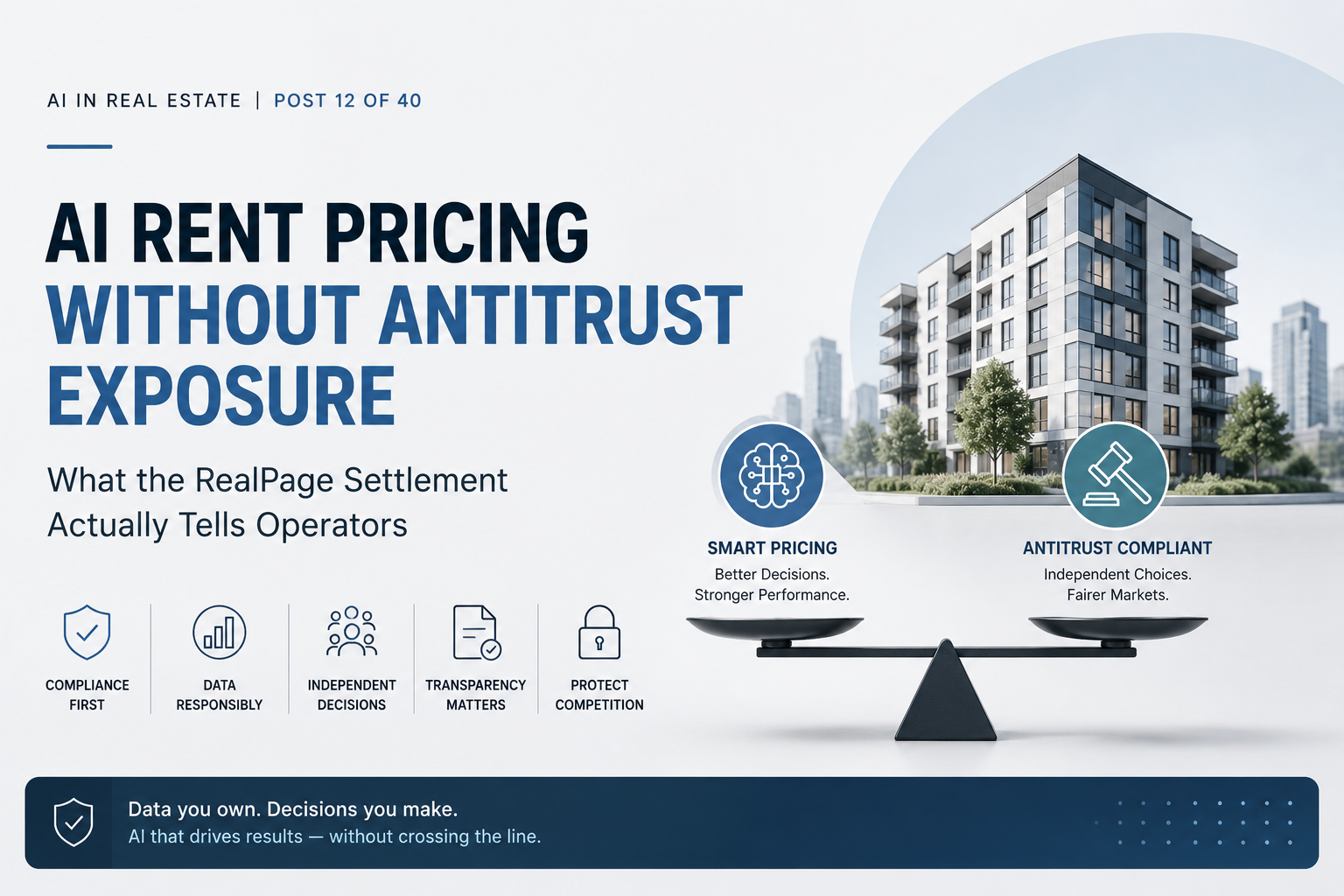
The RealPage antitrust case is the most closely watched technology enforcement action in real estate history, and its November 2025 resolution delivers something the industry has needed for three years: clarity. Not complete clarity — state litigation continues, private class actions remain active, and New York State has enacted a statute that goes further than the federal settlement — but enough clarity to understand what AI rent pricing looks like when it’s done legally and what it looks like when it isn’t. When we build revenue management features into multifamily platforms, the settlement terms are now the architecture specification, not just a compliance consideration.
The DOJ’s proposed settlement with RealPage, filed November 24, 2025 and subject to court approval, is not the end of algorithmic pricing scrutiny. The Assistant Attorney General of the Antitrust Division said in the settlement announcement that “competing companies must make independent pricing decisions, and with the rise of algorithmic and artificial intelligence tools, we will remain at the forefront of vigorous antitrust enforcement.” The settlement makes clear that this enforcement priority survived the administration change — the Trump DOJ continued pursuing the case that Biden’s DOJ initiated. Algorithmic pricing that coordinates rent-setting across competing landlords through shared nonpublic data is a durable enforcement target regardless of which administration is in office.
What the settlement also makes clear — and what the legal analysis from Duane Morris, Fenwick, and Hogan Lovells consistently confirms — is that algorithmic pricing itself is not inherently illegal. There was no judicial finding that algorithmic rent-setting violated the Sherman Act. The settlement targeted a specific practice: the use of nonpublic, competitively sensitive data collected from competing landlords to generate pricing recommendations that aligned rents across those competitors. Algorithmic pricing that uses a property’s own data, publicly available market data, and aged aggregate information — without sharing current nonpublic information across competing operators — is precisely how numerous industries already use pricing algorithms without antitrust concerns. The RealPage settlement reaffirms that boundary in the specific context of multifamily rent pricing.
This post is the practical guide to what that boundary means for multifamily operators: what the settlement terms establish as prohibited, what’s clearly legal, what remains in a gray zone, and how to structure AI rent pricing that captures the revenue management value without the coordination exposure.
What the DOJ Case Was Actually About
Getting the facts of the case right matters because the popular summary — “RealPage got in trouble for AI rent pricing” — conflates the technology with the practice that regulators found problematic. The distinction is the one that determines whether any given operator’s rent pricing approach carries antitrust risk.
The DOJ’s core allegation was that RealPage’s revenue management software — specifically YieldStar and AIRM — collected nonpublic, competitively sensitive data from competing landlords: rental applications, executed new leases, renewal offers and acceptances, and forward-looking occupancy data. That data is among the most competitively sensitive information a landlord maintains — it’s the information that would give a direct competitor an advantage in pricing decisions if they had access to it. RealPage used that current, nonpublic competitive data as a “building block of price” in generating pricing recommendations, then provided those recommendations to the competing landlords whose data it had collected.
The DOJ characterized this as a hub-and-spoke arrangement: RealPage at the hub, competing landlords at the spokes, with RealPage serving as the vehicle through which competitors effectively shared their most sensitive pricing information and coordinated their pricing decisions. The DOJ alleged that in 595 zip codes across 125 metropolitan areas, five or fewer landlords manage more than 50% of multifamily units — concentrations high enough that coordinated pricing in those markets would have material effects on rent levels. One landlord allegedly told RealPage that it started increasing rents within a week of adopting the software and, within eleven months, had raised them more than 25%.
The DOJ also alleged that RealPage used exclusionary conduct — including contractual terms that made it difficult for landlords to use competing revenue management products — to maintain a monopoly in the commercial revenue management software market. This Section 2 monopolization allegation is separate from the coordination allegation and received less attention but was part of the same complaint.
The settlement terms address specifically what the DOJ found problematic. RealPage must use data at least 12 months old for training its AI pricing models. Real-time lease data is prohibited from runtime operation — generating pricing recommendations. Geographic modeling below the state level is prohibited for models trained on nonpublic data from competing landlords. Auto-accept features — functions that automatically accept RealPage’s pricing recommendations without property manager review — are prohibited. RealPage cannot generate increased rental price recommendations when a floor plan reaches target occupancy based on competitors’ data. Pricing advisors cannot discuss market analysis or trends based on nonpublic data at meetings attended by competing operators.
Each of these restrictions targets a specific feature of the practice the DOJ found problematic: current data, automated acceptance, below-market-area granularity from competitor inputs, and information sharing in competitive settings. The restrictions do not prohibit algorithmic pricing. They prohibit specific design features that facilitated coordination.
The Legal Line: What Makes Algorithmic Pricing Risky vs. Safe
The Duane Morris analysis of the settlement articulates the takeaway that most operators need: the settlement confirms that proper algorithmic pricing — used independently and without competitively sensitive data sharing — remains well within the bounds of lawful conduct. The compliance fundamentals the settlement reinforces mirror decades of antitrust guidance on information exchanges:
Retain independent pricing authority. Avoid sharing sensitive, current competitive data with rivals, directly or indirectly. Understand and document the inputs used by pricing tools.
These are not new principles invented for algorithmic pricing. They’re the principles that have governed information exchange analysis in antitrust law for fifty years, applied to a new technology context. The technology doesn’t change the underlying legal analysis. What changed with RealPage is that the technology made it possible to share current competitive data at scale through a software intermediary in a way that might not have been recognized as anticompetitive under prior frameworks that focused on direct communications between competitors.
The specific factors that determine whether a pricing tool carries antitrust risk are, in order of importance:
The currency and nonpublic nature of the competitive data inputs. Current, nonpublic data from competing operators — real-time lease transaction data, current occupancy levels, renewal acceptance rates, forward-looking vacancy projections — is the category the settlement specifically restricts. The theory is straightforward: if I give you my current pricing data and you give me yours, we’ve achieved the coordination benefit that antitrust law prohibits even without a direct conversation. A software intermediary that aggregates current nonpublic data from competing operators and uses it to generate pricing recommendations for those operators is, under the DOJ’s theory, the mechanism of that coordination.
Publicly available data — advertised asking rents on listing platforms, publicly filed occupancy disclosures in REIT earnings reports, data from market research providers that compile publicly available information — does not raise the same concern. This is the data that any competitor could observe independently. Using it in a pricing model is pricing intelligence, not coordination.
Aged aggregate data — market data that is at least 12 months old, aggregated to a geographic level that prevents identification of specific competing properties — is what the RealPage settlement permits in training models. This is the data equivalent of using a historical reference: it informs the model’s understanding of market patterns without providing a current signal about what any specific competitor is doing right now.
The auto-accept architecture. The prohibition on auto-accept features is the design term that most directly addresses the independent decision-making requirement. When a pricing tool generates a recommendation and the operator’s system automatically accepts it without human review, the human decision-maker has been removed from the pricing process. The concern is that a pricing tool generating recommendations that are routinely auto-accepted is effectively setting prices — and if that tool is generating recommendations based on what competing operators are charging, the auto-accept feature is the mechanism by which pricing coordination occurs without any conscious decision by the operator.
The human review requirement is not just a compliance formality. It’s the architecture that ensures each operator is making an independent pricing decision, informed by the tool’s analysis, rather than delegating the pricing decision to a shared algorithm that may be coordinating across competitors.
The geographic granularity of competitive data sharing. The settlement’s prohibition on geographic modeling below the state level for models trained on nonpublic competitive data addresses the market definition concern in antitrust analysis. Rent prices compete at the metropolitan area level — what a landlord in Austin, Texas charges affects other Austin landlords, not Dallas landlords. Pricing recommendations based on competitor data aggregated at the zip code level are more likely to facilitate market-level coordination than recommendations based on state-level aggregates. The settlement’s state-level floor for nonpublic competitive data reflects the DOJ’s view that the market-level coordination risk requires that competitive data inputs be aggregated to a level that prevents market-specific pricing coordination.
What Remains in the Gray Zone
The RealPage settlement resolves the DOJ’s federal case but leaves several questions unanswered or only partially answered.
New York State’s statute is the most significant unresolved complication for national operators. New York State enacted a first-of-its-kind statute that broadly prohibits rent-setting software drawing on data from multiple unaffiliated landlords and treats violations as a state antitrust offense — regardless of whether the inputs are public or nonpublic. This goes further than the federal settlement, which permits publicly available data as an input. An operator using a pricing tool that incorporates publicly available comparable rents from other properties in the same New York market may be complying with federal law while violating New York State law. National operators with New York exposure need jurisdiction-specific legal review of their pricing tools, not just compliance with the federal settlement terms.
State attorney general litigation. The state attorneys general who joined the DOJ’s complaint have not settled. They may view the federal settlement as insufficient and continue litigation seeking stricter remedies or pursuing claims against landlords that the DOJ’s settlement with RealPage doesn’t resolve. Nine states reached a $7 million settlement with Greystar in November 2025 over its use of RealPage software. Private class action litigation by tenants against RealPage and landlords remains active. The federal settlement provides guidance on where federal enforcers draw the line. It doesn’t immunize operators from state or private liability, and state standards in New York and potentially other jurisdictions may be stricter than the federal standard.
Revenue management meetings. The settlement prohibits pricing advisors from discussing market analysis or trends based on nonpublic data at meetings attended by competing operators. This restriction addresses a practice the DOJ alleged was supplementing the software coordination with direct discussions between competitors — which is the most traditional form of antitrust coordination. Operators who participate in industry association meetings, regional landlord groups, or software user conferences where pricing trends are discussed among competing operators need to be careful that those discussions don’t cross from general market commentary into sharing nonpublic competitive pricing data.
The Compliant Architecture: How to Use AI Pricing Without Coordination Risk
The legal analysis converges on a clear framework for AI rent pricing that captures the revenue management value without the coordination exposure. The framework is not a set of restrictions imposed from outside but the logical consequence of the underlying antitrust principle: competing companies must make independent pricing decisions.
Own-property data as the primary input. A pricing model trained on the property’s own historical data — its lease transaction history, its occupancy trends, its renewal acceptance rates at different price points, its historical demand patterns by season and unit type — is pricing intelligence that any business routinely uses and that raises no coordination concern. This is the architecture we build from: the operator’s own data as the primary training signal, with public market data layered on top.
Publicly available market data as the competitive context layer. Advertised asking rents from listing platforms — Apartments.com, CoStar, Zillow, RentSpree, any platform that publicly displays the rents competitors are advertising — are information that any prospective renter can observe. Using that public information in a pricing model is exactly what a good leasing manager does when they check the competition’s pricing before setting their own: they’re observing what competitors have chosen to make public, not accessing their private competitive information. A pricing model that incorporates publicly listed competitor rents as a market context signal is using the same information that’s available to anyone, processed algorithmically rather than manually.
Aged aggregate data for baseline calibration. For broader market calibration — understanding where a market’s rent levels have been trending over time, what seasonal patterns exist, how the subject property’s performance relates to the market average — aged aggregate data from market research providers (CoStar, CBRE EA, Yardi Matrix) provides the historical context that helps a pricing model understand what’s normal in a specific market. The 12-month age threshold in the RealPage settlement is the federal benchmark; state-specific requirements may vary.
Human review of every pricing recommendation. The independent decision-making requirement means a property manager or revenue manager reviews the AI’s pricing recommendation before it takes effect. The review doesn’t need to be a deep analytical exercise for every unit at every pricing cycle — a trained revenue manager can review a batch of recommendations in minutes if the interface surfaces the recommendations that deviate significantly from expectations for focused review. What matters is that the human decision-maker has the ability and the responsibility to accept, modify, or reject the recommendation. Auto-accept is off. Human review is on.
Documentation of pricing decisions. In an enforcement environment where antitrust regulators are scrutinizing algorithmic pricing, documenting the basis for pricing decisions — what the AI recommended, what the property manager decided, and why any deviations from the recommendation were made — creates the record that demonstrates independent decision-making. This documentation is not just compliance overhead. It’s the evidence that would matter in a government investigation or private litigation.
The Revenue Management Tools That Remain Available
The RealPage settlement does not eliminate AI revenue management as a viable operational tool. It establishes the data and design parameters within which AI pricing tools can operate legally. Multiple alternatives to the restricted RealPage architecture exist and are developing.
Property-specific machine learning models are the approach that the most sophisticated operators have been developing — building pricing models trained on their own portfolio’s historical data, incorporating publicly available market information, and generating recommendations that are based on the operator’s own analysis rather than on shared competitor data. Rentana is one of the platforms developing this approach, providing AI-powered revenue management that uses a portfolio’s own operational data and publicly available market signals rather than cross-operator data sharing. The technical capability required is within reach of operators with sufficient historical data and access to data science resources.
Public data pricing tools that incorporate only publicly listed competitor rents — rather than nonpublic lease transaction data — represent a model of algorithmic pricing that the current legal framework appears to permit at the federal level. The tools that survive the post-RealPage environment will be the ones that can demonstrate clearly that their competitive data inputs are publicly available information, not shared nonpublic data.
Lease analytics platforms like Prophia and comparable tools provide the lease data foundation — clean, structured, current lease data from the operator’s own portfolio — that enables revenue-management analysis based on the operator’s actual portfolio performance rather than on competitive coordination. When an operator knows precisely what their current leases say about renewal timing, what their historical renewal acceptance rates have been at different price-increase thresholds, and what their vacancy patterns look like by unit type and season, they have the foundation for pricing intelligence that doesn’t require anyone else’s data.
The Remaining Operational Value of AI Rent Pricing
The legal analysis is clarifying, but the question it answers is whether AI pricing is legal, not whether it’s valuable. On the value question, the documented revenue management results remain real within the compliant architecture.
Dynamic pricing tools that optimize rents using the property’s own data and public market signals — adjusting recommendations based on traffic volume, conversion rates, days on market for comparable units, and seasonal demand patterns — produce measurable revenue outcomes relative to static pricing or informal market-based adjustments. The value doesn’t depend on accessing competitor nonpublic data. It depends on processing the property’s own signals more systematically than a leasing manager can do manually.
The specific value drivers in compliant AI pricing are occupancy rate optimization — pricing units to minimize the vacancy-versus-revenue tradeoff — lease expiration management — staggering expirations to avoid seasonal vulnerability — and unit-level pricing differentiation — capturing the premium for higher floors, better views, updated finishes, or preferred locations within a building. None of these require competitor nonpublic data. All of them require systematic analysis of the property’s own data.
The operators who will benefit most from AI pricing in the post-RealPage environment are the ones who build the data infrastructure that makes their own portfolio data clean, structured, and accessible to a pricing model — rather than relying on a shared data pool that creates coordination risk. That data infrastructure investment is the same prerequisite we’ve identified throughout this series for every AI application in real estate. The legal clarity from the RealPage settlement makes it more urgent, not less: the operators who want AI pricing capability need to own their own data layer rather than depend on a shared-data product whose legal status remains contested.
What Operators Should Do Now
For multifamily operators currently using RealPage’s AIRM or YieldStar, the settlement terms that RealPage is implementing — data age restrictions, elimination of auto-accept, geographic granularity limits — represent the minimum compliance baseline for the federal case. State-level exposure, particularly in New York, requires jurisdiction-specific review.
For operators evaluating revenue management tools, the evaluation questions that now carry legal weight alongside the performance questions are: what data sources does this tool use in runtime pricing recommendations, specifically distinguishing between the operator’s own data, publicly available data, and any nonpublic data from other operators? Does the tool include any auto-accept or recommendation-lock features that reduce the operator’s ability to exercise independent pricing judgment? Has the tool’s data architecture been reviewed by antitrust counsel in the context of the RealPage settlement?
For operators building custom pricing capabilities — whether in-house or through a software development partner — the architecture that the RealPage settlement points toward is one built on own-data intelligence, public market signals, and human review. That architecture is technically achievable, legally defensible, and produces the revenue management value that makes AI pricing worthwhile. It just requires the data infrastructure investment that the compliant approach depends on.
How GTC Builds Compliant Rent Pricing AI
When we build a revenue management feature into a multifamily platform, the data architecture is the compliance architecture. The distinction between what data feeds the model and how that data was sourced is the line that separates a defensible pricing tool from one with antitrust exposure.
The architecture we build uses three data inputs: the portfolio’s own historical transaction data as the primary training signal, publicly listed competitor asking rents from major ILS platforms as the market context layer, and aged aggregate market data from CoStar or Yardi Matrix for baseline calibration. We explicitly exclude real-time nonpublic data from other operators — not just because the settlement requires it, but because the model’s accuracy is genuinely better when trained on the operator’s own data than when trained on a pooled dataset that includes competitors’ pricing strategies.
The human review interface is designed so that a revenue manager sees the model’s recommendation alongside the inputs that drove it: current vacancy, recent traffic volume, days on market for comparable units in the current lease-up period, and the market-rate trend the recommendation is responding to. That transparency serves two purposes — it lets the revenue manager make an informed independent decision rather than accepting a black box, and it produces the audit trail that documents independent pricing decisions if the pricing program is ever examined.
The auto-accept feature is off by design. Every recommendation requires a human action to take effect. That’s not a limitation of the system — it’s the architecture that satisfies the independent decision-making requirement and that we’d build regardless of what the settlement requires.
The DOJ’s message from the settlement is clear: algorithmic pricing built on independent data and reviewed by independent human decision-makers is not what regulators are targeting. That’s the architecture we build. If you’re building a revenue management feature for a multifamily platform and working through what a compliant AI pricing architecture looks like, let’s talk through your specific pricing workflow.