
AI for Residential Brokerages and Agent Productivity: Wide Adoption, Shallow Impact — and How to Fix It
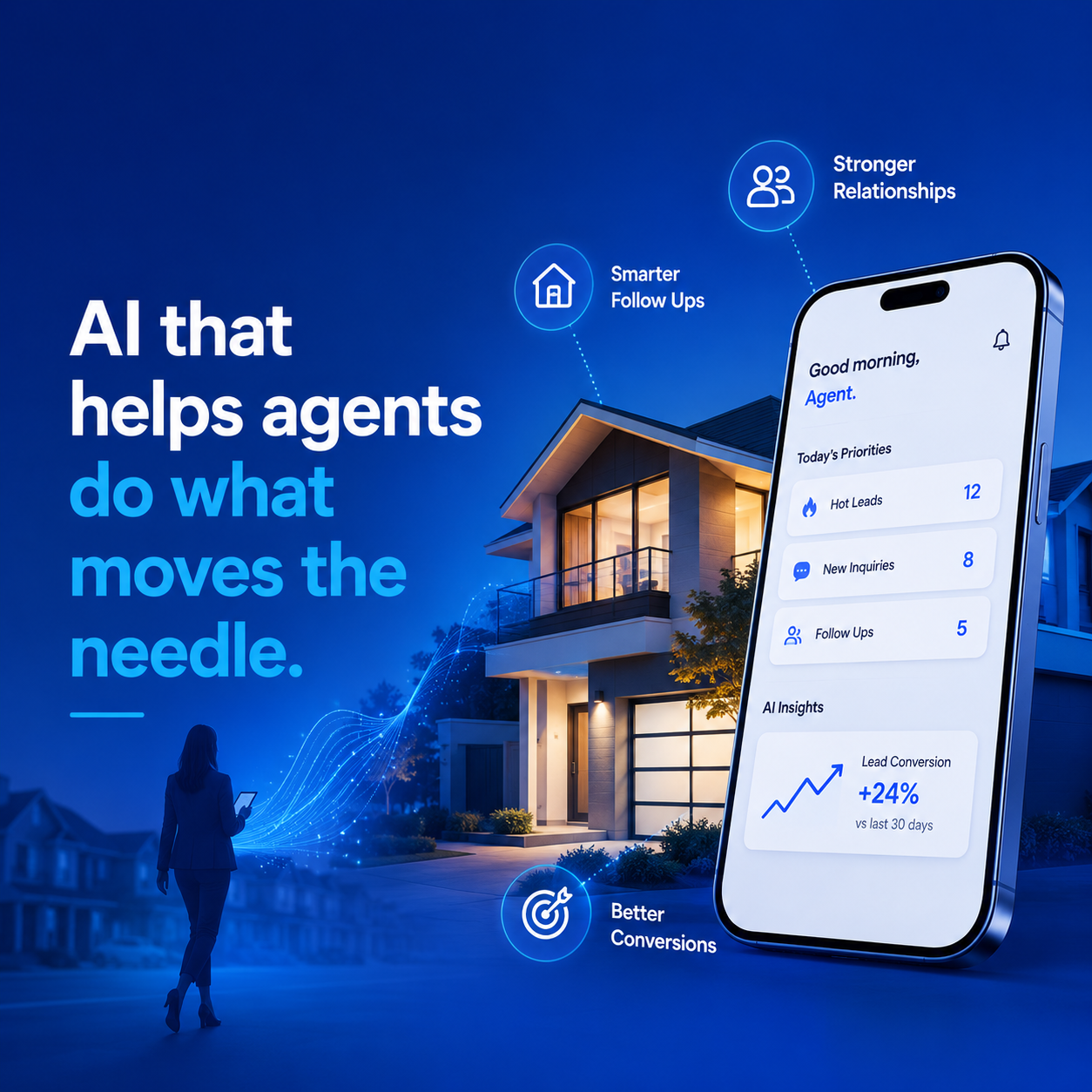
Residential real estate is the most AI-saturated segment in the industry by adoption metrics and the most underwhelming by outcome metrics. Over 87% of brokerages and agents are actively using AI tools daily. Agents are using AI for listing descriptions, email drafts, social media posts, and market update blurbs. The tool adoption is real, the time savings on those tasks are real, and the impact on what actually drives agent income — lead conversion, client retention, negotiation outcomes, listing acquisition — is largely marginal.
The reason for that gap is not that AI can’t help residential agents meaningfully. It’s that the adoption has concentrated in the most visible, lowest-leverage part of the workflow: content generation. An agent who saves forty-five minutes a week writing listing descriptions and then spends that time refreshing Instagram hasn’t moved the needle on their business. When we build AI capabilities into brokerage platforms, the first question we ask is which metric the AI is supposed to move — and “saves time on listing descriptions” rarely survives that question as the primary value driver.
The post-NAR settlement landscape makes this distinction more commercially urgent than it was two years ago. When buyer agent compensation is negotiated explicitly rather than baked into the listing-side commission, agents are under pressure to articulate and demonstrate the value they provide. AI that makes an agent more efficient at writing descriptions doesn’t help with that pressure. AI that makes an agent more responsive, better informed, and more systematically attentive to every client relationship does.
This post is about where AI is actually moving the needle for residential brokerages and agents — and where it’s being deployed busily but not productively.
Lead Management: The Highest-Leverage AI Application Most Agents Underuse
The workflow where AI delivers the most measurable revenue impact for residential agents is lead management — specifically, lead scoring, behavioral prioritization, and automated follow-up that keeps the agent visible to prospects at the moment they’re most likely to act.
The economics of residential real estate make this clear. The average residential agent closes twelve to fifteen transactions per year. Their CRM typically contains hundreds to thousands of contacts at various stages of intent. The gap between the transactions that close and the transactions that don’t is often not the quality of the leads — it’s the consistency and timing of follow-up. A lead who expressed interest six months ago, cooled off when rates rose, and is now actively searching again has a high probability of closing with whoever reaches out first with something relevant. That lead is in most agents’ CRMs right now. Most agents aren’t reaching out because they don’t know the lead has re-engaged.
AI behavioral scoring solves this problem. Lead scoring and prioritization tools analyze data from the CRM, website, and marketing campaigns to score leads based on their likelihood to convert, with signals including property search activity, email engagement, and time spent on listings. Behavior-based triggers flag leads as “hot” when they view a property multiple times or request a second showing, alerting the agent to follow up immediately. This is not theoretical — it’s the production capability of Follow Up Boss, CINC, BoomTown, and kvCORE’s AI layers. An agent running one of these platforms with the behavioral scoring configured and acted on is systematically converting leads that would have gone cold in a manual workflow.
Revaluate and SmartZip are more specifically AI for real estate leads — they identify homeowners most likely to move soon, providing a strategic edge for targeted outreach. The mechanism is predictive: these platforms analyze patterns in publicly available data — tax assessment changes, property search activity from IP addresses associated with specific addresses, life event signals from social media — to identify households that are statistically likely to list within the next six to twelve months. An agent who calls a homeowner six months before they’ve decided to sell — because the data suggested they were likely to — is having a different conversation than the agent who calls after the homeowner has already interviewed three agents. First-mover advantage in listing acquisition is one of the few durable competitive advantages in residential real estate, and predictive targeting is the AI application that most directly enables it.
Structurely’s AI assistant (Aisa Holmes) qualifies leads via conversational text exchange before handing them off to the agent — handling the initial qualification workflow for leads who come in through web forms or portal registrations, determining timeline, motivation, and pre-approval status through a natural language conversation, and only routing to the agent when the lead has reached a defined qualification threshold. The documented impact is on lead-to-appointment conversion: agents using AI qualification tools report higher show rates from the leads that do reach them, because the unqualified leads are filtered out earlier rather than consuming showing time and follow-up capacity.
Content Generation: Real Value, Inflated Expectations
Content generation is where most agents have started with AI, and it delivers genuine value in proportion to how the agent uses it. The key is framing it correctly: AI content generation is a time compression tool, not a quality replacement for human judgment about what to communicate and how.
AI helps real estate agents maintain consistent property marketing without burnout. AI writing tools generate property descriptions, email campaigns, blog posts, market updates, and social media posts that align with an agent’s voice and brand. That value is real. An agent who was previously spending two hours per listing on marketing copy can now produce a first draft in five minutes and spend twenty minutes editing it into something that represents their brand and their local knowledge. The net time saving is significant across the volume of listings an active agent manages.
The tools that produce better results for real estate content are purpose-built rather than general-purpose. Epique is purpose-built for real estate with twelve specialized tools for copywriting. It understands real estate terminology, can write in your brand voice, and handles everything from listing descriptions to email campaigns. The quality is notably better than generic AI tools for real estate content. Writer.Homes, ListingAI, and similar purpose-built tools are producing listing descriptions that require less editing than generic ChatGPT output because they’ve been trained on real estate language patterns, know how to handle specific property types, and generate content that doesn’t require the agent to remove generic marketing language and reinsert local specificity.
The fair housing compliance dimension of AI-generated listing descriptions is the one most agents are not thinking about carefully enough. AI models can inadvertently generate language that implies preferences for specific types of buyers — references to “walkability” that may correlate with disability status concerns, neighborhood descriptions that reference demographic characteristics, school district emphasis that may reflect racial composition patterns. When we build content generation features into brokerage platforms, we include a compliance scanning layer as a standard component — not an optional add-on — because the agent’s license is at risk, not the AI tool’s.
The honest assessment of AI content generation for residential agents: it saves real time on tasks that are necessary but not differentiating. No buyer chose their agent because the listing description was exceptionally well-written. Agents who are spending the time they save on content generation doing more of the work that actually differentiates them — more client conversations, more prospect outreach, more market knowledge development — are getting compounding value from the tool. Agents who are spending that saved time on lower-value activities are getting marginal benefit.
CMA and Pricing: Better Data Faster, Same Judgment Required
Comparative market analysis is one of the most time-consuming parts of the listing acquisition workflow and one of the areas where AI is producing the most consistent time savings for agents who are using it well.
AI-powered CMA tools — HouseCanary, MarketLens.ai, and CMA features built into platforms like Cloud CMA and Remine — process comparable sales data, adjust for property differences, and produce a preliminary pricing range faster than manual CMA preparation. For an agent preparing for a listing appointment on a standard residential property in a market with adequate comparable data, the AI CMA is a credible starting point that can be reviewed, adjusted for qualitative factors the model doesn’t capture, and presented with confidence in a fraction of the time manual preparation would require.
The limitations are the same ones that apply to AVMs throughout this series: thin comparable markets, unique properties, and rapidly changing market conditions all reduce the reliability of AI pricing models. An agent who presents an AI-generated CMA to a seller without understanding its methodology and its limitations is an agent who will struggle to defend the pricing recommendation when the seller pushes back. The AI produces the analysis. The agent’s job is to understand it well enough to explain it, defend it, and adjust it for the factors the model doesn’t see.
The post-NAR settlement context adds a dimension here: as buyer agent compensation becomes explicitly negotiated, the agent’s ability to demonstrate market knowledge and analytical rigor is more commercially important than it was when the commission structure was invisible to the consumer. An agent who can walk a buyer through the pricing dynamics of a specific neighborhood using data and tools that demonstrate analytical sophistication is making a clearer value case than one who is guiding primarily by experience and intuition. AI-enhanced market analysis, used well, is part of how agents demonstrate the value of professional guidance in a market where that value is being actively questioned.
Transaction Coordination: AI Reducing the Administrative Load
Transaction coordination is the part of the residential agent workflow that consumes the most administrative time per transaction and produces the least client-visible value. Coordinating signatures, tracking contingency deadlines, chasing document uploads, scheduling inspections, managing the communication chain between buyer, seller, lender, title, and agents — all of it is necessary and none of it is why the client chose their agent.
ListedKit AI is an AI-powered transaction coordinator that assists solo agents, teams, and brokerages with organizing their transaction paperwork. It reviews all documents for accuracy, creates timelines, sets task reminders, and integrates with Outlook or Google Calendar and email for timely communication between all parties. Rex Real Estate claims to automate 85% of transaction workflows using AI, including contract analysis, compliance checks, and document processing. SkySlope and Dotloop have added AI layers that flag missing documents, surface approaching deadlines, and route signature requests automatically.
The value of AI in transaction coordination is not in replacing the transaction coordinator — the human oversight layer for a residential transaction, especially one with complications, requires experienced judgment. It’s in reducing the volume of manual tracking, reminder sending, and document chasing that consumes coordinator capacity. A transaction coordinator managing twenty simultaneous files manually is stretched. The same coordinator with AI surfacing what needs attention on each file — what’s missing, what’s approaching a deadline, what’s generating a discrepancy — can manage significantly more files at the same attention level.
For solo agents who are also their own transaction coordinator, the ROI calculation is direct: every hour AI saves on transaction administration is an hour available for lead generation, client relationship building, or listing acquisition. The agents who most acutely feel the value of transaction coordination AI are the ones running at capacity — where the bottleneck on their production is time, not leads.
Photography, Staging, and Visual Marketing: The Clearest Productivity Win
The visual marketing workflow — photography scheduling, photo enhancement, virtual staging, listing video production — is where AI has produced the most immediate, most visible productivity gains for residential agents, and where the barrier to adoption is lowest because the output is immediately assessable.
AI photo enhancement tools — Virtually Staging AI, BoxBrownie, PhotoAI — automate the editing workflows that previously required either expensive retouching services or significant Lightroom time: sky replacement, clutter removal, brightness and contrast normalization, lens distortion correction. Restb.ai uses computer vision to automatically tag photos with key features like “open floor plan” or “pool,” enhancing searchability and improving the listing’s SEO. For high-volume agents shooting their own listing photos or working with photographers who don’t provide edited files, AI editing tools are compressing the post-production workflow from hours to minutes.
Virtual staging is the visual marketing AI application with the highest ROI for specific property types. An empty listing — a vacant investment property, a newly constructed spec home, an estate sale with dated or removed furniture — photographs poorly relative to its potential and converts poorly in online search. AI virtual staging tools generate furnished room renderings from empty room photos in minutes and at a fraction of the cost of physical staging. The disclosure requirement — virtually staged images must be labeled as such — is a compliance obligation that most MLS boards now enforce, and agents using virtual staging need to ensure their listing photos include that disclosure to avoid compliance issues.
The one caution: virtual staging that is used to misrepresent a property’s condition — staging around visible damage, obscuring structural issues, depicting amenities that don’t exist — is not a visual marketing tool. It’s a misrepresentation issue with potential disclosure liability. The tool’s capability has outrun the ethical guardrails that some agents are applying to its use.
Where AI Doesn’t Help Residential Agents: The Honest Limits
The agent capabilities that produce the highest client value and the most referral business are the ones AI does not and cannot replicate.
Negotiation strategy and execution is the clearest example. AI can provide data about market conditions, comparable sales, days on market, and seller motivation signals. It cannot read the specific seller in this specific transaction, understand the emotional dynamics that are affecting their decision-making, or make the judgment call about when to push and when to concede. The agents who consistently produce the best negotiation outcomes for their clients are the ones with deep experience reading and managing complex interpersonal dynamics under financial pressure. No AI tool changes that equation.
Neighborhood expertise and local market intelligence — the knowledge of which street in a neighborhood commands a premium and why, which school boundaries are changing, which development projects will affect values over the next three years, which blocks have HOA drama that doesn’t show up in a database — is information that lives in the agent’s head, built from years of active market participation. AI can analyze publicly available data about a neighborhood. It can’t replicate the tacit local knowledge that experienced agents have accumulated. That knowledge is a genuine competitive advantage that AI can help agents communicate more effectively but can’t substitute for.
Client trust and relationship management is the capability that drives referrals, which drive the income that sustains most successful residential agents’ businesses. An agent who is consistently attentive, genuinely responsive, and deeply invested in their client’s outcome builds relationships that produce referrals for years. AI can help the agent be more consistently attentive — by surfacing past client anniversaries, flagging when a past client’s home has appreciated significantly enough to trigger an upgrade conversation, automating market updates that keep the agent top of mind. But the trust is built by the agent, not by the tool.
The Brokerage-Level AI Opportunity
The AI opportunity at the brokerage level is different from the agent-level opportunity and larger in aggregate. Brokerages that deploy AI systematically — as a platform capability that every agent benefits from — can create competitive differentiation in agent recruitment and retention as well as direct operational efficiency.
The brokerage capabilities that benefit most from systematic AI deployment: lead routing and qualification at scale, so that leads coming through the brokerage’s marketing channels are scored and routed to the most appropriate agent based on buyer profile and agent specialty. Commission calculation and disbursement automation, reducing coordinator overhead on the most compliance-sensitive financial workflow. Compliance monitoring across agent-generated content — scanning listing descriptions and marketing materials for fair housing compliance before they’re published. And performance analytics that give the broker visibility into which agents are converting at what rates from which lead sources.
These brokerage-level AI capabilities require integration with the brokerage’s core systems, data governance across the agent population, and the administrative infrastructure to manage access, compliance, and output quality at scale. That’s the build work — and when we design brokerage platforms, it’s where we focus the AI investment first, because it multiplies across the entire agent population rather than improving one agent’s individual workflow.
How GTC Builds AI Capabilities for Brokerage Platforms
When we build AI into a residential brokerage platform, the two integrations that deliver the fastest demonstrable return are lead scoring and commission automation.
For lead scoring, we connect the behavioral data that already exists in the CRM — email open rates, portal activity, listing view patterns, inquiry frequency — to a scoring model that surfaces high-intent leads to the right agents before those leads go cold. The integration work is connecting the data sources the brokerage already has into a unified scoring pipeline rather than building new data collection. Most brokerages are sitting on the behavioral data that would feed this model and not using it.
For commission automation, we build the calculation engine that handles the specific split structures, team overrides, cap tracking, and referral fees that a brokerage’s plans actually contain — not a generic commission module that requires manual exceptions for everything that doesn’t fit the standard case. The error rate on manual commission processing is high enough that this is one of the highest-trust builds we do: agents notice every mistake, and getting it right consistently builds the kind of operational credibility that retention depends on.
The fair housing compliance monitoring layer — scanning agent-generated listing descriptions and marketing copy before they’re published — is a third build we’re increasingly including as a standard feature rather than an optional add-on. The regulatory exposure of an unchecked AI-generated listing description with a fair housing issue is too high to leave to individual agent discretion.
In the next post in this series we go deep on AI for commercial real estate operations. If you’re building a brokerage platform and thinking through where AI capabilities belong in your agent-facing product, let’s talk through where AI would move the needle in your specific brokerage operation.