
How to Build a Real Estate Investment Platform: From Deal Pipeline to Investor Portal
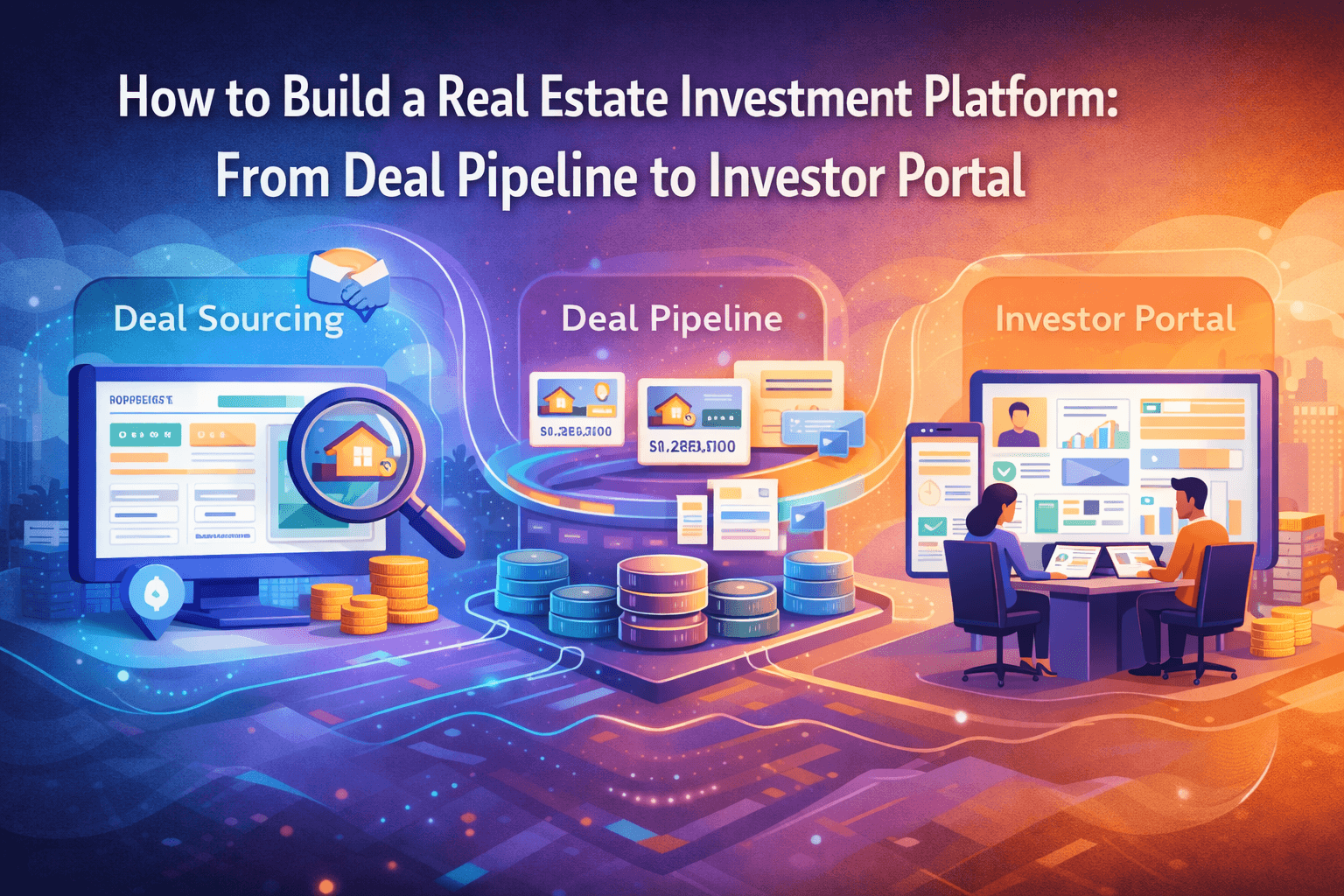
Here’s a scenario we see often. A real estate investment firm is growing - managing three or four active syndications, twenty or thirty LPs per deal, maybe $80–100M in assets under management. They’re still running on a combination of Excel models, Dropbox folders, DocuSign, and a shared inbox. The partners know they need a platform. What they’re not sure about is what “a platform” actually means for a firm at their stage, or what it would need to do on day one versus year two.
The answer isn’t a single system. Real estate investment platform development is really the work of connecting several distinct operational domains - deal pipeline, investor relations, capital management, compliance, and reporting - into something that feels like one coherent tool. Each domain has its own data model, its own users, and its own failure modes. Getting them right individually is necessary but not sufficient. The integration between them is where the real value lives.
This post walks through what each of those domains actually needs, where the architecture decisions matter, and what separates investment platforms that get used from ones that get abandoned three months after launch.
Deal Sourcing and Pipeline Management
Before capital moves, deals need to be found, evaluated, and prioritized. Most investment firms track this in spreadsheets for longer than they should - and the reason is that generic CRMs don’t understand deal flow, and deal-specific tools often don’t connect to the rest of the firm’s operations.
A deal pipeline for a real estate investment firm needs to capture things that don’t exist in standard CRM objects: property type, acquisition strategy (value-add, core-plus, development), underwriting assumptions, target return metrics, deal source (broker, on-market, off-market), and deal stage (initial review, LOI submitted, under PSA, due diligence, closed, passed). The status model is more complex than a sales pipeline because deals can move backward - a signed LOI can fall apart in due diligence, and that information needs to be tracked with context, not just reset.
The deal record is also a collaboration object. Multiple people on the investment team are contributing to the same deal simultaneously - an analyst is building the model, a partner is managing the broker relationship, and an asset manager is reviewing comparable operations. If the deal record doesn’t support concurrent editing, version history, and task assignment, the team will default back to email and shared drives, which defeats the purpose.
One pattern that works well here is separating the deal record from the underwriting model. The deal record in the platform tracks status, people, documents, and decisions. The underwriting model - the actual financial projection - typically lives in Excel or Argus, and that’s fine. The platform links to the model file and captures the key outputs (projected IRR, equity multiple, cash-on-cash) as structured data fields, so you can compare deals side by side without opening every spreadsheet.
Underwriting Workflows and Due Diligence Tracking
Once a deal reaches serious consideration, the due diligence process needs structure. This is where investment firms lose the most time to manual coordination - tracking what’s been received, what’s outstanding, what’s been reviewed, and who’s responsible for what.
Due diligence in real estate acquisitions involves multiple workstreams running in parallel: legal (title search, survey, zoning verification), financial (rent rolls, operating statements, tax records), physical (inspection reports, environmental assessments), and market (comparable sales, rent comps, market absorption). Each workstream has a checklist, a responsible party, and a deadline anchored to the PSA contingency period.
The software problem here is that due diligence is time-bounded and non-repeating. You need enough structure to ensure nothing gets missed, but the system can’t be so rigid that it creates overhead for a team that’s already moving fast against a hard deadline. What works is a template-driven checklist system - a library of due diligence templates by property type (multifamily, industrial, retail, etc.) that gets applied when a deal enters the due diligence stage and can be customized per deal without requiring developer involvement.
Each checklist item should have a status (outstanding, received, reviewed, approved, flagged), an owner, a deadline, and a document attachment. The platform should send automated reminders as deadlines approach and surface items that are overdue or flagged to the deal lead. This is not complex software. But it’s the kind of structured coordination that saves a deal team from discovering two days before the contingency deadline that the Phase I environmental report hasn’t been ordered yet.
Investor Verification: KYC, AML, and Accreditation
Before a single dollar of investor capital is accepted, the platform needs to confirm that the investor is who they say they are and that they qualify to invest. For private real estate syndications operating under Reg D exemptions, this means verifying accredited investor status. For funds with international investors, it may also mean running AML checks.
This is an area where investment firms consistently underestimate the compliance burden when they’re building their first platform. The assumption is usually “we’ll add this later” - and then they launch, start accepting investors, and realize that their manual verification process doesn’t scale and creates audit liability.
Accredited investor verification needs to be integrated into the onboarding flow, not bolted on afterward. When an investor creates their account and expresses interest in a deal, the platform should route them through a verification workflow: they select their accreditation basis (income, net worth, entity status, professional certification), upload supporting documentation, and receive a verification status that determines their access to deal materials and the ability to subscribe to capital calls. Third-party verification services like Parallel Markets or Verify Investor can be integrated via API to automate most of this process.
KYC and AML screening for international investors is a separate layer. It typically involves identity verification (government-issued ID, address verification), politically exposed person (PEP) screening, and sanctions list checking. These checks run against third-party databases and need to be logged with timestamps and results - because if an LP ever becomes the subject of a regulatory inquiry, you need to demonstrate that you ran appropriate diligence at the time of onboarding.
The output of this workflow should be a clean investor profile: verified status, entity structure (individual, LLC, trust, IRA), tax information (W-9 or W-8BEN), and banking details for distributions. That profile becomes the foundation for every capital event downstream.
Capital Calls and the Subscription Workflow
A capital call is the moment a syndication requests committed capital from its LPs. For investors, it’s one of the most important touchpoints in the entire relationship. For the firm, it’s a coordination exercise that involves sending notices, tracking responses, collecting funds, and reconciling what was promised versus what was received.
In the early stages of a firm, capital calls are managed over email - a notice goes out, investors wire funds to the escrow account, and someone manually updates a spreadsheet as confirmations come in. This works until it doesn’t. At twenty investors per deal and four active deals, the coordination overhead becomes significant. At fifty investors and ten deals, it becomes a dedicated job.
A well-built investment platform handles the capital call workflow end-to-end. The firm creates a capital call in the system - specifying the deal, the amount, the deadline, and the purpose - and the platform generates personalized notices for each LP showing their pro-rata share based on their ownership percentage. Notices go out via email with a link to the investor portal, where the LP can confirm their intent to fund and see their banking instructions.
The platform then tracks funding status in real time - which LPs have confirmed, which have funded, which are outstanding - and sends automated reminders as the deadline approaches. When funds arrive, the operations team marks the funding as received. The platform produces a reconciliation report showing total committed, total received, and any shortfalls, which the fund admin uses to finalize the capital call.
This process also needs to handle the edge cases: an LP who wants to fund over two payments, an LP who is being called on a deal where they co-invested through a different entity than their primary account, an LP who over-funded and needs a partial return. Building for the edge cases is what separates a production-ready capital call system from a demo.
Waterfall Calculations and Distribution Management
Distributions are the moment investors see their returns materialize. Getting the calculation right is not optional - a distribution error, even a small one, damages LP trust in a way that’s very hard to recover from.
The waterfall is the logic that determines how distributions flow between investors and the sponsor. A typical real estate syndication waterfall has several tiers: return of capital (investors get their original investment back first), preferred return (investors earn a defined rate - say, 8% - before the sponsor participates in profits), catch-up (the sponsor receives a share of profits until they’ve caught up to their carry percentage), and carried interest (remaining profits split, often 70/30 or 80/20 in favor of investors).
The complexity compounds when you have multiple investor classes, different preferred return rates across investor groups, a deal that’s been running for several years with partial distributions already paid, or a sale that triggers a full liquidation waterfall calculation across the entire deal history.
Waterfall engines need to be modeled carefully before they’re built. The calculation logic should be defined in a configuration file or database record - the specific tiers, rates, percentages, and sequencing for each deal - not hardcoded into the application. This means that when a new deal has a slightly different structure (a different catch-up percentage, or a second tier of preferred return), the configuration is updated rather than the code. We’ve seen investment platforms where the waterfall calculation was hardcoded and correct for the first deal, then quietly wrong for the second deal because the structure was slightly different and no one caught it until a distribution had already gone out. The investor relations consequences were significant. Building the calculation engine as a configurable, auditable system from the start is the right architecture, regardless of how many deals are currently active.
The Investor Portal: What LPs Actually Need to See
The investor portal is the front-end that LPs interact with. It’s where they track their investments, review documents, receive distributions, and get quarterly updates. It’s also the primary vehicle for the relationship between the firm and its investors - which means it needs to feel professional and clear, not like an internal admin tool with a login page added.
LPs need to see a small number of things, but they need to see them clearly. Their portfolio summary - how much they’ve invested, how much they’ve received in distributions, their current equity value - should be on the dashboard, not buried behind three clicks. Each deal they’re invested in should have its own record showing investment date, ownership percentage, capital contributed, distributions received, and the most recent performance update.
The document library matters more than most platforms give it credit for. LPs need to retrieve their K-1s at tax time, find their subscription agreements, and access quarterly reports. If those documents aren’t organized by deal and year and easily downloadable, you will receive a wave of support emails every January from LPs who can’t find their tax documents. That’s a solvable problem at the software level.
Reporting and communication belong in the portal, not just in email. When a deal update goes out, it should be logged in the portal as a record attached to the deal - so an LP who joins partway through the deal lifecycle can see the full history, and an LP who missed an email can find the update in the portal. This also creates an auditable record of all LP communications, which matters for SEC compliance under certain exemptions.
A note on design: investor portal design signals the firm’s professionalism. A portal that looks generic or hard to navigate sends the wrong message to LPs who are trusting you with significant capital. The UI doesn’t need to be flashy, but it needs to be clean, clear, and consistent with how a serious financial firm presents itself.
Compliance Reporting and Audit Trails
Investment firms operating under Reg D, Reg A, or other exemptions have reporting obligations that need to be supported at the platform level. This isn’t just about generating reports - it’s about ensuring the data integrity, access logging, and audit trail infrastructure that regulators expect to see.
Every significant action in the platform should be logged: investor onboarding and verification, capital call creation and distribution, document access, distribution approvals, and any manual overrides. These logs need to be immutable - an admin should not be able to delete a log entry, only add a correction record. This is a basic requirement for any platform that touches investor capital.
The reporting layer needs to support the specific formats that fund administrators, CPAs, and attorneys expect to work with. Distribution summaries, capital account statements, ownership schedules, and K-1 preparation support are the minimum. The platform doesn’t need to be a full accounting system - most firms use a separate platform like QuickBooks or Yardi for the general ledger - but it needs to export data in formats that integrate cleanly with those systems.
We go deeper on the reporting architecture in our guide to automating investor reporting and compliance, but the key design principle for the platform layer is this: build the data model assuming that every number will eventually need to be audited. That means timestamps on every financial event, approval workflows before any distribution goes out, and no calculation that can’t be re-run and explained.
Architecture: One Platform or Several Systems?
A common question in investment platform projects is whether to build one integrated platform or connect best-of-breed tools. The honest answer is that it depends on where you are as a firm.
For firms earlier in their growth, a hybrid approach often makes the most sense: a purpose-built deal pipeline and investor portal handling the front-end and investor-facing workflows, connected via API to a specialized fund administration tool (Juniper Square, Investor Management Services, or similar) that handles the accounting and compliance layer. This gets you most of the value without the complexity of building a full accounting system from scratch.
For larger firms with highly specific workflows, custom waterfall structures across deals, or proprietary models they want to protect, a more fully custom platform makes sense - particularly if the competitive advantage is tied to how they operate, not just what they invest in. The architecture decisions for scalable real estate platforms are worth working through carefully before scoping a project like this, because the data model you choose for deal and investor relationships will determine what’s possible when the firm grows from three active deals to thirty.
If you’re building a syndication platform or scaling an existing investment operation and you’re trying to figure out where software can actually compress the work - in deal evaluation, capital management, or investor reporting - we’ve helped firms at different stages design the right architecture for their specific model. Let’s talk through where your current process breaks and what’s worth building.
Related Reading
- Building a Real Estate Developer Portal: Project Tracking, Sales, and Investor Reporting
- From Spreadsheets to Systems: Designing a Real Estate Deal Pipeline That Actually Scales
- Automating Investor Reporting and Compliance in Real Estate Platforms
Building a real estate platform?
From MLS integrations to investor portals, we've shipped the systems real estate operators actually run on.
Platform architecture, data pipelines, and delivery.
Discuss your platformA technical conversation, not a sales pitch.