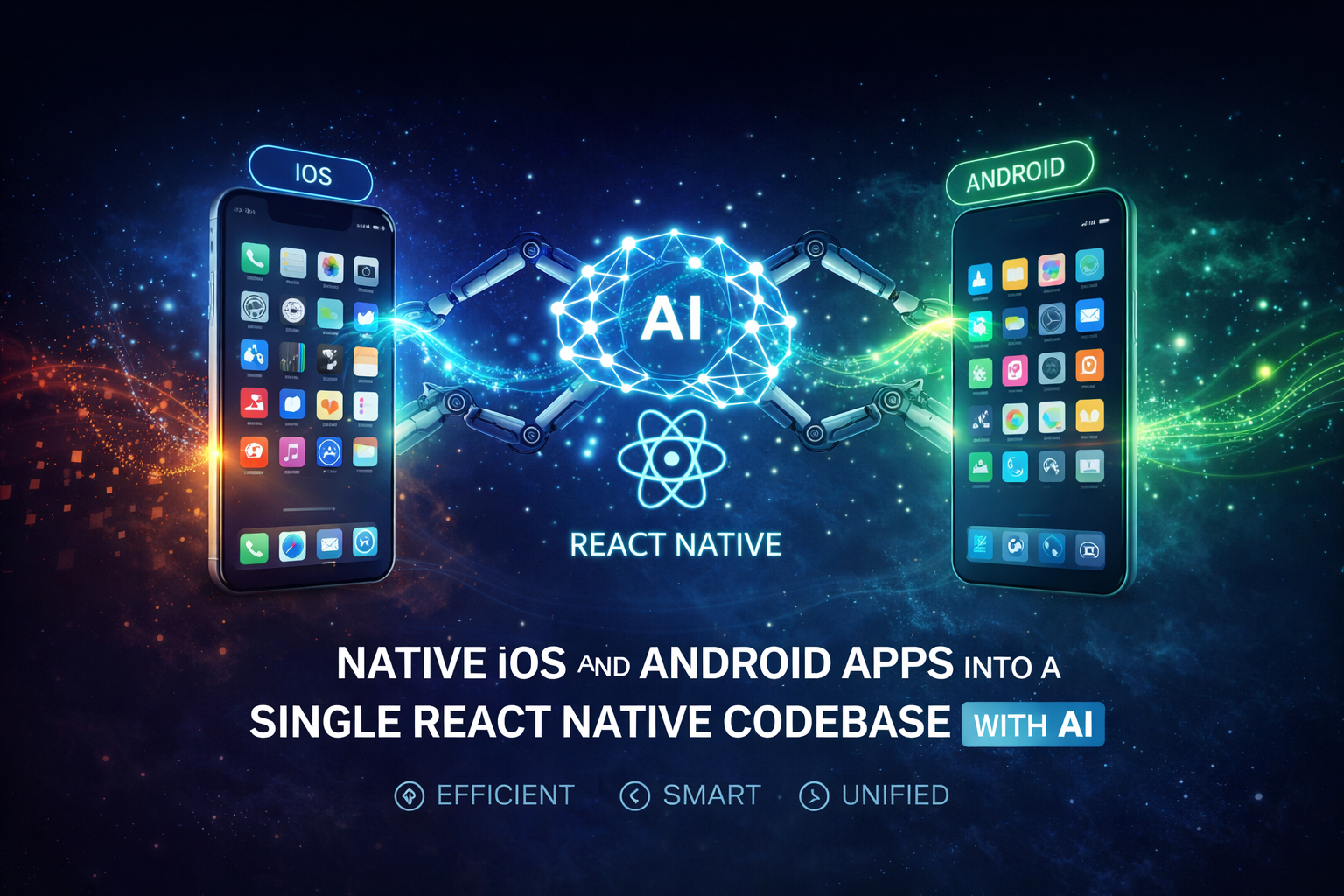
Consolidating Native iOS and Android Apps into a Single React Native Codebase with AI
The hidden cost of running two apps
Most organizations that built native mobile apps didn’t set out to maintain two separate codebases forever. It happened gradually. Someone built the iOS app first. Android followed later, usually by a different team or a different vendor, because that’s how the project was structured at the time.
Now you have two apps. Every bug fix needs to happen twice. Every feature needs to be designed, built, and tested twice. Every deployment is two separate processes. Every regression on one platform may or may not exist on the other, and you won’t know until users report it.
This is not a technical failure. It’s the natural outcome of building native apps before cross-platform tooling was mature enough to trust in production. The question now is how to get out of it without disrupting users or burning six months of engineering time.
Why this problem compounds over time
Separate native codebases don’t just cost twice as much to maintain. They diverge.
iOS and Android apps built and maintained by different teams, or maintained sequentially because there aren’t enough engineers to work on both simultaneously, end up with different behavior. Features get implemented slightly differently. Bug fixes on one platform introduce differences from the other. Session handling, error states, and edge cases accumulate inconsistencies that nobody planned and nobody fully mapped.
By the time an organization seriously considers consolidation, they’re not just merging two codebases. They’re reconciling two different versions of the product that have drifted apart.
This is where AI-assisted migration changes the calculus. It makes the divergence visible before you start writing code, and it makes the convergence faster once you do.
Planning to consolidate iOS and Android?
We help teams map both apps, surface divergence, and plan a safer React Native migration.
Useful before you commit to a rewrite.
Discuss your mobile migrationArchitecture and rollout guidance, not a generic pitch.
The case study: consolidating two native apps into one
This is a real project. The customer had separate native iOS and Android applications, both of which had been in production for several years. Both were functional. Both required ongoing maintenance. Neither had significant test coverage.
The iOS and Android apps had been maintained separately over time, which meant they had drifted in ways that weren’t always obvious. Some features behaved slightly differently between platforms. Some bugs existed on one platform and not the other. The teams managing them spent meaningful engineering time just keeping both versions aligned.
The goal was straightforward: consolidate into a single React Native codebase that could be maintained once, deployed to both platforms, and extended without the parallel overhead.
We used Cursor AI to support this migration. Here is what that process looked like in practice.
Step 1: Map both apps before touching either
The first mistake in any consolidation project is starting with one platform and treating it as the reference. This almost always means the second platform’s specific behavior gets underweighted, and differences surface late when they’re expensive to fix.
We started by mapping both apps independently. Using Cursor AI, we analyzed the iOS and Android codebases to produce parallel documentation of:
- Screen inventory: every screen in each app, what state it managed, and how it connected to other screens
- Feature comparison: where the apps had identical behavior, where they differed intentionally, and where they differed because of drift rather than design
- Data access patterns: how each app communicated with backend services, what it stored locally, and what format it expected
- Third-party library usage: what each app depended on, the current maintenance status of those libraries, and the React Native equivalent for each
This produced something the customer didn’t have before: a clear side-by-side picture of what both apps actually did and where they had diverged. Some differences were intentional, reflecting genuine platform-specific behavior. Others were accidental drift, bugs on one platform that had been fixed on the other, or features that had been updated in the iOS app and not yet ported to Android.
Knowing this before starting migration meant those decisions could be made explicitly rather than discovered mid-build.
Step 2: Define the single source of truth
Before writing React Native code, we needed to agree on what the merged product should do. This is a product decision, not a technical one, but it requires the technical map to make it well.
For each area of divergence, the options were: adopt the iOS behavior, adopt the Android behavior, or define a new standard behavior. In most cases the right answer was obvious once the difference was visible. In a few cases it required a conversation with the product team to decide.
Getting this alignment before development started avoided the most common failure mode in consolidation projects: building the React Native app to match one platform and then discovering the other platform’s users expected different behavior.
Step 3: Build once, deploy to both
With the analysis done and the target behavior defined, we built the React Native application using Cursor AI to accelerate the structural work.
The architectural decisions we made up front shaped how much code-sharing was actually possible:
Navigation was handled with React Navigation, which supports both iOS and Android with a consistent API and platform-appropriate animations by default.
State management was implemented with a clear separation between global application state and local component state, using patterns that are predictable for any React engineer rather than idiomatic to a specific platform.
Platform-specific behavior, where it genuinely existed, was handled with React Native’s built-in Platform.OS checks or with separate component files using the .ios.js and .android.js extension pattern. The goal was not to pretend platforms are identical, but to handle their differences explicitly and in one place rather than across two codebases.
API integration was built as a typed service layer shared across all screens. Both native apps had been calling the same backend, but with slightly different implementations in each codebase. Consolidating these into a single service layer removed a source of inconsistency.
For third-party libraries that the native apps had relied on, we evaluated React Native equivalents the same way as the Objective-C migration: functionality match, active maintenance status, and community support level. Libraries that hadn’t been updated in two or more years were replaced regardless of whether they technically still worked.
Step 4: Documentation as a deliverable, not an afterthought
Neither native app had documentation that matched what it actually did. This is standard for apps built and maintained under typical product pressures.
During the React Native migration, we generated documentation alongside the code rather than planning to document after the fact. This included component documentation, API integration references, state management patterns, and platform-specific handling notes.
The customer ended with something genuinely more valuable than two working apps: one working app with a documented codebase that any React Native engineer can understand without needing institutional context.
Step 5: Test coverage built in from day one
The native iOS and Android apps had no automated testing. Any change required manual verification on both platforms, which was slow and imprecise.
Using Cursor AI, we generated unit tests for business logic, validation rules, and state transitions throughout the migration. These were extended by the engineering team to cover edge cases identified during manual testing.
The React Native application shipped with test coverage neither native app had. Going forward, a bug fix validated by a test on one platform is a bug fix that doesn’t need to be manually re-verified on the other.
The divergence-visibility effect
One of the more significant outcomes was not something we had explicitly planned for.
The process of mapping both apps in parallel, and then building a unified model of what they should do, surfaced issues that had been invisible during routine maintenance. Several bugs that users had reported intermittently on one platform were traced back to differences in how the iOS and Android apps handled the same edge case. Others turned out to be bugs that existed on both platforms but had never been clearly isolated.
Fixing these during migration rather than after meant the React Native app launched with fewer known issues than either native app had accumulated.
The result
A single React Native codebase, running on both iOS and Android, with consistent behavior across platforms and a maintenance burden that no longer multiplies.
What the team gained:
Bug fixes happen once. A fix validated on one platform deploys to both. There is no longer a question of whether Android has been updated after the iOS fix, or vice versa.
Testing happens once. A test case covers both platforms. End-to-end testing no longer requires separate Android and iOS test runs for every regression cycle.
Feature development is no longer doubled. New features are built once, with explicit handling for any genuine platform differences, rather than being designed and built separately for each platform.
The codebase is documented. Engineers joining the team don’t need to reverse-engineer what the app does from the code.
The app has test coverage. Future changes have a baseline to validate against.
What the AI specifically contributed
In a consolidation project like this, Cursor AI contributed most in the phases that are typically the slowest: analysis and structural code generation.
The parallel mapping of both native codebases, the feature comparison, and the library audit were done significantly faster with AI assistance than they would have been manually. What might have taken two to three weeks of careful reading and documentation took days.
The structural React Native code, navigation setup, typed service layer, component scaffolding, test generation, was generated with AI assistance and then reviewed and hardened by engineers. This is where the calendar time difference is most visible. Building this scaffolding from scratch takes time that follows a predictable pattern. AI compresses it.
What it did not compress: the product decisions about how to handle behavioral divergence, the validation that generated code actually matched the original behavior, and the edge cases that only surface through manual testing and user feedback. Those required engineering judgment throughout.
The things that actually slow consolidations down
Based on this project and similar ones, here are the real friction points in a native iOS and Android consolidation:
Behavioral divergence is harder to resolve than technical divergence. Two codebases written in different languages using different frameworks is a technical problem. Two products that have drifted apart in how they handle specific workflows is a product problem that requires human decisions before engineering can proceed.
The shared database or API is rarely as clean as assumed. Both native apps called the same backend, but often with slightly different request formats, different error handling expectations, or different assumptions about response structure. The API layer needs an honest audit before building the React Native service layer.
Third-party library parity matters. If the iOS app used a library with specific behavior and the Android app used a different one with subtly different behavior, the React Native replacement needs to be evaluated against both sets of expectations, not just one.
Users on each platform have expectations. Navigation gestures, back button behavior, notification handling, and keyboard interaction have platform defaults that users have internalized. React Native handles most of these correctly by default, but you need to test on real devices for both platforms, not just simulators.
Do not skip the parallel map. The temptation is to treat one platform as the reference and port to React Native from that. This consistently surfaces the other platform’s differences too late. Invest the time to map both before starting.
Trying to reduce parallel app maintenance?
If two mobile codebases are slowing releases, we can help you evaluate the cleanest path to one React Native app.
Scope, risk, and rollout planning.
Plan the migrationHelpful before you commit budget and timeline.
Why this is the right moment
The React Native ecosystem in 2025 and 2026 is meaningfully better than it was three or four years ago. The New Architecture, stable from React Native 0.76, eliminated the performance limitations that used to be the primary argument against React Native for production apps. Major community libraries, React Navigation, Reanimated, Gesture Handler, are fully compatible and actively maintained. The tooling, including Expo’s managed workflow, has reduced the friction of getting a production-quality build configuration.
The window where “native only” was the defensible answer for most mid-sized apps has closed. For apps that need to run on both platforms, don’t require intense graphics or low-level hardware access, and need to be maintained by a team of realistic size, React Native is the correct default in 2025.
The question is not whether to consolidate. It’s when and how.
AI makes the “how” significantly more tractable. It doesn’t make the decisions that require human judgment. It compresses the phases that have always been the bottleneck: understanding what you have, mapping what it should become, and generating the structural code that connects those two states.
If you’re running separate native iOS and Android apps with a growing maintenance burden and no clear path to resolving it, the consolidation is not as far out of reach as it probably looks.