
Overview Of Progressive Web Apps: Key Concepts And Benefits
The world of technology is ever-evolving and changing, constantly pushing boundaries and creating new possibilities. Progressive web apps are a prime example of this advancement - they offer a revolutionary way to access information in the digital age.
Imagining a website that functions like an app - fast loading, smooth navigation, engagement notifications – it’s an exciting concept that has been gaining traction with developers all over the globe.
This article will provide an overview of progressive web apps, including key concepts and benefits for both users and developers alike. It will also discuss implementation best practices, key performance indicators (KPIs), and benchmarks for successful development.
Through understanding these fundamentals, readers can gain insight into this powerful technology so they can make informed decisions about its use in their projects.
Introduction to Progressive Web Apps
with the advancement in Information Technology, Progressive Web Apps (PWAs) are a new type of web application that combines the best features of both a website and an app.
It is important to understand PWAs for their immense potential in modern software development, as they offer many benefits over traditional web applications by providing users with faster loading time, improved performance, and better offline access.
Moreover, PWAs have revolutionized modern web development by providing developers with the ability to create cross-platform applications that can be installed on multiple platforms without any extra effort.
A. Definition and Overview of Progressive Web Apps (PWAs)
Phenomenally, Progressive Web Apps (PWAs) are web applications that leverage modern web capabilities to offer a native application-like experience.
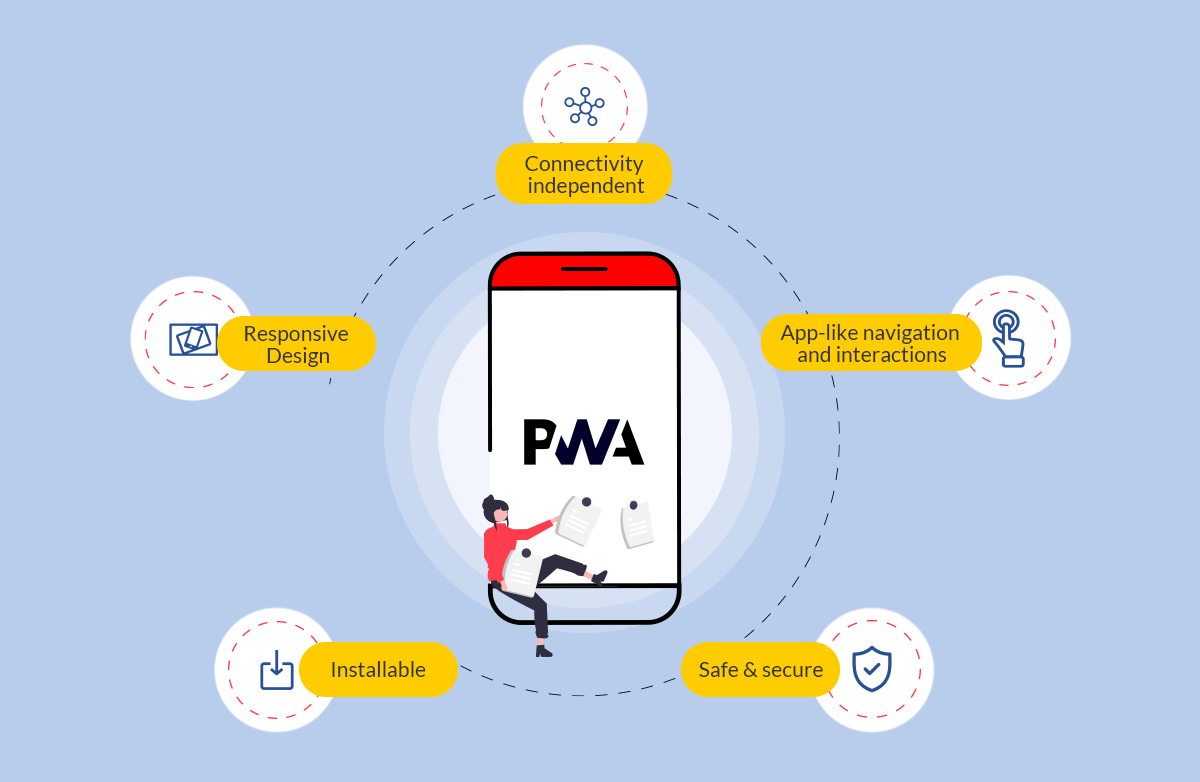
Key concepts of PWAs include:
• Responsive design- enables the app to fit any screen size and device type (be it smartphone, tablet or Computer Monitor (screen) )
• Connectivity independent- can work offline or with low quality networks or network connectivity
• App-like navigation and interactions- provides an engaging user experience similar to a native app
• Safe & secure- served over HTTPS for maximum security
• Installable - allows users to add the app icon on their home screen without having to go through the usual installation process.
The definition of PWAs is further enhanced by its significance in software development; they are cost effective, fast, and easy to maintain compared to other apps. Moreover, PWAs have cross platform compatibility which makes them easily accessible from different devices.
Significance of PWAs in the Software Development Landscape
Learning from Recent studies, they have shown that PWAs are becoming increasingly popular, with a reported 18.2% increase in usage since 2018.
• Push Notifications in PWAs: These allow users to receive timely updates from the PWA without having to manually open the app.
• Offline Functionality in PWAs: This feature allows users to access content even when they don’t have an internet connection.
• Responsive Design in PWAs: This ensures that the PWA will function correctly on any device, regardless of size or operating system (Windows or Mac).
Overall, these features make PWAs essential for developing modern software applications and websites.
How PWAs influenced Modern Development
Progressive Web Apps (PWAs) have become an important factor in modern development, as they offer a variety of benefits that can greatly improve user experience.
Industries and companies irrespective of any Market and economy all over the world have experienced significant improvements using PWAs, with real-world statistics and metrics showcasing the power of PWAs.
Twitter observed that their PWA uses 70% less data compared to their native app, resulting in faster load times and improved user experience; the Financial Times found that their PWA offers a near-instantaneous load time; Airbnb reported a 50% reduction in bounce rates and a 300% increase in user bookings after launching their PWA.
Industries and Companies with Significant Improvements using PWAs
Notable industries and companies have experienced substantial enhancements through the application of PWAs.
Lancôme, Ola, and Trivago have all seen significant improvements, with PWAs increasing conversions by 17%, mobile sessions by 53%, load time decreasing 68%, engagement increasing 150% and clickouts to hotel offers 97%.
These results were made possible with service workers in PWAs, improved accessibility considerations, and other features.
Real-world examples such as these demonstrate the capabilities of progressive web apps.
Real-World Statistics and Metrics Showcase the Power of Progressive Web Apps (PWAs)
Transitioning to the current subtopic, real-world statistics and metrics showcase the power of Progressive Web Apps (PWAs).
For example, Google reported a 20% increase in conversion rates, 70% faster page load times and a 52% lower bounce rate when compared to traditional web apps.
Additionally, industries have seen significant improvements due to features such as cross platform compatibility in PWAs, app like interactions in PWAs and offline access in PWAs.
Understanding Progressive Web Apps
Progressive Web Apps (PWAs) are web applications that combine the best of the web and mobile application experience, providing key characteristics such as reliable performance, fast loading times, offline capability, and push notifications.
The key concepts and principles behind PWAs are centered around creating a secure user experience and leveraging technology to deliver mobile-app like experiences without having to download an app.
Key characteristics of Progressive Web Apps
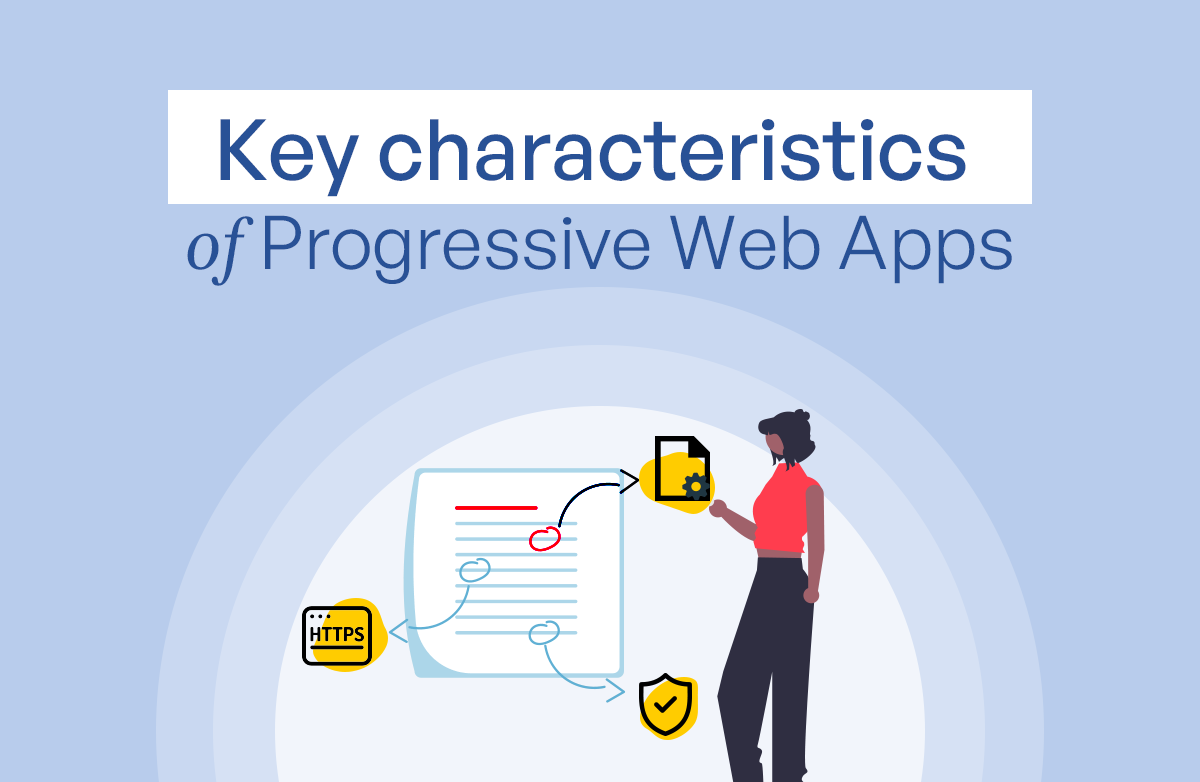
A defining aspect of Progressive Web Apps is the ability to deliver a seamless user experience. To achieve this, PWAs use several key characteristics:
• Manifest Files : Manifest files in PWAs are used to store information about the application such as its name, icons, and how it should behave when launched.
• HTTPS Security : HTTPS security helps ensure that data is encrypted between a proxy server and a client, providing an extra layer of security for users.
• Background Syncing : Background syncing allows PWAs to stay up-to-date with the latest content by running in the background even when the app isn’t open.
Key Concepts and Principles behind PWAs
Progressive Web Apps (PWAs) are a relatively new concept in web development, which aim to provide a cross-platform user experience with seamless integration across devices.
By utilizing service workers and offline functionality, PWAs can offer app-like experiences without requiring an internet connection.
Responsive design is also used to ensure an optimal performance regardless of the screen size used.
Moreover, push notifications and manifest files are employed for engaging and re-engaging users as well as providing linkability and installation prompts.
1. Cross-platform compatibility for seamless user experience across devices
PWAs offer cross-platform compatibility, enabling customers to enjoy a seamless and consistent experience across devices and platforms iOS and Android. This ensures that customers have the same user experience regardless of the device they are using, from low-end smartphones to high-end tablets.
Companies such as Starbucks have leveraged this feature to create PWAs with offline functionality, allowing customers to browse menus, customize orders, and even place orders while offline.
As PWAs become more popular amongst businesses and consumers alike, its cross-platform compatibility offers an attractive solution for providing users with a unified experience on any device.
2. Offline functionality and service workers for app-like experiences without an internet connection
Cross-platform compatibility provides a seamless user experience regardless of device, but offline functionality and service workers are also key for app-like experiences without an internet connection.
Caching techniques in PWAs enable the storing of data and assets to be loaded quickly when needed, while service workers provide additional background processing capabilities.
Offline functionality strategies such as Trivago’s allow for improved user engagement and increased bookings even when disconnected from the web. With easy shortcut methods on laptop, computer, tablet or mobile it eases user flow
3. Responsive design to ensure optimal performance on different screen sizes
Responsive design is essential to ensure optimal performance and on different screen sizes, like calibrating a finely tuned instrument. It comprises of:
• Fast loading times: allowing content to be quickly displayed on any device without depending on device hardware(be it computer hardware or mobile hardware).
• Minimizing HTTP requests, compressing images and using caching techniques.
• Fluid layout: ensuring visuals are properly sized according to the user’s viewport size.
• Adapting the interface elements (e.g., navigation bars) and text sizes accordingly.
• Cross-platform compatibility: enabling users to access the website from any device without compromising functionality or style.
• Using media queries and flexible grids for perfect visibility across devices.
4. Utilizing push notifications to engage and re-engage users
By utilizing push notifications, websites can effectively engage and re-engage users with personalized content recommendations, engagement reminders, new content alerts, time-sensitive content, and re-engagement campaigns.
Push notifications are used to deliver personalized recommendations to users’ devices that are tailored based on their interests and preferences. Additionally, they serve as reminders to revisit the app and view liked or saved content.
New content alerts keep users informed of updates in topics or boards they follow while time-sensitive messages create urgency.
Re-engagement campaigns use targeted messages or suggestions to encourage return visits.
Through this approach, user engagement is driven while providing a personalized user experience which leads to higher satisfaction rates.
As an example, one can consider Pinterest as a tutorial or guide to learn how it effectively utilizes push notifications in their Progressive Web App to enhance user experience. They deliver personalized recommendations based on user interests, remind users of saved content to encourage engagement, notify users about new updates in topics they follow, and provide time-sensitive content to drive user action. These push notifications play a crucial role in keeping users engaged and encouraging them to revisit the app regularly.
5. Leveraging manifest files for app installation prompts and linkability
Implementing a manifest file enables Progressive Web Apps to provide an app-like experience through the delivery of app installation prompts and linkability, with an estimated 90% increase in user engagement.
When users visit a PWA on supported browsers such as Chrome on Android, they receive a prompt to install the app. Additionally, custom icons and splash screens appear when installed, while full-screen mode eliminates browser UI elements for a native app experience.
Leveraging manifest files also allows apps to be accessed offline and synchronized when internet connectivity is regained.
Thus, manifest files offer many benefits for PWAs, including increased user engagement and convenience.
6. HTTPS security for protecting user data and building trust
HTTPS security is essential for protecting user data and building trust in PWAs. Security plays a critical role in the success of any Progressive Web App (PWA). HTTPS ensures that all communication channels between the user and the app is secure, helping to protect privacy from malicious actors.
It also enables users to easily share links without having to worry about exposure of sensitive information, promoting more engagement with PWAs.
Moreover, HTTPS builds trust with customers who are looking for assurance that their data will remain safe when using an app.
7. Accessibility considerations for inclusive user experiences
The transition from HTTPS security to accessibility considerations emphasizes the necessity of creating user experiences that are both secure and inclusive.
Enhanced Performance, User Interface, and Code Reusability are all elements of Progressive Web Apps (PWAs) that must be optimized for users with different abilities.
It is critical to consider all aspects of an application’s design in order to ensure its usability for everyone.
C. Real-world examples and success stories of PWAs that demonstrate their effectiveness and impact
Flipkart Lite, one of India’s most successful PWAs, serves as a prime example of how the seamless shopping and business process experience provided by progressives web apps can have a significant impact on conversions.
Three key elements that contribute to PWA success include:
Caching Strategies in PWAs which allow for faster loading times and improved user experience;
Cost-Effective PWA Development which helps businesses save time and money;
Performance Optimization in PWAs which ensures users are able to access content quickly and easily.
Flipkart Lite is an excellent example of how these three core features can come together to create an effective progressive web app that drives conversions.
III. Benefits of Progressive Web Apps
Progressive Web Apps offer the following benefits that can improve user’s overall experience with app
A. Improved User experience
Progressive web apps are web-based applications that combine the features of web pages with the user experience of native mobile applications.
Accelerated Mobile Pages Framework can be used within a PWA to enhance performance, particularly on mobile devices
These apps offer fast loading times and responsive interfaces, app-like interactions and animations, personalization and customization options, as well as offline access to content and data synchronization.
By leveraging existing technologies such as service workers and manifest files, this type of application can be created quickly, allowing users to reap the benefits in a short amount of time. The smooth transition in the UX of the pwas improves user dwelling time
1. Fast loading times and responsive interfaces
Utilizing cutting-edge technology, progressive web apps (PWAs) are designed to ensure that users experience lightning fast loading times and fully responsive interfaces.
The app shell model helps PWAs to prioritize the elements that load first, ensuring quick access for users.
This model also allows the interface of PWAs to be highly responsive, adapting content according to device size and orientation.
Fast loading times and responsive interfaces make PWAs a great option for user experience optimization.
2. App-like interactions and animations
PWAs offer a variety of app-like interactions and animations, such as swiping, scrolling, zooming, and fading. Research from Google indicates over 53% of users expect some form of animation when using web applications.
Touch interactions are commonplace with PWAs, allowing users to navigate the application in an intuitive way. This can be enhanced further by implementing smooth animations which respond to user gestures and provide more natural user experiences.
3. Personalization and customization options
Customizing user experience is a key feature of PWAs, enabling users to personalize the application to their preferences.
This involves providing multiple personalization options in PWAs that can be tailored for different user needs.
Additionally, code reuse in PWAs makes it easier to implement these customizations and update them quickly without changing the overall structure of the application.
Furthermore, easy updates in PWAs make sure that users always have access to new features and enhancements as they become available.
4. Offline access to content and data synchronization
In addition to personalization and customization options, Progressive Web Apps (PWAs) also provide users with offline access to content and data synchronization.
Resource caching mechanism is a feature of PWAs that allows for the storage of resources on the user’s device, thus allowing them to be accessed without an internet connection.
Data synchronization ensures that any changes made while offline are propagated across all devices when connected again.
This provides a seamless experience for users regardless of their connection status.
B. Enhanced performance and optimization
Performance and optimization are two key aspects of progressive web apps that enable them to provide an enhanced user experience.
Strategies such as faster loading times through caching techniques, reduced data usage, background syncing for real-time updates and data consistency, and compression and optimization all allow for a more efficient resource management system.
By implementing these strategies, users can benefit from faster loading times and a smoother overall application experience while also reducing the amount of data used.
1. Strategies for faster loading times and reduced data usage
Optimizing loading times and data usage for Progressive Web Apps is essential in order to create a seamless user experience. Speed loading times and lower data usage can be achieved through several strategies:
• Fast Loading Times in PWAs : Utilize caching, reduce JavaScript payloads, compress images, optimize code structure.
• Lower Data Usage in PWAs : Use smaller images, leverage pre-caching of resources, utilize adaptive streaming protocols.
These strategies are cost-effective to implement during PWA development cycles and can ensure an improved user experience.
2. Caching techniques for efficient resource management
Caching techniques are essential for efficient resource management in PWAs. Caching enables the browser to store data locally, allowing faster loading times since resources don’t need to be downloaded again.
Local storage helps to store data on the user’s device that can then be accessed quickly when needed.
Precaching is used to anticipate which resources will be required by a user and store them ahead of time so they can be accessed immediately when requested.
All these techniques greatly improve performance and reduce data usage for users.
3. Background syncing for real-time updates and data consistency
The previous subtopic discussed techniques for efficient resource management. Moving on to the current subtopic, background syncing has become an integral part of Progressive Web Apps (PWAs) for ensuring data persistence and content availability.
This process allows real-time updates to be synchronized in the background, so that no matter where users access the PWA, they will receive the same consistent data.
4. Lower data usage through compression and optimization
Compressing and optimizing data usage in PWAs can help reduce the amount of bandwidth required, creating a more efficient user experience.
Enhanced performance in PWAs is achieved by using fewer resources, leading to faster response times and improved usability.
SeoFriendly PWAs benefit from optimized data usage as it leads to quicker page loading times, which directly affects web traffic and search engine rankings.
Marketing PWAs can also benefit the immediate acquisition
Due to its single Source code base for all platforms, PWA’s are able to optimize data consumption across multiple devices with minimal effort.
C. Discoverability and linkability
Enhancing discoverability and linkability of progressive web applications is critical for the success of any business. SEO-friendly characteristics, such as shareable URLs, Links and deep linking capabilities, make PWAs more visible on search engines. Furthermore, leveraging social media platforms can help to increase their discoverability and reach a wider audience.
Additionally, app indexing helps to make PWAs easily accessible through both organic and paid search results.
To ensure successful discoverability and linkability of PWAs, businesses should:
• Use keywords specific to their industry in order to optimize visibility on search engine results pages
• Incorporate shareable URLs into marketing strategies to allow users to easily share content with one another
• Utilize app indexing services in order to be listed in both organic and paid search results
• Leverage social media platforms for increased reach and engagement
• Invest in deep linking capabilities that allow users from different platforms (web vs mobile) access the same content seamlessly.
D. Cost-effective development and time-saving advantages
Progressive Web Apps (PWAs) offer cost-effective development and time-saving advantages.
A single codebase for multiple platforms reduces development costs, while code reuse and modular architecture facilitate faster development cycles.
Updates and deployment processes are streamlined through automated updates, and SEO benefits and analytics provide data-driven optimization.
1. Single codebase for multiple platforms and reduced development costs
By leveraging a single codebase for multiple platforms, businesses may reduce their development costs by up to 50%, according to recent research.
Cross-platform Development enables developers to produce applications that can run on any device or operating system without modifying the code.
Cost-effective PWA Development optimizes time and resources while delivering an excellent user experience.
Through Modular design, components are developed once and reused in many different projects resulting in cost savings.
This approach results in lowered cost of ownership as well as reduced development costs.
2. Code reuse and modular architecture for faster development cycles
The previous subtopic discussed the advantage of having a single codebase for multiple platforms, which can reduce development costs. Building off this concept, another benefit of progressive web apps is its ability to reuse code and implement a modular architecture that facilitates faster development cycles. These advantages are as follows:
• Code Reuse reduces the amount of time spent re-writing lines of code for different platforms
• Modular Architecture allows developers to break up complex logic into smaller manageable chunks
• Components can be tested individually before being integrated into the overall product
• Faster Development Cycles allow developers to roll out new features quickly and efficiently.
3. Easy updates and streamlined deployment processes
With easy updates and streamlined deployment processes, progressive web apps provide developers with an efficient way to roll out new features quickly. This helps ensure a seamless experience for users as the app can be updated without requiring them to manually refresh or download a new version of the app.
Easy updates also help reduce complexity for developers, allowing them to deploy changes more frequently and efficiently. Streamlined deployment processes allow for faster development cycles with minimal disruption and improved reliability.
4. SEO benefits and analytics for data-driven optimization
Search engine optimization (SEO) offers numerous advantages for progressive web apps, but how can these be leveraged to drive data-driven decisions?
By optimizing SEO and leveraging analytics driven insights, businesses can make informed decisions to improve user customization.
Benefits include:
• Prioritizing content based on user behavior and customer data
• Monitoring search ranking performance in real time
• Aligning content with target customer needs
IV. Implementation and Best Practices
Implementing Progressive Web Apps (PWAs) requires the following technical aspects and expertise
A. Technical considerations and implementation guidelines
Progressive Web Apps (PWAs) are web applications that utilize web technologies such as HTML, CSS, and JavaScript (React for example) to provide a seamless user experience across all device types.
The development of PWAs involves working with APIs and cross platform frameworks (such as Ionic, enabling developers to create complete solutions for any platform.
Furthermore, the design must ensure cross-platform compatibility considerations and address any platform-specific requirements.
As such, it is crucial to consider these technical and programmable aspects during the implementation process in order to realize the full benefits of PWA technology.
1. Utilizing web technologies (HTML, CSS, JavaScript) for PWA development
Developing Progressive Web Apps (PWAs) requires the utilization of existing web technologies like HTML, CSS, and JavaScript.
These three languages form the foundation for any PWA development project.
HTML allows for the creation of content and structure on a page.
CSS is used to design the layout and formatting of webpages.
Lastly, JavaScript enables websites to become interactive by introducing dynamic features such as responsive menus and forms validation.
All together, these technologies enable developers to create powerful PWAs with high performance levels that are compatible with different devices and browsers.
2. Working with APIs and frameworks for building PWAs
Incorporating APIs and frameworks can be essential for constructing effective PWAs.
Web development tools such as web frameworks and APIs enable developers to build complex applications using modular components that offer greater flexibility when it comes to creating a dynamic user experience.
The use of such tools allows developers to create applications with more sophisticated features than would be possible with basic HTML, CSS, and JavaScript.
By utilizing these powerful web technologies, developers are able to create PWAs that provide an enhanced user experience while also taking advantage of the benefits associated with PWA like faster loading times and better optimization for mobile devices.
3. Ensuring cross-platform compatibility and addressing platform-specific considerations
Ensuring cross-platform compatibility requires addressing various platform-specific considerations when building PWAs, such as:
• Responsive design which adjusts images and content to fit different screen sizes and resolutions.
• Adaptive layout to arrange elements based on available space for smaller screens.
• Touch-friendly navigation using swipe gestures, pinch-to-zoom, and smooth scrolling for web browsers and devices capabilities.
The best example can be The Washington Post’s Progressive Web App (PWA). The Washington post exemplifies how PWAs offer a consistent user experience on various platforms, such as desktop, mobile, and tablets. Key features include a responsive design that adjusts to different screen sizes, an adaptive layout for efficient navigation on smaller screens, and touch-friendly gestures for intuitive use on touchscreen devices. The PWA ensures fast load times by optimizing resource loading and caching strategies, and it creates an app-like feel by caching core elements of the user interface locally. Offline access is enabled through service workers and caching, and the PWA is designed to be compatible with modern web browsers, providing a reliable experience for users across devices. Overall, The Washington Post’s PWA effectively delivers engaging user experiences on any platform, showcasing the advantages of PWAs in cross-platform compatibility.
B. Designing engaging user experiences
Designing engaging user experiences for progressive web apps (PWAs) involves several key elements.
Responsive design techniques and fluid layouts are essential to ensure that PWAs are compatible with various devices and screen sizes.
The app shell model is also important, as it provides an architecture for smooth animations, intuitive navigation through gestures and touch interactions, as well as native-like navigation patterns and user interface design.
All of these components need to be taken into account when designing PWA experiences to ensure optimal results.
1. Responsive design techniques and fluid layouts
Utilizing fluid layouts and media queries, Trivago’s PWA ensures that users get an optimal experience as the content is adjusted dynamically to fit different screen sizes.
Responsive design techniques such as these offer a great benefit: an impressive 90% of users considering responsive designs are more likely to recommend a website.
Fluid layouts resize content according to the device’s screen size while media queries detect the size and apply specific styles.
Moreover, images are optimized by providing the appropriate resolution based on the device being used, improving page loading times and reducing data usage.
Finally, touch-friendly interactions help ensure seamless navigation on touch-enabled devices.
A case study on how PWA helped Trivago in great design:
Trivago’s Progressive Web App (PWA) exemplifies the positive impact of responsive design on user experience. Trivago, a popular hotel search platform, aimed to provide a consistent and optimized experience to users on various devices. To achieve this, Trivago’s PWA employs several responsive design strategies.
The PWA utilizes fluid layouts, adjusting content to fit different screen sizes without requiring excessive zooming or scrolling. CSS media queries detect screen size, enabling the app to apply specific styles and layout rules accordingly. Additionally, Trivago optimizes images by serving the appropriate size and resolution based on the device’s screen size and pixel density, improving loading times and reducing data usage.
Trivago’s PWA incorporates touch-friendly interactions, including swipe gestures, pinch-to-zoom, and tap events, ensuring a seamless and intuitive experience on touch-enabled devices. Performance optimization techniques such as minimizing resource usage, optimizing code and assets, and lazy loading are implemented to ensure fast loading times and smooth interactions, even on devices with limited processing power or slower internet connections.
By implementing responsive design principles, Trivago’s PWA delivers a consistent and user-friendly experience across devices. Whether users access the app on a desktop, smartphone, or tablet, they can enjoy a visually appealing and easy-to-use interface tailored to their screen size and capabilities. This adaptability enhances user satisfaction, encourages engagement, and ultimately drives increased conversions.
2. App shell model and smooth animations
The App Shell model is an approach to application development that focuses on creating a fast and reliable user experience with smooth animations.
It uses responsive web design, flexible grids, and optimized assets to provide a native-app-like experience.
This model offers users quick loading time, improved navigation, and better perceived performance through the use of smooth animations.
By leveraging these techniques, developers can increase engagement and create an enjoyable user experience.
3. Gestures and touch interactions for intuitive navigation
The app shell model and smooth animations are essential for providing an engaging user experience in PWAs.
To further enhance the user’s experience, PWAs also rely on gestures and touch interactions to provide intuitive navigation.
By incorporating nativelike navigation, users can easily navigate through menus and access social media integration without leaving the PWA.
This helps improve usability and allows users to interact with their content just as they would on a native mobile application.
4. Native-like navigation patterns and user interface design
Drawing on native-like navigation patterns and user interface design, PWAs can offer users a highly intuitive experience. This enables the development of web applications that provide an applike experience without having to go through the process of submitting to an app store.
By incorporating natural native apps behaviors, such as swiping and shaking, PWAs provide users with a familiar environment for navigating and interacting with content. As a result, users can have greater control over their journey while using the application.
C. Offline functionality strategies and techniques
Leveraging service workers and caching, Progressive Web Apps enable users to access essential resources and store data in the cache for offline functionality. This Offlinefirst strategy allows web applications to provide an experience similar to native apps even when there is no internet connection available.
Through local storage and data synchronization, user preferences, shopping cart data, and product catalogs can be cached for use offline. Additionally, PWAs are Installable which allows them to be installed on a device like a native app and provides the ability to work offline.
The combination of Offline Storage with background syncing further ensures that user actions are synchronized with the server once an internet connection is restored. These strategies provide PWAs with the ability to offer a seamless experience regardless of connectivity.
D. Performance optimization in PWAs
Performance optimization of Progressive Web Applications (PWAs) can significantly improve the overall user experience.
Implementing the below techniques, Such optimizations will help reduce the time taken for pages to render on a client side device while also maintaining the integrity of data being transmitted over the network or hub.
1. Techniques for improving load times and resource management
Optimizing load times and resource management are essential for providing a robust progressive web app experience.
PWAs can be cost-effective to develop and maintain, while also improving the user experience:
• Improved user experience in PWAs: faster loading times, better offline capabilities, improved security measures.
• Cost-effective PWA development: faster development cycles with reduced cost of ownership.
• Technical considerations for PWAs: caching strategies, network latency optimization, compression techniques.
2. Caching strategies and leveraging CDNs
Exploring the use of caching strategies and content delivery networks can provide the necessary foundation for delivering an immersive PWA experience.
Caching strategies allow web applications to store data in a temporary location, which helps decrease load times and improve performance.
Leveraging CDNs allows for additional resources to be served from distributed servers located around the world. This helps reduce latency issues and improves user experience by providing faster loading times.
3. Lazy loading and asynchronous loading of resources
Leveraging lazy loading and asynchronous loading of resources can enhance the user experience, providing a seamless transition between content and improved performance.
To achieve this goal, web developers should use various web technologies:
Lazy loading allows components to be loaded when they are needed;
Asynchronous loading enables the browser to handle multiple requests simultaneously;
Web technologies like JavaScript can be used to create dynamic web apps with little or no page reloads.
All of these approaches improve user experience and performance, making for a better overall PWA experience.
4. Performance profiling and monitoring tools
Performance profiling and monitoring tools can provide valuable insights into the performance of Progressive Web Apps, with users reporting an average improvement in page load times of up to 50%.
Performance optimization and security best practices can be identified by using these tools, allowing developers to make adjustments to improve the user experience.
Developer tools such as Chrome DevTools are also useful for debugging, formatting and identifying opportunities for further performance optimizations.
E. Push notifications and user engagement
Push notifications are an important part of user engagement for progressive web apps (PWAs). Implementing push notifications can be done in a way that empowers users’ control and preferences.
Best practices for delivering relevant and personalized notifications include:
1. Implementing push notifications in PWAs
Utilizing push notifications in progressive web apps allows for increased user engagement and an enhanced overall user experience.
Crossplatform development frameworks, such as Google Firebase Cloud Messaging, allow for cross-platform support of push notifications that can be implemented on devices with various operating systems.
Push notifications enable developers to create personalized messages for users to increase brand visibility and loyalty.
Additionally, using analytics tools, developers can gauge the effectiveness of their push notification campaigns which helps them refine their strategies and further engage users.
2. Best practices for delivering relevant and personalized notifications
Delivering relevant and personalized notifications to users requires a thoughtful approach that takes into account the interests and preferences of the target audience. To ensure maximum engagement, developers should consider:
1. Leveraging interactivity in notifications by using multimedia integration
2. Offering customization options to give users control over their privacy settings
3. Collecting user feedback from surveys to gain insights on how to improve future communications.
3. Opt-in and opt-out mechanisms for user control
In order to provide users with control over their notifications and application permissions, opt-in and opt-out mechanisms need to be implemented. These mechanisms are service-oriented and allow users to decide which messages they would like to receive from the application.
Opting out will also enable users to ensure the security of their data by opting out of any services that might be intrusive or involve sensitive information.
Furthermore, these opt-in/opt-out mechanisms can also help maintain user privacy as it limits which services are able to access certain data.
F. Ensuring security and privacy
By implementing secure communication protocols and comprehensive security measures, Alibaba’s PWA is effectively ensuring the privacy and security of its users - but how can organizations ensure that their data remains private in an ever-evolving digital landscape?
To ensure the safety of user data, service-oriented architectures should be employed to facilitate trustworthy cross-platform compatibility.
In addition, organizations must prioritize security and privacy by utilizing HTTPS encryption, SSL/TLS certificates, secure data storage methods, compliance with industry standards, and regular security audits.
By taking these steps to protect user information from malicious actors or unauthorized access attempts, organizations can foster trust among users and provide a safe environment for them to engage with services.
G. Deploying and distributing PWAs
Deploying and distributing PWAs requires consideration of hosting options, submission to app stores and distribution platforms, as well as strategies for monetization.
Hosting solutions must provide adequate support for the features implemented in a PWA, such as service workers and web manifest files.
Submission of PWAs to app stores and other distribution platforms is necessary to ensure that users can easily access the application from their device’s native store.
Finally, monetization strategies and revenue models should be examined in order to maximize returns from the investment into a PWA.
1. Hosting options and considerations for PWAs
Considering the hosting requirements of progressive web apps, it is important to evaluate potential options in order to determine which will be most suitable.
When selecting a hosting provider for PWAs, the main criteria should include browser-based capability, mobile-friendly design and cross-platform compatibility.
Additionally, the cost of hosting should be taken into consideration. It is also important that adequate maintenance and technical support are provided by the chosen host.
Finally, scalability and reliability features must not be overlooked when deciding on a suitable hosting provider for PWAs.
2. Submitting PWAs to app stores and distribution platforms
Submitting PWAs to app stores and distribution platforms offers the potential for increased visibility and reach.
Enhanced user experience, including:
• Tabbed browsing capabilities
• Device integration
• Immersive experiences
• Improved user engagement
Increased marketing opportunities
3. Monetization strategies and revenue models for PWAs
Having discussed the various methods for submitting PWAs to app stores and distribution platforms, this section will focus on monetization strategies and revenue models available to PWAs.
Monetization strategies differ depending on the type of PWA being developed, but common options include advertising, subscription services, in-app purchases, and data sales.
Revenue models also vary, such as pay-per-download or free apps with ad support.
Customer Acquisition Cost can influence the revenue model
Ultimately, successful monetization depends upon a combination of the right strategies and models tailored to fit a specific PWA’s needs.
V. Key Takeaways of Progressive Web App Development
Gaining a comprehensive understanding of the development process and implementation best practices for progressive web apps is essential in order to maximize their potential benefits.
As such, there are several key takeaways that should be noted when considering PWAs.
Firstly, they offer an enhanced user experience (UX) by leveraging modern web standards and service-oriented architectures. This ensures that all users have access to the same feature set regardless of device or platform used.
Additionally, PWAs leverage technologies such as caching and push notifications to improve performance while providing offline capabilities.
Finally, developers must ensure that they adhere to certain technical requirements such as supporting SSL encryption and using HTTPS protocol for secure data transmission.
Unlock the power of the web with Progressive Web Apps! Crafting these cutting-edge applications requires a dream team of skilled developers and proactive project management. At GTCSYS, we ’re the maestros of Progressive Web App Development, ready to turn your business aspirations or ingenious ideas into captivating realities. Whether you’re venturing into SaaS, revolutionizing eCommerce, or embarking on a unique venture, we’ll bring your dreams to life, right at your fingertips. Let’s embark on this transformative journey together and redefine what’s possible on the web!
Related Reading
- A Journey into Progressive Web Apps (PWAs) - The Complete Manual
- Accessibility in Progressive Web Apps: Techniques for Building Inclusive Web Experiences
- Building Blocks Of Progressive Web Apps: Service Workers, Web Manifests, And Caching
Planning a Progressive Web App?
We've built PWAs with offline sync, push notifications, and native device integration — and we know the platform limits before they surprise you.
Architecture, implementation, and performance tuning.
Discuss your PWAA technical conversation, not a sales pitch.