
Property Management Software Development: Key Modules for Scaling Operations
Property management is an operations business. Not a sales business, not a relationship business - though it involves both - but fundamentally an operations business. The quality of the product you deliver to owners is almost entirely determined by how well you run the day-to-day: how fast you respond to maintenance requests, how accurately you collect and disburse rent, how cleanly you turn a unit, how clearly you communicate with every party in the chain. That’s not a people problem. At any meaningful scale, it’s a systems problem.
Most property management companies figure this out the hard way. They start with a single property manager handling twenty units manually - calls, texts, spreadsheets, bank transfers - and it works. Then they grow to two hundred units across multiple properties and suddenly the thing that worked at twenty is causing daily fires at two hundred. By five hundred units, they’re either running a patched-together mess of five or six different tools, or they’ve bought one of the large property management platforms (Yardi, AppFolio, Buildium) and are living with its limitations.
Custom property management software development makes sense in a specific set of circumstances: when your portfolio has a complexity that off-the-shelf tools don’t accommodate well (mixed asset classes, unique owner structures, highly specific reporting requirements), when you’re operating at a scale where platform licensing costs have become a significant margin issue, or when your operational model is genuinely differentiated and you want the software to reflect that rather than bend around it.
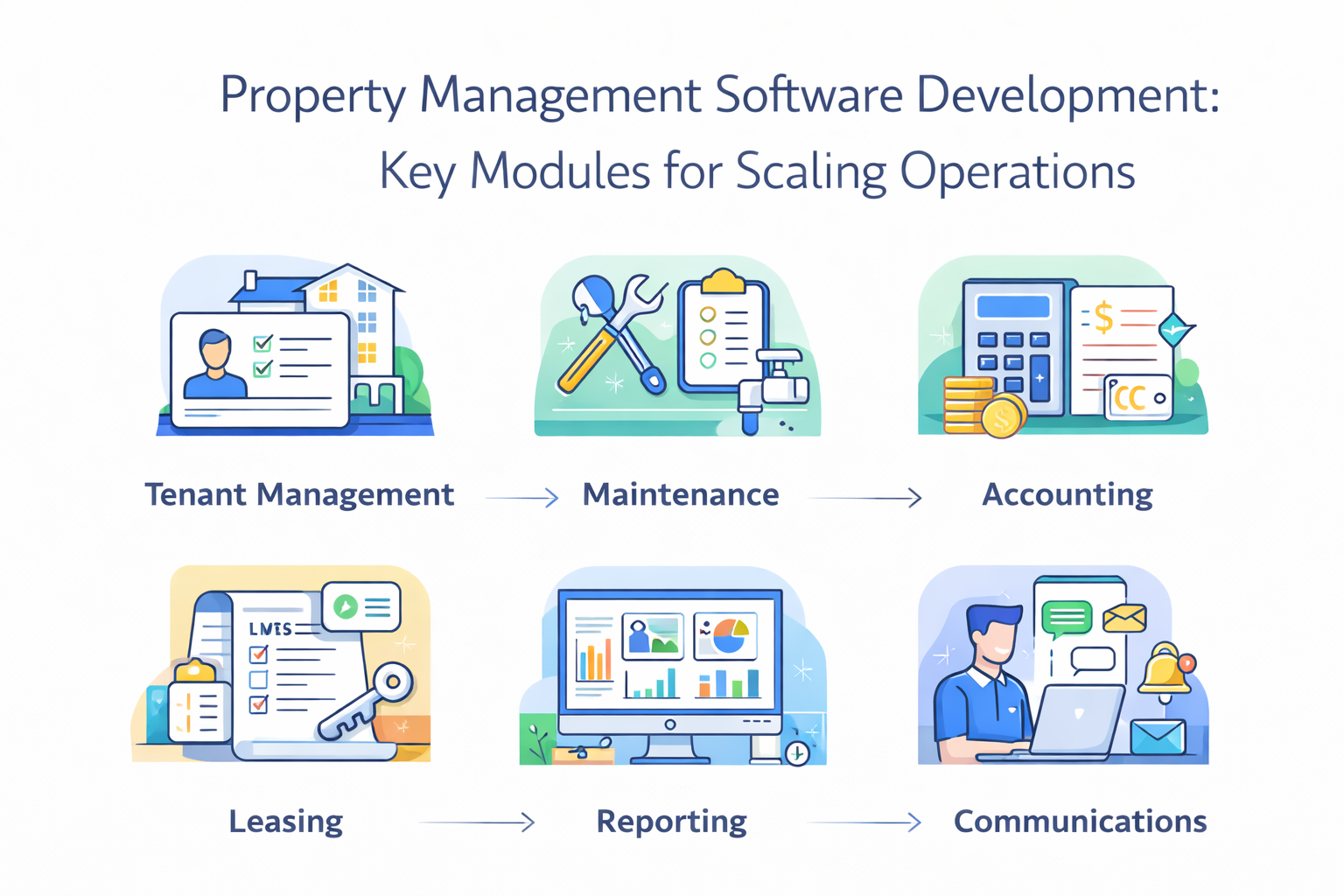
This post is about what that software actually needs to do - module by module - and where the architectural decisions that look minor early on become expensive to undo at scale.
Lease Management: The Data Foundation Everything Else Depends On
Lease management is not the most exciting module to talk about. But it’s the one that, if modeled incorrectly, poisons every other part of the system. Rent collection, maintenance permissions, tenant portal access, owner reporting, compliance tracking - all of it traces back to the lease record. Get the data model right here and the rest of the system has a solid foundation. Get it wrong and you spend years patching around a broken core.
A lease record needs to carry more than just the tenant name, unit, and term dates. It needs to capture the full financial structure of the tenancy: base rent, rent escalation schedules (annual increases by percentage or fixed amount), concessions (free months, reduced first month), security deposit amount and current balance, pet deposits and fees, parking and storage addons, late fee policy (flat fee vs percentage, grace period, cap), and any custom clauses specific to this tenancy. It also needs to track co-applicants and guarantors as first-class entities, not afterthoughts - because when a tenant defaults, the guarantor’s information needs to be immediately accessible and actionable.
The lease lifecycle also needs to be modeled explicitly. A lease moves through distinct states: application, approved, signed, active, notice given, expired, holdover, and terminated. Each state transition triggers downstream actions - a signed lease triggers the move-in checklist, a notice given triggers the make-ready workflow, an expired lease in holdover status triggers a rent-to-month adjustment if your policy changes the rate. If these state transitions are implicit (buried in UI logic) rather than explicit (modeled in the data layer with timestamps and triggered workflows), auditing the lease history of a unit becomes nearly impossible.
One architectural pattern worth implementing from the start: separate the lease agreement document from the lease data record. The signed PDF lives in document storage. The lease terms live as structured data in the database. Both are linked, but the structured data is what drives the system’s behavior - rent calculations, portal access, maintenance permissions - while the document is the legal record. This distinction matters when leases are amended: you need to track which data fields changed, when, and what the previous values were, without replacing the original signed document.
Tenant Portals: Designed Around What Tenants Actually Do at 11pm
The tenant portal is the part of the system your residents actually experience. And the dominant use case - the one that shapes the entire design - is not the one property managers usually think about first. It’s not lease signing or move-in documentation. It’s a tenant in their apartment at 11pm realizing their heater isn’t working, opening their phone, and trying to report it without calling anyone.
That moment defines what the portal needs to do well. Maintenance request submission needs to work flawlessly on mobile, require minimal steps, and give the tenant clear confirmation that their request was received and will be addressed. Anything that creates friction - mandatory fields they don’t understand, a UI that doesn’t work on Safari mobile, an upload requirement for a photo they can’t easily attach - means the tenant gives up and calls or texts the property manager directly, which is exactly the outcome the portal is supposed to prevent.
Beyond maintenance, the tenant portal needs to handle the three things tenants access most frequently: rent payment, lease documents, and communication history. Rent payment should support multiple methods - ACH, debit, credit (with the fee disclosed upfront), and ideally autopay setup - because tenants pay in different ways and making the payment experience frictionless directly impacts on-time collection rates. Lease documents should be retrievable without a support request; the number of property managers who receive emails asking “can you resend my lease” because their tenant portal buries the document would surprise you. Communication history - every maintenance ticket, every notice sent, every payment confirmation - should be visible to the tenant in one place, searchable, with timestamps.
The notification architecture behind the portal is as important as the UI. Tenants need to receive updates through the channel they actually check - email, SMS, or push notifications depending on their preference - and those preferences need to be configurable per tenant, not set globally. A maintenance update sent only via email to a tenant who checks email once a week is functionally the same as no update at all. We typically build notification preference management into the tenant onboarding flow, not as a buried settings page, because adoption at setup is far higher than retrofit.
One feature that gets underbuilt consistently: the status transparency layer. After a tenant submits a maintenance request, they want to know what’s happening. Not just “your request was received” - they want to know that a vendor was assigned, that the vendor is scheduled for Tuesday between 10am and 12pm, that the vendor checked in and checked out. Each of these status updates, delivered proactively via the tenant’s preferred channel, eliminates a “what’s happening with my request” call to the property manager. At fifty units that call is annoying. At five hundred units it’s a staffing problem.
Maintenance and Work Order Management: The Operational Core
Maintenance is where property management operations either hold together or fall apart. It involves the most parties (tenant, property manager, owner, vendor, sometimes insurance), the most time pressure (emergency repairs vs routine maintenance vs preventive work), and the most variability in cost and complexity of any operational area. The software needs to match that complexity without creating overhead for the people using it.
Work order management starts with intake categorization. Not all maintenance requests are equal, and the system needs to route them differently based on urgency and type. An HVAC failure in winter is an emergency that triggers immediate vendor dispatch. A running toilet is high priority but not emergency. A cosmetic paint touch-up on a shared wall is low priority scheduled maintenance. These categories need to be defined by the property management company and enforced at intake - either through tenant-facing categorization options or through property manager triage - because the downstream routing, SLA tracking, and vendor selection logic all depend on it.
Vendor management sits alongside work order management as a deeply underappreciated part of the system. Property management companies work with a network of vendors - plumbers, electricians, HVAC technicians, general contractors, cleaning crews - and the quality of the vendor relationship directly affects maintenance resolution time, which affects tenant satisfaction, which affects renewal rates. The platform needs to maintain a vendor database that tracks not just contact information but trade specializations, service area by geography, license and insurance status with expiration dates, pricing agreements or rate cards, and performance history (average response time, completion rate, tenant rating per job).
The insurance and license tracking piece has operational consequences that aren’t obvious until something goes wrong. If a vendor’s general liability insurance lapses and they cause damage during a job, the property management company may bear liability if they can’t demonstrate they verified coverage. A system that tracks certificate expiration dates and alerts the operations team before a vendor becomes uninsured is not a nice-to-have feature - it’s risk management infrastructure.
Work order lifecycle tracking needs to be explicit and timestamped at every stage: submitted, triaged, vendor assigned, vendor notified, vendor accepted, vendor scheduled, vendor on-site, work completed, invoiced, owner approved, paid, closed. This level of granularity serves multiple purposes. It gives the property manager real-time visibility into open work across the portfolio. It gives the owner an audit trail for every dollar spent on their property. It gives the accounting team the data they need for reconciliation. And it gives the analytics layer the raw material for performance reporting - average time to close by trade, cost per unit per month by property, vendor performance comparison.
Preventive maintenance scheduling deserves its own mention. Most property management software treats maintenance as reactive - something triggers, you respond. Preventive maintenance is scheduled ahead of time based on asset type and age: HVAC filter replacements every 90 days, annual roof inspections, quarterly fire safety checks, boiler servicing before winter. Building a preventive maintenance calendar into the platform - where tasks generate automatically based on property-level schedules - reduces emergency work orders over time, extends asset life, and gives owners something tangible to point to when they ask what property management is actually doing for their fee.
Rent Collection and Payment Automation
Rent collection is the financial heartbeat of the operation, and the gap between how it works in manual processes and how it should work in software is larger than almost any other function in property management.
The collection workflow needs to handle the full payment lifecycle without requiring property manager intervention for the normal case. On the first of the month (or whatever the lease start date dictates), each active lease generates a rent charge automatically. If the tenant has autopay enabled, the payment initiates without any action required. If they don’t, they receive a payment reminder via their preferred notification channel. Payments are confirmed when they clear, applied to the correct lease balance, and reflected in the owner ledger immediately.
The places where this breaks - and where the software needs to be specifically designed - are the exceptions. Partial payments, returned ACH payments (NSF), late fees applied correctly per the lease policy, payment plans for tenants in arrears, and security deposit accounting (held separately, interest-bearing in some states, applied correctly at move-out) all require rules that vary by lease, by state, and by owner preference. A rent collection engine that works correctly for the normal case but requires manual ledger adjustments for every exception is not a rent collection engine - it’s a semi-automated version of the spreadsheet it was supposed to replace.
Late fee logic is a specific example worth detailing. A late fee policy might say: after a five-day grace period, a flat $75 late fee is applied. Some states cap late fees at a percentage of monthly rent. Some leases waive the first late fee as a courtesy. Some owners want late fees auto-applied; others want property manager approval before they’re charged. The system needs to encode all of this at the lease level, not globally, because applying one owner’s late fee policy to another owner’s portfolio creates disputes and owner relationship damage that are hard to repair.
The accounting integration layer is where rent collection connects to the broader financial system. Most property management companies operate a trust accounting model - tenant funds are held in a trust account separate from operating funds, and disbursements to owners happen on a defined schedule (typically monthly, after expenses are deducted). The platform needs to produce owner statements that are accurate, clear, and formatted in a way that builds confidence - showing beginning balance, all income received, all expenses deducted with receipts attached, management fee calculation, and net disbursement. If that statement takes more than a few seconds to generate and looks like a raw data export, owner retention suffers. We’ve seen property management companies lose owner clients not because the operations were bad, but because the reporting made the operations look opaque.
Integration with accounting platforms - Yardi, AppFolio, or QuickBooks for smaller operators - needs to be two-way and real-time where possible. Expenses entered in the property management platform should sync to the accounting ledger without manual re-entry. Owner disbursements calculated in the platform should post to the accounting system automatically. This eliminates a reconciliation step that, at scale, consumes significant staff time and introduces error risk.
Inspection Management: The Evidence Layer
Inspections are the evidentiary foundation of property management. Move-in inspections document unit condition at tenancy start. Move-out inspections document condition at end of tenancy. Periodic inspections (quarterly or annual, depending on the owner’s preference and local law) document ongoing condition and catch deferred maintenance before it becomes expensive. Vacancy inspections document a unit’s condition between tenants.
The core requirement for inspection software is mobile-first field capture. Property managers conduct inspections on-site with a phone or tablet, not in an office. The inspection tool needs to load the inspection template for the unit, allow photo capture per room per condition item, record notes by voice or text, and submit the completed inspection - including all photos - from the field without requiring a reliable internet connection. Offline-first design is not optional here; properties in basements, garages, or areas with poor cell coverage will break any inspection tool that requires a live connection to function.
The inspection record needs to be linked directly to the lease it’s associated with - move-in inspection to the move-in date, move-out inspection to the move-out date - and that link is what makes security deposit accounting defensible. When a tenant disputes a deduction, the property manager needs to produce a side-by-side comparison of move-in and move-out inspection reports, with photos, showing the specific condition change that justifies the charge. If the inspection records aren’t attached to the right lease at the right dates, that comparison falls apart.
The Reporting Layer: What Owners and Operators Both Need
Property management software needs to serve two very different reporting audiences: the property management company’s own operations team and the property owners they work for. These are not the same reports.
Operations reporting is about throughput and performance: open work orders by age and property, average maintenance resolution time by trade, occupancy rate by property, lease expiration schedule for the next 90 days, delinquency report by dollar amount and days overdue, rent collection rate by property. This is the dashboard the operations team monitors daily to know where fires are starting and where performance is drifting.
Owner reporting is about confidence and trust: here is every dollar that came in, every dollar that went out, every work order that was opened and closed on your property this month, your current occupancy and the market rate context, and your net return. The format matters as much as the content - owners who receive a professionally formatted statement with receipts attached behave differently than owners who receive a raw export from whatever accounting system is in use. We cover the full analytics architecture in our guide to real estate analytics and dashboards, but the property management reporting layer specifically needs to be designed with owner trust as the primary design constraint.
Where Property Management Software Projects Go Wrong
The most consistent failure mode we see in property management software projects is treating accounting as a downstream concern. Teams build the operational modules - maintenance, tenant portal, inspections - and then try to connect them to accounting at the end. By that point, the data model has been built without the financial precision that accounting requires: charges aren’t dated correctly, payment records don’t have the right ledger codes, owner distribution logic isn’t tied to specific income and expense categories. Retrofitting accounting accuracy onto an operationally-built system is genuinely painful.
The second failure mode is underbuilding the exception handling in rent collection. The happy path - tenant pays on time, full amount, every month - is easy to build. The exception paths are where the business complexity lives, and they’re where the system will spend a disproportionate amount of real-world time. Building exception handling as a first-class requirement from day one, not as a v2 consideration, is the difference between a platform your team trusts and one they work around.
Third is neglecting vendor management infrastructure. Companies build the work order flow but not the vendor database behind it - no license tracking, no insurance expiration alerts, no performance history. Six months in, they realize their operations team is making vendor decisions based on muscle memory rather than data, and they have no system-level visibility into vendor quality across the portfolio.
If you’re operating a property management company that’s growing past the point where your current tools - whether off-the-shelf or a patchwork of systems - can keep up with the portfolio, we’ve built platforms for operators managing hundreds of units and operators managing tens of thousands. The architecture looks different at each scale, but the operational principles that matter are the same. Let’s talk through where your current system is costing you time, money, or owner trust.
Related Reading
- Centralizing Communication Between Tenants, Owners, and Vendors in Property Management
- How to Choose a Real Estate Software Development Partner: A Checklist for Founders and Operators
- Real Estate Software Development Costs: What Actually Drives the Budget?
Building a real estate platform?
From MLS integrations to investor portals, we've shipped the systems real estate operators actually run on.
Platform architecture, data pipelines, and delivery.
Discuss your platformA technical conversation, not a sales pitch.