
The New Math of Building Real Estate Software
A point of view from GTCSYS, after 7+ years of building only for real estate companies.
The old equation is broken
If you run a real estate software product, you have two ways to add engineering capacity. Both were designed for a world that no longer exists.
Option one: hire. A senior engineer search takes four to six months. Then onboarding, then ramp. Call it eight months before the hire is shipping at full speed. Your roadmap waits the entire time. And the hire is a bet. If it goes wrong, you restart the clock.
Option two: an agency. Now the roadmap moves, but you pay a different tax. You write specs. You explain your domain to people who have never seen an MLS feed or a county record. You sit in coordination meetings. You review work you should not need to review. The agency bills for time, so none of this friction costs them anything. It costs you.
Both models share one flaw. They price the input, not the output. You pay for hours or headcount, and the risk of slow delivery sits entirely with you.
That made sense when one engineer’s output was roughly fixed. It is not fixed anymore.
What changed
AI changed how software gets built. Not as a slogan. As a measurable shift in what one engineer ships per week.
We rebuilt our entire workflow around it. Every engineer at GTCSYS works AI-assisted across the full lifecycle. Architecture exploration, boilerplate, test coverage, code review, documentation, migration scripts. The repetitive 60% of software work that used to consume most of a developer’s week now runs at machine speed, with the engineer directing and verifying instead of typing.
The honest numbers, from our own delivery data:
On average, one of our engineers ships about double what a traditional team member does. On the right kind of work, it reaches 5x or more.
What counts as the right kind of work matters, so here it is plainly. The multiplier is highest on greenfield builds, integrations, CRUD-heavy platforms, data pipelines, and internal tools. It is lower on novel algorithmic work and on untangling undocumented legacy systems, where the bottleneck is thinking, not typing. Most real estate software is the first category. Marketplaces, qualification pipelines, workflow automation, vendor integrations. That is why this shift hits our industry harder than most.
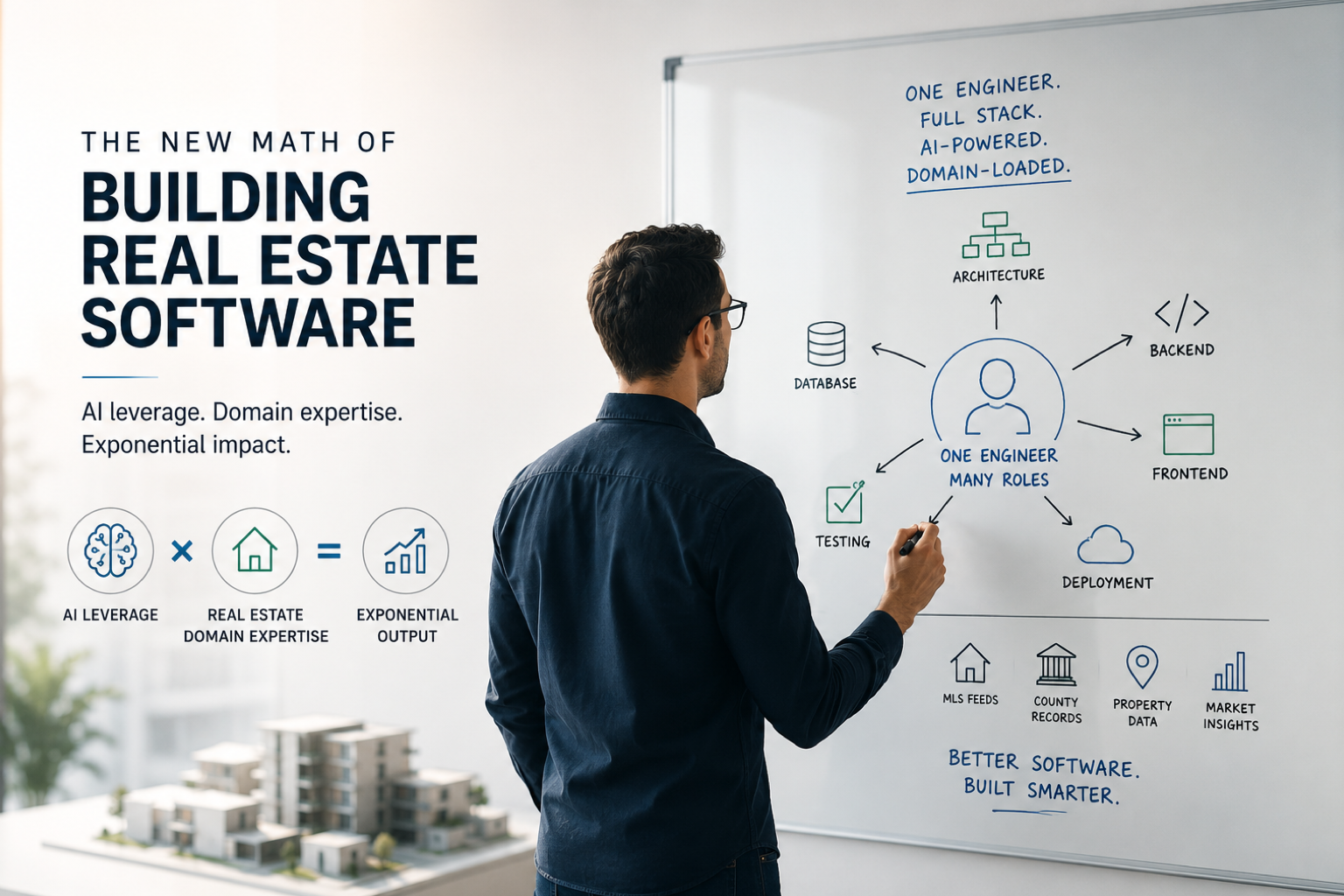
One more thing changed. AI collapsed the need for role specialization. The same engineer now carries architecture, backend, frontend, and deployment, because AI handles the breadth that used to require a team. That removes handoffs, and handoffs were where most agency time actually went.
Why domain depth multiplies the speed
Here is what most people miss about AI-assisted development. Speed without context just produces the wrong software faster.
An AI-equipped engineer who does not know real estate will rapidly build a lead pipeline that breaks on the first duplicate MLS record. They will design a clean schema that ignores how county data actually arrives. The code will be fast and wrong, and you will spend your saved time explaining why.
We have built only for real estate companies for more than seven years. Sundae, Splitero, FairTrade, Dwellist, BirdEarly. Marketplaces, home equity, property management, brokerage operations. Our engineers already know what an MLS integration breaks on, how qualification pipelines should score, what agents will and will not tolerate in a workflow, and where county records lie to you.
This is the real unlock. Domain knowledge plus AI leverage means the engineer does not need a spec. You talk in goals. “Cut our qualification time” is a complete instruction, because the engineer already knows what qualification looks like in this industry, what usually slows it down, and what the fix tends to be.
The engineer stops being a pair of hands and becomes a product owner. They make the small decisions without you, bring you the big ones with options attached, and own the result. You stay at the level where your time is actually worth something.
The model, in practice
Two ways to work with us.
Resource-based. The familiar one. You take an engineer, you direct the work, you manage the output. It still works, and some clients prefer the control. The engineer comes AI-equipped and domain-loaded, so you get the speed either way. But the management overhead stays with you.
Outcome-based. The model that is replacing it. You define the goal. We own the build, define the budget around the outcome, and carry the delivery risk. No specs, no coordination tax, no managing developers. You review working software, not tickets.
The honest comparison: resource-based is better when you have strong internal product leadership and just need hands. Outcome-based is better when you want the product to move and your time is the scarce resource. Most clients who start resource-based migrate to outcome-based once they see how little direction the work actually needs.
What this looked like for Sundae
Sundae runs a nationwide marketplace for distressed properties. Their problem was the standard one at scale. Lead qualification was manual. Property data lived in fragments across MLS feeds, county records, a CRM, and internal tools. Agents, operations, investor relations, and marketing all worked on disconnected systems.
We built their platform end to end. Automated data enrichment from MLS and county records. Lead qualification workflows. One integrated layer connecting agents, ops, investor relations, and marketing.
The results:
- Lead qualification got 60% faster
- 40 hours a week of manual work eliminated
- Lead response time improved by 18 hours
What Sundae’s role looked like during the build: goal-setting at the start, a short weekly review, and decisions only where the business had a real preference. No specs. No daily standups on their calendar. The domain knowledge meant we asked questions in their language, and not many of them.
Where to start
Do not start with a big commitment. Start with a test that costs you almost nothing to evaluate.
Pick one contained piece. An integration that keeps slipping. An internal tool your ops team keeps asking for. An MVP you have parked until the next hire. Give us the goal and two weeks.
Then judge from the output. Working software is the only proof that matters, and this model produces it fast enough that you do not have to take anything in this document on faith.
GTCSYS builds software exclusively for real estate companies. 7+ years, one industry. Sundae, Splitero, FairTrade, Dwellist, BirdEarly.
Have a contained piece worth testing?
An integration that keeps slipping, an internal tool your ops team needs, a parked MVP — give us the goal and two weeks.
You judge from working software, not a proposal.
Start the conversationA technical conversation, not a sales pitch.