
WordPress to Headless: The Performance Gain Is the Smallest Benefit
The migration everyone frames wrong
Most discussions of moving off WordPress to a headless architecture focus on the obvious wins. Faster pages. A frontend you control. Content decoupled from presentation. These are real, and for a content-heavy site they justify the project on their own.
But they are the smallest part of what a headless migration actually unlocks. The framing that focuses only on performance misses the larger shift, which is this: when your content stops being HTML trapped in a database and becomes structured data an AI can reason about, an entire category of capability opens up that was simply not available before.
That category is the subject of this post. The performance gain gets you in the door. What you can do with structured content and AI on top of it is the reason the migration is worth far more than the speed numbers suggest.
A quick word on the architecture
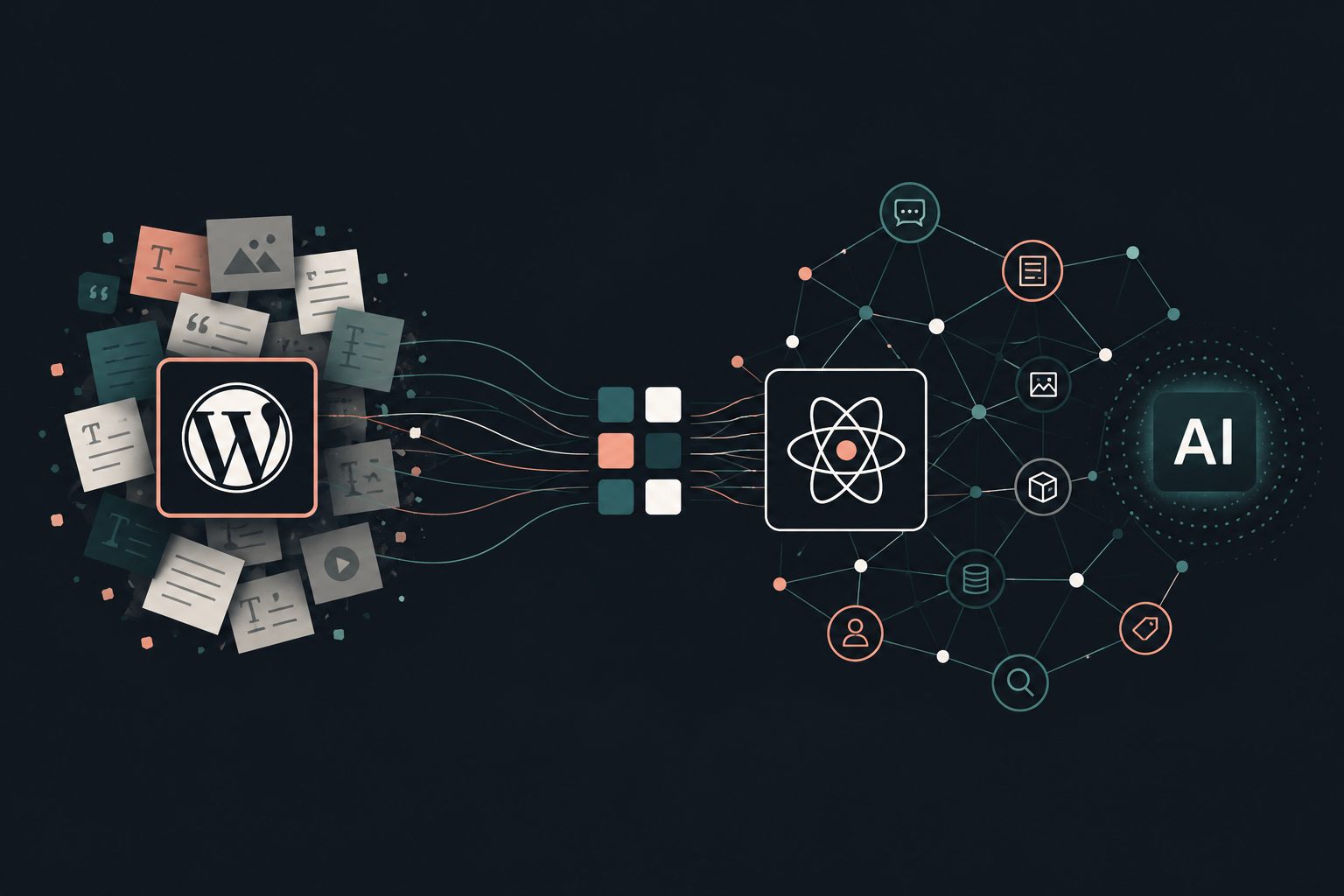
The setup is straightforward to describe. A headless CMS like Strapi holds the content as structured data, defined fields and explicit relationships, served through an API. A modern frontend, Next.js with React, consumes that API and renders the pages, with server-side rendering and static generation for speed and SEO.
The key word is structured. In WordPress, a blog post is a blob of HTML mixed with shortcodes, block markup, and plugin formatting. Content and presentation are welded together. In a headless CMS, a post is a record: a title, a body, an author, a category, tags, and defined relationships to other content. That difference, content as structured data rather than as presentation-bound HTML, is what makes everything below possible.
What becomes possible when AI can read your content
Here is the part that matters. Once your content is structured and mapped, AI can apply intelligence to it in ways that were not feasible when it was locked inside WordPress. These are not hypothetical. They are the concrete capabilities a structured content base enables.
1. Recreate content with AI so it actually fits the page it lives on
Content written over years accumulates drift. A page written three years ago reflects what you knew then, the way you framed things then, and the context that existed then. It no longer quite fits where your thinking, your offering, or your audience is now.
With structured content, AI can work through your pages and recreate them to make sense in the current context. Not a blind rewrite, but a guided pass that updates framing, sharpens language, aligns older content with current positioning, and brings consistency to material written by different people at different times. A migration already forces every page through your hands. Applying AI to that forced pass turns “move the content” into “improve the content” at almost no additional cost, because you were touching every page anyway.
This is work that would never be approved as a standalone project. “Let’s rewrite all our old content” has a return too diffuse to justify on its own. As a side effect of a migration you are doing regardless, it is nearly free, and it compounds the value of everything you have already published.
2. Map all your content and surface the internal links you never made
This is one of the highest-leverage capabilities, and it is nearly impossible without structured content.
Over years of building content, internal linking happens organically. You link a new post to one or two related ones you happen to remember. But as the content base grows into hundreds or thousands of pages, no human can hold the full map in their head. The result is always the same: dozens of pages that should be linked together never are, simply because nobody could see that the connection existed. Relevant articles sit in isolation. Topic clusters are fragmented. The SEO value of internal linking, which is substantial, goes largely uncaptured.
When all your content is structured data, AI can build a complete map of it and identify the linking opportunities that were never acted on. It can see that an article written last year on one topic relates directly to three articles written since, and suggest those links. It can find the orphaned pages with no inbound internal links. It can identify the natural topic clusters and propose the linking structure that connects them coherently.
For a large content base, this alone can meaningfully improve search performance, because you are finally capturing link equity that was always available but never visible. The bigger your content base, the more value is trapped in unmade connections, and the more this matters.
3. Find the content that is missing
A complete content map reveals not just what you have, but what you do not have.
When AI can see your entire content base as structured data, it can identify the gaps: topics your audience cares about that you have not covered, questions adjacent to your existing content that you have not answered, clusters where you have written around a subject but never addressed it directly, and stages of the buyer or reader journey where your content thins out.
This turns content planning from guesswork into something grounded in an actual map. Instead of brainstorming topics, you are filling identified gaps in a structure you can see. The content strategy becomes a function of what the map shows is missing, which is a far more reliable basis than intuition about what might be worth writing.
4. Turn the whole content base into a knowledge base
Once content is structured and mapped, it can become the foundation of a genuine knowledge base, internal, external, or both.
The same structured content that feeds your website can feed a searchable, organized knowledge base where information is connected by its relationships rather than scattered across pages. For an organization with years of accumulated content, this transforms a pile of posts and pages into an organized body of knowledge that people can actually navigate and query.
This was not feasible when the content was HTML locked inside WordPress’s storage format. The structure that the headless CMS imposes is exactly the structure a knowledge base needs. You get the knowledge base as a natural extension of the content you already have, rather than as a separate system you would have to build and populate from scratch.
5. Build an AI chatbot grounded in everything you have published
This is where the structured content base becomes a genuinely new capability rather than an improvement on an old one.
With all your content available as structured, mapped data, you can build an AI chatbot that answers questions based on the entirety of what you have published. Not a generic bot, but one grounded specifically in your content, your expertise, your answers. A visitor can ask a question and get a response synthesized from your actual published material, with the relationships in your content map helping the bot understand how topics connect.
For a content-rich organization, this is a direct line from “we have published a lot of valuable material” to “our visitors can have a conversation with that material.” The chatbot is only as good as the content behind it and the structure that lets the AI navigate it, which is precisely why this is impossible while the content is trapped in WordPress and natural once it is structured.
6. Tooling that makes every new piece of content smarter
The content map does not just improve existing content. It changes how you create new content.
When you write a new page or post, AI tooling with access to the content map can work alongside you in real time. It can suggest internal links to relevant existing content as you write, so new content is connected into your structure from the moment it is published rather than retrofitted later. It can suggest keywords for existing pages based on where they sit in the content map and what they relate to. It can flag when new content overlaps with something you have already published, preventing duplication and cannibalization. It can recommend which existing pages should link to the new piece, building inbound internal links automatically.
This turns content creation from an isolated act into something that strengthens the whole structure each time. Every new piece is born connected, optimized, and aware of everything around it, because the tooling has the map and applies it.
The capabilities that emerge beyond these
Once you have structured content and AI applying intelligence over it, the list keeps extending. A few more that become available:
Automated content auditing. AI can continuously assess the content base for outdated information, broken internal logic, pages that contradict each other, or material that no longer reflects current positioning, flagging what needs attention rather than waiting for someone to notice.
Dynamic content repurposing. Structured content can be automatically adapted into other formats: a long article into a summary, a series of posts into a guide, web content into material for other channels, because the content is data that can be transformed rather than HTML that has to be manually rewritten.
Personalized content delivery. With content as structured data, the frontend can assemble different combinations for different audiences or contexts, surfacing the most relevant material to each visitor based on their behavior or entry point.
Semantic search across everything. Beyond keyword matching, AI can enable search that understands meaning, so a visitor finds the right content even when their words do not match yours exactly, because the system understands the concepts in your content map.
Translation and localization at scale. Structured content is far easier to translate and maintain across languages, because you are translating defined fields rather than untangling presentation-bound HTML for each locale.
Content performance intelligence. Connecting the content map to analytics lets AI identify which structures, topics, and linking patterns actually drive outcomes, feeding that intelligence back into what you create next.
The pattern in all of these is the same. The structure is the enabler. AI is the intelligence applied on top. Neither works without the other, and the migration is what creates the structure.
The honest trade-offs
This is not the right move for everyone, and saying so is part of giving an honest account.
A headless setup requires development capability. WordPress lets non-technical users build and change a site without code. A headless frontend requires developers for frontend changes. For an organization without development resources, that is a real cost. For a simple brochure site that rarely changes, WordPress remains the better answer and none of the advantages above are worth the overhead.
The upfront build is more involved than installing a theme, and content modeling requires deciding how your content should actually be structured rather than letting it accumulate loosely. That decision is more work, and it is also exactly why the result enables everything described here.
The real reason to do this
If the only benefit of moving off WordPress were faster pages, the decision would be a narrow performance calculation. It is not.
The real reason is that structured content plus AI is a fundamentally more capable foundation than HTML in a database. Once your content is structured and mapped, you can improve it, connect it, complete it, query it, converse with it, and build tooling that makes every future piece stronger. None of that is available while your content is locked in a format that AI cannot meaningfully read.
The performance gain gets the project approved. The intelligence you can then apply to your entire body of content is what makes it one of the highest-return moves a content-heavy organization can make right now. The content you have already published is an asset you are almost certainly underusing. Structuring it is what lets you finally put it to work.
Sitting on years of WordPress content?
We migrate content-heavy sites to headless Strapi + Next.js and build the AI tooling — content maps, internal linking, knowledge bases — that structured content makes possible.
Performance gets you in the door. The intelligence on top is the real return.
Discuss your migrationA technical conversation, not a sales pitch.