
Real Estate Software Development Costs: What Actually Drives the Budget?
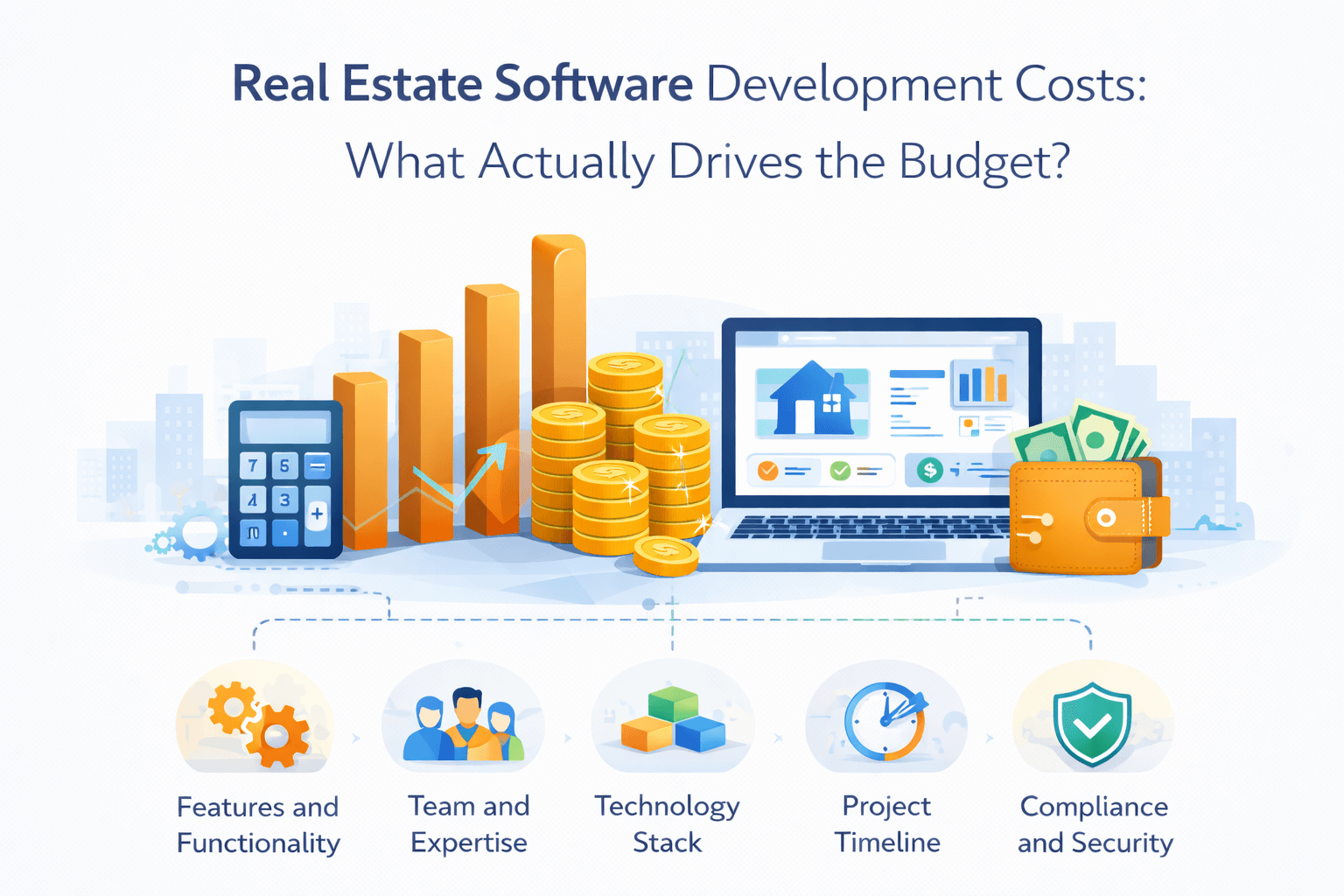
If you search for “real estate software development cost,” you’ll find articles that give you ranges like “$25,000 to $500,000+” and then explain that the cost “depends on your requirements.” That’s not wrong. It’s just not useful. A founder trying to build a real budget for a brokerage commission engine or an investor portal needs to understand what specifically drives that range - which decisions push a project toward the lower end, which push it toward the higher end, and where spending more upfront prevents much larger costs later.
This post is the honest version of that conversation. We’re not going to quote day rates or give you a pricing calculator. What we’re going to do is walk through the cost drivers that are specific to real estate software - the ones that separate a $150,000 project from a $600,000 project building nominally the same thing - so you can look at your own requirements and understand roughly where they sit and why.
The Baseline: What You’re Actually Paying For
Before breaking down the cost drivers, it’s worth being clear about what custom software development costs actually cover. The largest component - typically 60–70% of a project budget - is engineering time: the hours spent by architects, senior developers, and junior developers designing, building, testing, and deploying the system. The remainder covers project management, UX and product design, quality assurance, infrastructure setup, and the discovery and specification work that happens before development begins.
What’s not in that number: ongoing hosting costs (AWS, GCP, or Azure infrastructure, typically $500–$5,000 per month depending on scale and data volume), third-party service costs (MLS data aggregator fees, payment processor fees, identity verification services, email delivery, SMS), and post-launch maintenance - which in our experience runs at roughly 15–20% of the initial build cost annually for a platform that’s actively used and periodically extended.
The ranges you see in the market for real estate software development - from $80,000 for a simple property management MVP to $800,000 or more for a full investment management platform with custom waterfall calculations, multi-MLS integration, and investor portal - reflect genuine differences in what was built, not just differences in who built it. Understanding which of your requirements sit at which end of that range is the goal of this post.
Cost Driver One: Integration Complexity
Integrations are the single largest source of budget variance in real estate software projects. They’re also the most underestimated, because integrations look like configuration work until you’re actually doing them - and then they reveal complexity that a project plan built on optimistic assumptions doesn’t have room for.
MLS integration is the canonical example. A project that needs to connect to a single MLS board through Trestle’s aggregated API - one set of credentials, one normalized data format - is a meaningfully different scope than a project that needs to connect directly to six regional boards, each with their own API implementation, field naming conventions, rate limiting behavior, and compliance requirements. The former might add three to four weeks of engineering time to a project. The latter might add three to four months. Both are described as “MLS integration” in a scope document, and the difference between them is the difference between a $200,000 project and a $350,000 one.
Payment integrations have a similar dynamic. A basic Stripe integration for card payments - standard use case, well-documented API, predictable behavior - is a few days of engineering work. A full escrow workflow with staged payment releases, multi-party splits, ACH settlement tracking, dispute handling, and reconciliation against an external accounting system is several weeks. Investment platforms that need to handle capital calls via ACH with individual investor confirmation workflows, distribution processing with waterfall calculations driving the payment amounts, and K-1-ready transaction records add complexity on top of that.
The cost implication: before a project is scoped, every integration should be evaluated individually - not as a line item that says “third-party integrations” but as a specific description of what data needs to flow in which direction, at what frequency, through what mechanism, with what error handling. That specificity is what produces an estimate you can trust.
Cost Driver Two: Data Model Complexity
The data model is the foundation of the system. Getting it right is largely invisible to anyone who’s not an engineer. Getting it wrong is felt by everyone, for years, in the form of features that are hard to build, reports that can’t be produced, and migrations that are expensive and risky.
Real estate data models are complex for reasons that are specific to the domain. Commission structures involve relationships between agents, teams, transactions, split plans, caps, and override arrangements that don’t map cleanly onto standard CRM data models. Waterfall calculations require tracking capital account balances across multiple events over the lifetime of a fund, with the calculation logic varying per deal. Multi-MLS listing data requires a normalization layer that maps diverse source schemas onto a consistent internal model while preserving board-specific fields that the normalization would otherwise discard.
The cost implication of data model complexity is not primarily the time to build the initial model - it’s the time to build it correctly. A commission engine built on a data model that was designed for simple splits can calculate simple splits quickly and correctly. Adding a tiered split that changes when an agent crosses a production threshold requires either retrofitting the data model - expensive, risky - or working around it with logic that lives in application code rather than in the data layer - fragile, hard to maintain. A well-designed data model anticipates the edge cases from the start and builds the schema around them. That takes longer in the discovery and architecture phase, but it saves multiples of that time in the build and extension phases.
Projects that invest in architecture and discovery - typically two to four weeks at the start of the engagement - consistently produce better outcomes at lower total cost than projects that skip discovery and move directly to development. This is the cost that clients most often want to cut and most often regret cutting.
Cost Driver Three: Compliance and Security Requirements
Compliance requirements add cost in ways that are often invisible until the scope is examined carefully. Not because compliance features are technically complex - most aren’t - but because they add testing surface area, audit trail requirements, access control granularity, and data retention obligations that affect every part of the system rather than just a specific feature.
For investment platforms operating under Reg D, compliance requirements shape the entire investor onboarding flow - accreditation verification, KYC/AML screening, entity structure documentation, subscription agreement execution - and the audit trail that needs to exist behind every capital event. Building this correctly, with immutable logs, approval workflows, and the document retention structure that regulators expect, adds meaningful scope compared to building the same workflows without compliance requirements.
For property management platforms operating across multiple states, jurisdictional variation in habitability laws, late fee caps, security deposit rules, and notice requirements means the system’s business logic needs to be configurable per jurisdiction rather than globally defined. That configurability adds scope to every feature that touches tenant financials or communications.
For any platform handling payment card data, PCI DSS compliance shapes the infrastructure architecture - which components can touch card data, how that data is stored and transmitted, what the audit trail looks like. Most real estate platforms avoid PCI scope by using a payment processor like Stripe that handles cardholder data directly, but the integration still needs to be designed with PCI in mind to ensure that scope is correctly limited.
The cost implication: compliance requirements should be identified and scoped explicitly during discovery, not treated as implementation details that will be figured out during development. A project that discovers a compliance requirement mid-build typically pays two to three times more to address it than a project that planned for it from the start.
Cost Driver Four: Performance and Scale Requirements
The scale a system needs to operate at on day one, and the scale it needs to reach within eighteen months, shapes architecture decisions that are much cheaper to make correctly upfront than to retrofit later.
A property management platform for 200 units and a property management platform for 20,000 units are not the same system with more data. They have different database architecture requirements, different caching strategies, different background job designs, and different infrastructure configurations. The 20,000-unit platform needs to be designed for the query patterns and data volumes that scale produces - which means the architecture decisions need to be made at the start, not after the system is in production and performance problems are already affecting users.
This doesn’t mean over-engineering for scale that may never materialize. It means being honest about the realistic scale trajectory and making the architectural decisions that are appropriate for it. A marketplace expecting 50,000 listings at launch needs Elasticsearch from day one - building on PostgreSQL full-text search and planning to migrate “when we need to” is a plan for an expensive migration at exactly the moment the business is growing fastest. A brokerage CRM expecting 500 agents needs multi-office data isolation designed into the access control layer from the start - retrofitting it after launch requires touching every query in the system.
The cost implication is typically an additional 15–25% on the architecture and infrastructure components for a platform that needs to scale significantly versus one that doesn’t. That premium pays for itself quickly when the platform doesn’t require a costly rewrite at growth stage.
Cost Driver Five: Team Composition and Engagement Model
The team composition - the mix of seniority levels and specializations on a project - is a cost variable that clients often underweight in vendor evaluations. A project staffed predominantly with junior developers supervised by a part-time senior architect costs less per hour but takes longer, requires more rework, and produces a codebase that is harder and more expensive to extend. A project staffed with experienced engineers who have built similar systems before costs more per hour but typically produces better outcomes at lower total cost when the full project lifecycle is considered.
For real estate software specifically, domain experience in the team matters more than in most categories. An engineer who has built MLS integrations before knows where the edge cases are and designs for them from the start. An engineer building their first MLS integration will discover those edge cases in production. The discovery process costs money either way - the question is whether it happens in architecture reviews or in post-launch incident responses.
The engagement model - fixed-price versus time-and-materials - affects the effective cost in ways we covered in how to choose a development partner, but from a pure budget planning perspective: fixed-price projects require a detailed specification before the contract is signed, and the cost of producing that specification is real whether it’s itemized or embedded in the project price. Time-and-materials projects require active client engagement and budget discipline throughout the engagement. Neither model is inherently more expensive - the right choice depends on how well-defined the requirements are and how actively the client can participate in the build.
Approximate Cost Ranges by Platform Type
With those cost drivers in mind, here are approximate ranges for the platform types we build most frequently. These are not quotes - they’re rough bands based on typical scope, and actual project costs vary based on the specific requirements within each type.
A brokerage CRM with MLS integration, lead routing, pipeline management, and commission tracking - without a custom mobile app and with integration to a single MLS market via an aggregator - typically falls in the $150,000–$280,000 range for initial build. Adding a custom mobile app, expanding to direct integrations with multiple MLS boards, and building advanced commission structures with team overrides and cap calculations pushes toward $350,000–$500,000.
A real estate investment platform with deal pipeline, investor onboarding (including KYC/AML), capital call management, waterfall calculation engine, and investor portal typically falls in the $250,000–$450,000 range. Adding complex multi-class waterfall structures, integration with a fund administration platform, and SEC compliance documentation infrastructure pushes toward $500,000–$700,000.
A property management platform with tenant portal, maintenance and work order management, rent collection with ACH, lease management, and owner reporting - for a single-market operator - typically falls in the $120,000–$250,000 range. Adding multi-state compliance logic, vendor management with insurance tracking, inspection management with offline-first mobile capability, and accounting integration with Yardi or AppFolio pushes toward $300,000–$500,000.
A real estate marketplace with MLS listing ingestion, Elasticsearch-based search with geospatial capability, listing detail pages, and basic agent/broker accounts typically falls in the $200,000–$350,000 range for initial build. Adding multi-MLS aggregation across dozens of boards, custom polygon search, listing deduplication, a full agent portal with listing management, and a monetization layer with subscription billing pushes toward $450,000–$800,000.
These ranges assume a US-based or equivalent-cost development team. Offshore teams typically cost 40–60% less per hour, but the total cost savings are typically lower than that figure suggests, because offshore engagements for complex real estate platforms require more project management overhead, more detailed specifications, and more rework cycles to achieve the same outcome.
The Cost of Getting It Wrong
The cost figures above are for projects that are scoped correctly, architected well, and delivered by a team with real estate domain experience. The cost of a project that isn’t those things is harder to quantify but consistently higher - not because the initial build costs more, but because the consequences accumulate over time.
A commission engine built on a data model that can’t handle the brokerage’s actual split structures requires either a rewrite or a set of manual workarounds that cost staff time indefinitely. An MLS integration built without proper rate limit handling and monitoring starts silently dropping records under load and costs agent trust that’s hard to rebuild. A marketplace built on PostgreSQL full-text search that needs to migrate to Elasticsearch when it reaches scale loses months of engineering time at exactly the moment the business needs that engineering capacity for growth.
The real cost question for a real estate software project isn’t “how do we minimize the build cost?” It’s “what is the right investment to make this platform hold up in production, serve our users well, and extend cleanly as the business grows?” That question produces a different set of trade-offs - and usually a different answer - than a pure cost minimization exercise.
If you’re trying to build a realistic budget for a real estate software project and you want a more specific estimate based on your actual requirements, the right starting point is a scoped conversation about what the platform needs to do - not a quote from a page like this one. The real estate software development work we do starts with that conversation, and if the scope is genuinely beyond what custom development can justify economically, we’ll say so. Let’s talk through what you’re building and what it actually needs to cost.
Related Reading
- How to Choose a Real Estate Software Development Partner: A Checklist for Founders and Operators
- Custom Real Estate Brokerage Software: CRM, MLS Integrations, and Agent Workflows Explained
- Custom Real Estate Software vs Off-the-Shelf Tools: When to Build, Buy, or Hybridize
Building a real estate platform?
From MLS integrations to investor portals, we've shipped the systems real estate operators actually run on.
Platform architecture, data pipelines, and delivery.
Discuss your platformA technical conversation, not a sales pitch.