
AI Engineers
One engineer. AI-powered.
The output of a full team.
AI Engineers combine deep software expertise with AI-native development systems to design, build, and ship products dramatically faster than traditional teams. One person. Full lifecycle ownership. 5x-10x the output.
Built for speed without handoff overhead.
One engineer holds the full product context across planning, architecture, build, testing, deployment, and iteration.
5x-10x
Typical output increase over traditional workflows
1 owner
From problem definition through post-launch improvement
Days, not weeks
For early prototypes and architecture validation
Zero handoffs
Between product, engineering, QA, and infrastructure
The shift in software development
Software no longer needs a chain of specialists to move forward.
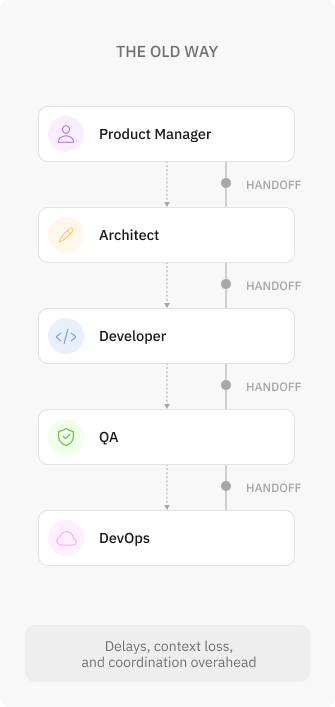
For years, building software meant assembling a team. Product managers defined requirements. Architects designed systems. Developers wrote code. QA tested it. DevOps shipped it. Every stage involved handoffs, delays, and overhead that added up.
AI changed this model. Modern engineering workflows now combine human expertise with AI systems that assist with development, testing, debugging, documentation, and infrastructure.
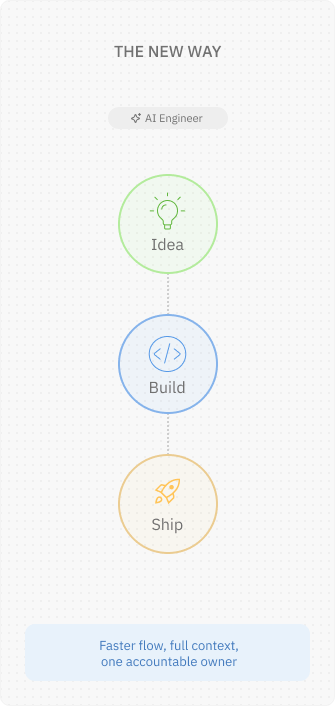
The result is a new kind of builder, one who can move from idea to production with far less friction. That is what an AI Engineer is.
What is an AI Engineer
An AI Engineer is not a developer using AI on the side.
These engineers are trained to work AI-first. They design their entire workflow around AI systems using them for code generation, architecture exploration, automated testing, debugging, and documentation. Not as shortcuts. As infrastructure.
One AI Engineer can carry responsibilities that traditionally required multiple roles. They understand the business problem, translate it into architecture, build and deploy the system, and keep iterating after launch.
Ownership stays with one engineer from start to finish. No handoffs. No translation layer. No context lost between specialists.
What one AI Engineer can do
Full lifecycle ownership, compressed into one workflow.
Understand the problem
They start with your business goals, not a ticket queue. That distinction shapes every decision made downstream.
Design the system
Architecture, services, APIs, databases, and infrastructure. All mapped before code is written, using AI to pressure-test decisions early.
Prototype fast
Initial versions built quickly to validate ideas before committing to a full build. What used to take two weeks takes two days.
Build full-stack
Frontend, backend, APIs, databases, integrations. The full product, developed with AI-assisted coding while the engineer maintains architectural control.
Deploy and run infrastructure
Cloud setup, CI/CD pipelines, monitoring, and environments. Configured properly from the start.
Test and iterate continuously
AI-assisted test generation means QA is built into the workflow, not added at the end before launch.
5x-10x output. Where it actually comes from.
The productivity gains are real. But they're not magic - they come from specific places.
Boilerplate is gone
Scaffolding, CRUD operations, schema generation, test stubs – AI handles all of it. Engineers aren’t paid to do repetitive work. Now they don’t have to.
Debugging is faster
Error traces and regression hunting that used to take hours can be resolved in minutes with AI-assisted diagnosis.
Prototyping is compressed
Two weeks to test an idea becomes two days, which improves learning speed and reduces expensive wrong turns.
Architecture gets explored properly
Engineers can stress-test design decisions early, leading to better choices and fewer reversals later.
Add it up across a full project and you're not getting slightly faster delivery. You're getting a different category of throughput. Smaller team, larger output, more coherent product - because the same person made every decision.
How a project moves with an AI Engineer
Fast execution with one accountable owner.
This is not a compressed timeline that cuts corners. It is what happens when repetitive work is automated and product judgment stays concentrated in one capable person.
Align on product vision, business goals, and constraints before touching code.
Map architecture and validate technical decisions with AI-assisted planning.
Build core user flows quickly so ideas are tested in days, not weeks.
Ship the full stack faster without compromising architectural quality.
Keep momentum after launch with the same engineer and the same context.
How a project moves with an AI Engineer
Best fit for teams that need leverage, speed, or both.
Get something real into users’ hands without standing up a large team first.
Add meaningful throughput without adding coordination overhead.
More developers does not automatically produce more speed or coherence.
Move through analysis, refactoring, and migration faster than a traditional team can.
Build automation platforms, dashboards, and operational systems quickly.
Why not just hire a traditional team
Traditional teams often lose time in the spaces between roles.
Coordination overhead between specialists. Context lost every time someone joins or leaves. A project manager translating between product and engineering. Slow feedback loops between decisions and execution.
An AI Engineer eliminates most of that. One person with full context, moving fast, making coherent decisions across the entire product.
| Category | Traditional team |
AI Engineer
Recommended approach
|
|---|---|---|
|
|
Fragmented ownership
Distributed across roles
|
One accountable owner
Full context, full ownership
|
|
|
Frequent handoffs
Built into the process
|
Minimal handoffs
Most are eliminated
|
|
|
Slow cycles (weeks)
Many dependencies
|
Days, not weeks
Ship and learn faster
|
|
|
Inconsistent usage
Ad hoc, varies by person
|
AI as core system
Built into every decision
|
|
|
Disjointed decisions
Often fragmented
|
Cohesive product thinking
Single-threaded context
|
How to work with us
Different engagement models. Same engineering standard.
Every engagement starts with a real conversation about your product. What it needs to do, where it is today, and what done looks like. No proposal until we understand the problem.
One AI Engineer embedded in your product. Long-term. Accountable for architecture, development, and delivery. Treats your product like their product.
Scoped engagement to take a defined product from zero to production. Fixed deliverables, clear timeline, AI-accelerated execution.
GTC AI Engineers working alongside your current team – adding AI-native throughput to a build already in progress.
Start building with AI Engineers.
Software development is entering a new phase. The teams winning now aren’t the biggest – they’re the ones with the most leverage.
If you’re building a product, scaling a platform, or trying to move faster than your current team allows, let’s talk. You’ll speak to an engineer, not a salesperson.
No pitch deck. No generic proposal. Just a real conversation about your product.