Strategic Technology Partnership
Building the Operating System for a Surplus Auction Leader
Over a decade-long partnership, GTCSYS helped Silicon Valley Disposition transform a fragmented, manual auction operation into SAM — a unified enterprise platform that now powers every part of their business.
Who is svdisposition?
Silicon Valley Disposition (SVD) is a long-established player in the surplusasset disposition space, running auctions for corporate facilities,manufacturing plants, logistics centers, retailers, industrial yards, andgovernment entities with recurring liquidation needs.
Their operational strength was real. The infrastructure holding it togetherwas not.
As auction volume grew and client expectations rose, it became clear thebusiness needed more than incremental fixes. It needed a platform builtaround how the business actually worked.
The Situation Before SVD
SVD relied on AuctionFlex for auction-day bidding. Everything before and after the sale — cataloging, marketing, reporting, client interaction, buyer management — lived in disconnected spreadsheets, email threads, shared folders, and SaaS tools that didn’t talk to each other.
The result was predictable:
No single source of truth
Asset data, photos, project notes, buyer records, and campaign details were scattered across Excel, AuctionFlex, shared drives, and email. Finding anything took effort. Trusting it took more.
Triple data entry.
Field teams cataloged in spreadsheets. Admins re-entered everything into AuctionFlex. Marketing recreated asset highlights for campaigns. The same information moved through three sets of hands before a single item went live.
No real-time visibility
Leadership couldn't tell where a project stood without chasing someone. Was cataloging done? Had the client approved? Was the landing page live? No one could answer without making calls.
AuctionFlex as a ceiling
Bidding, invoicing, and buyer data all lived in a third-party system. SVD couldn't innovate around the buyer experience, own their data, or differentiate on anything downstream of the auction.
Clients and buyers left in the dark
Clients got status updates by email. Buyers got invoices by email. Every question — pickup details, payment status, report requests — generated a support ticket someone had to handle manually.
SVD's leadership understood what this meant at scale: you can't grow a business on manual labor and email threads. They needed a central operating system, not another point solution.
Why SVD, and Why GTCSYS
SVD didn’t hire GTCSYS to build a tool. They engaged us to co-create a platform that couldevolve with the business over years — and hold up during live auctions with real money onthe line.
That distinction shaped how we worked from day one.
Our teams embedded directly into SVD’s operations — sitting with admins during livesales, walking facilities during cataloging, joining leadership in roadmap discussions. Notto observe from the outside, but to understand the edge cases, the informal rules, and theoperational realities that never make it into a requirements document.
Every major capability went through a tightly scoped pilot on a real auction before beingrolled out broadly. We agreed on a small set of shared KPIs that tied directly to businessoutcomes. And we structured the roadmap around phases that could be delivered,measured, and built upon — not a single big-bang implementation.
This is how SVD/SAM grew from a website initiative into the platform that now runs theentire business.

We’ve worked with a lot of vendors over the years. Most of them show up with aprocess and fit your business into it. GTCSYS did the opposite. They took thetime to understand how we actually operate before writing a single line of code.
SAM didn’t happen overnight. It was built in phases, tested on real auctions,and adjusted based on what we saw in the field. That kind of patience anddiscipline is rare. What we have today is a platform that runs our entirebusiness: operations, client reporting, buyer management, marketing. It worksbecause it was built around our realities, not around someone else’s template.
Ten years in, they’re still the team we call when something matters.
John Carrol
Precident | SVD
Our Partnership Process
When we partner with a client, we work as an extension of their product and engineering team. The focus is on understanding thebusiness deeply, aligning priorities across departments, and shaping a roadmap that supports both immediate needs and long-termgoals. The process is structured enough to bring clarity and predictability, while staying flexible as the business evolves.
Our approach

Stakeholder and Customer Alignment
We begin by meeting all key teams — acquisitions, agents,seller advisors, investor relations, marketing, and engineering.Each team brings its own pressures, workflows, anddefinitions of success. These conversations help us map realpain points and understand the needs of both internal teamsand external customers.

Vision & Current-State Assessment
Next, we look at Sundae through two lenses:
- Where the organization wants to be (its long-term vision and market strategy)
- How things work today (processes, systems, bottlenecks, and assumptions)
This gives us the foundation to design solutions that match the business model rather than forcing a standard playbook.

Proposed Operating Process
With a clear understanding of the current state, we propose an operating model that de nes how ideas move from discovery to delivery. This includes how work is prioritized,
how teams collaborate, and how small improvements and large initiatives flow through product and engineering.

Roadmap Creation (12- Month Plan + Long-Term Alignment)
We create a dynamic, quarterly roadmap influenced by the 5- year vision, integrating system improvements and future feature development with operator and system alignment.

Project Kickoff Documents
For each major initiative, we develop structured project documents that outline goals, requirements, user journeys, dependencies, risks, and success criteria. This ensures
alignment between leadership, product, engineering, and operations before development begins

Buildout & Delivery
We translate these documents into Epics and Stories with detailed breakdowns, estimates, and sequencing. From there, we run design, engineering, and QA in iterative cycles, delivering value in consistent increments rather than long,
opaque development windows.

Ongoing Collaboration & Improvement
Once the initial roadmap is active, we stay embedded with leadership and operational teams. We review progress regularly, validate outcomes, monitor system performance,
and adjust priorities as new insights emerge. This ongoing collaboration ensures that technology, operations, and growth stay aligned — not just during the initial buildout, but
throughout the partnership.
Solutions Delivered
The SAM journey followed a deliberate progression. Each phase solved the most pressing operational gap while building the infrastructurethe next phase depended on. Every step delivered measurable value before the next one began.
Phase 1
Modern Marketing Site andAuction Showcase
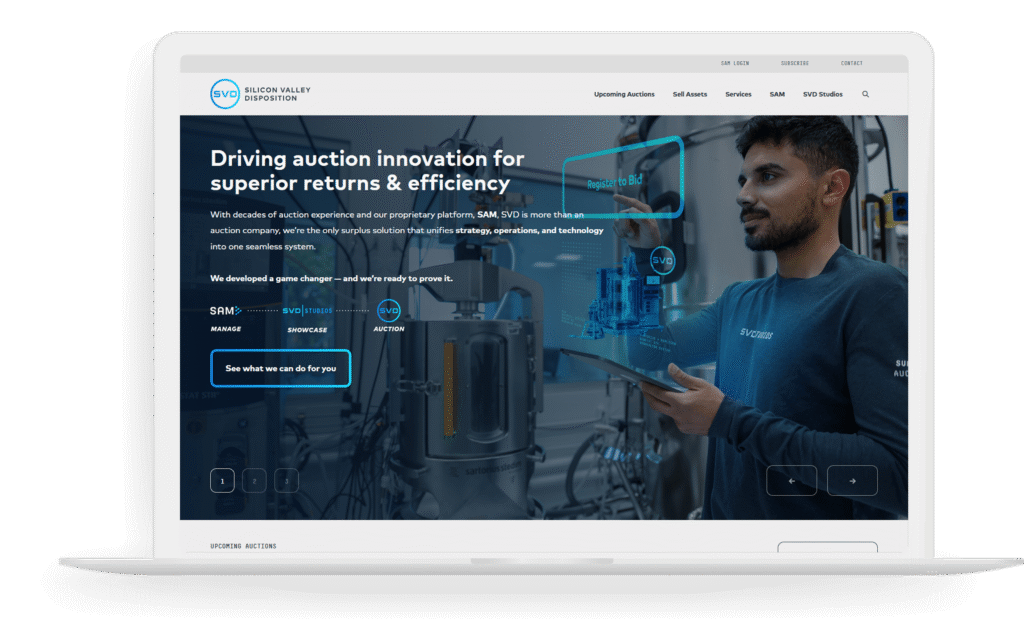
Transform a static brochure site into a dynamic auction hub with structured listings, search, and email integrations — making digital marketing measurable for the first time.
Phase 2
Core SAM Platform for Auctionsand Assets
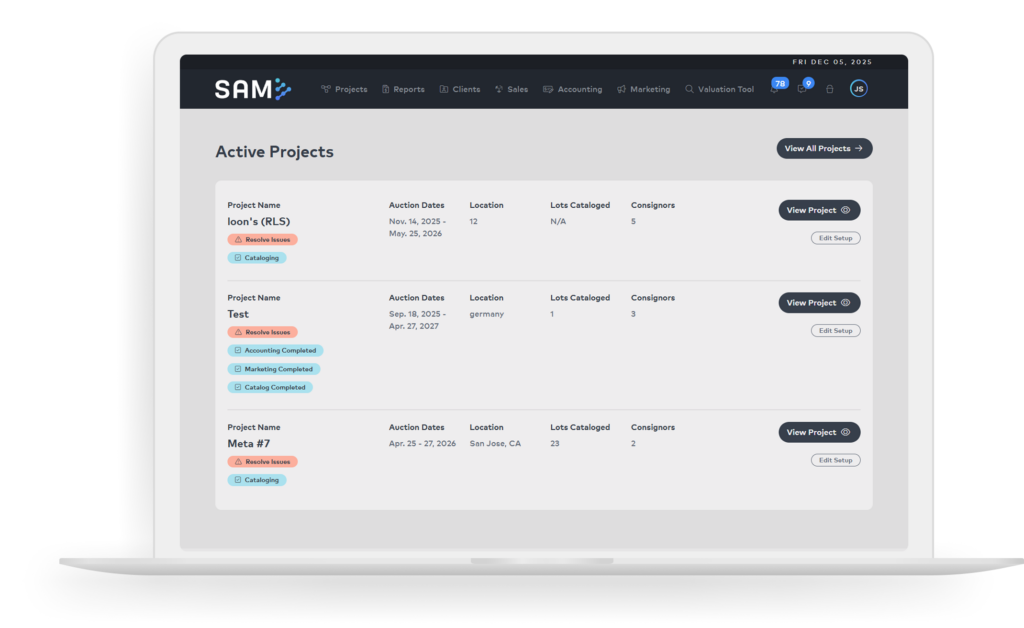
Build the operational backbone: full auction and asset management, one-click AuctionFlex export, results import, inventory workflows, and a unified project timeline.
Phase 3
Integrated Sales andMarketing
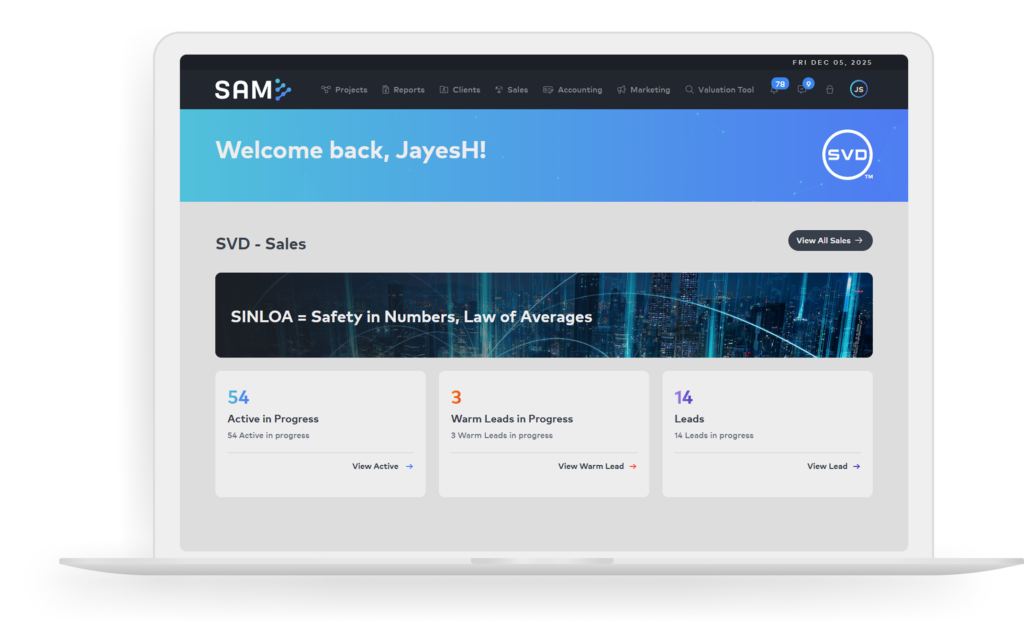
Connect sales pipeline, campaign management, and marketing attribution directly into SAM — giving leadership visibility from lead to auction revenue in one place.
Phase 4
Client Portal: Transparencyand Self-Service
Give enterprise clients 24/7 access to project dashboards, asset catalogs, approval workflows, sales reports, and direct messaging — replacing email with shared visibility.
Phase 5
Buyer Portal, Invoicing, andPickup
Close the loop on the buyer experience: automated invoicing, a self-service buyer portal, pickup scheduling, and a public onboarding flow from the marketing site.
Phase 6
AI, Analytics, SEO, andInfrastructure
Layer intelligence across the platform: cross-platform analytics, AI-assisted asset valuation, SEO automation at scale, and infrastructure built for long-term growth.
Phase 1
Modern Marketing Site and Auction Showcase
Goal
Give SVD a digital presence that matched the quality of the business — and make buyer discovery and marketing measurable for the first time.
The Problem
The existing site was a static brochure. Buyers had no way to find upcoming auctions online. Marketing spend had no attribution. There was no structured data anywhere.
What We Delivered
- Dynamic auction hub with live and upcoming listings, search, and asset photo galleries
- Email subscription flow integrated with Constant Contact
- Google Ads integration for campaign tracking and attribution
- Foundational data models for assets, auctions, clients, and locations
What changed
- Buyers could discover and track auctions online for the first time
- Marketing campaigns became tied to real auction activity and measurable
- The structured data layer built here became the foundation every later phase depended on
Phase 2
Core SAM Platform for Auctions and Assets
Goal
Replace the fragmented, multi-tool operation with a single system that owns the full auction workflow — from asset intake to final results.
The Problem
Everything before and after auction day lived in spreadsheets, shared folders, and AuctionFlex. The same data was entered multiple times by multiple people. No one had a clear view of where a project stood without making calls.
What We Delivered
- Full asset intake workflow with photo management, client and location linking, and role-based permissions
- End-to-end project timeline visible across every team
- One-click validated export to AuctionFlex — eliminating manual re-entry and the errors that came with it
- Automatic import of auction results: sold/unsold status, prices, and buyer records back into SAM
- Unsold asset inventory pool for reuse across future auctions
What changed
- SAM became the single source of truth — AuctionFlex reduced to a bidding engine
- Duplicate data entry dropped dramatically across cataloging, admin, and marketing
- Project status became visible in real time without anyone having to chase an update
- Unified reporting was possible for the first time, with results flowing directly into SAM
Phase 3
Integrated Sales and Marketing
Goal
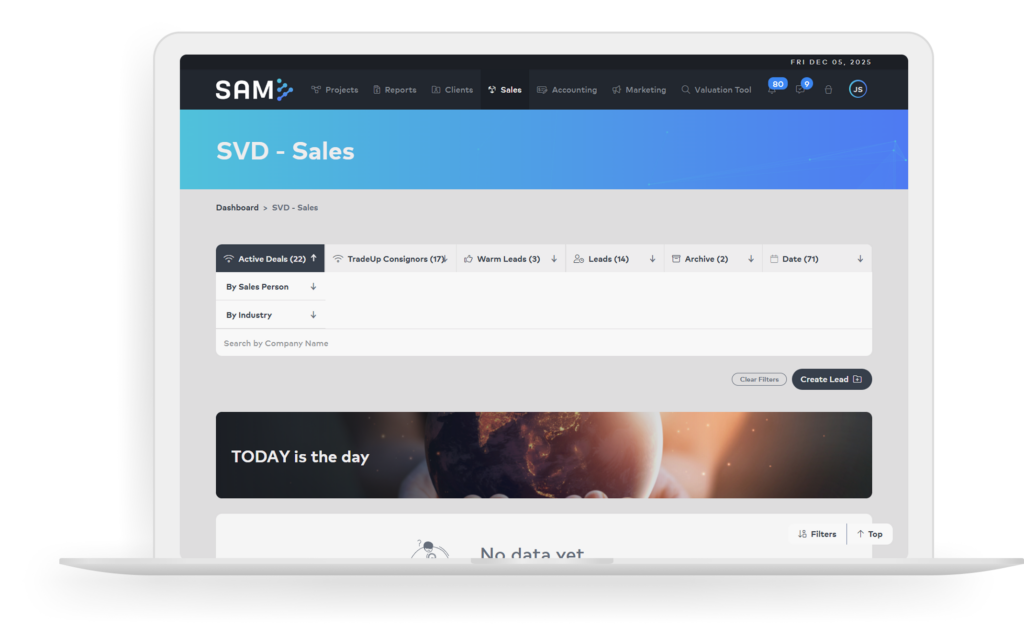
Connect sales and marketing directly into SAM so the full funnel — from lead to auction revenue — was visible in one place.
The Problem
Operations were now centralized, but sales and marketing were still running in isolation. Leads weren’t connected to projects. Campaign spend had no line of sight to auction outcomes. Teams were updating each other manually.
What We Delivered
- Sales module for tracking leads, opportunities, and project conversion — linked directly to SAM clients and projects
- Marketing module with budget tracking, campaign management, and Constant Contact and Google Ads integrations
- Attribution reporting that tied campaign spend to actual auction outcomes
- Notification layer to keep sales, marketing, and operations aligned without manual check-ins
What changed
- SVD could see the full funnel in one place for the first time — from lead to closed auction
- Marketing spend was no longer a black box — results traced back to specific campaigns
- Cross-team coordination happened through the system, not through email and calls
Phase 4
Client Portal: Transparency and Self-Service
Goal
Give enterprise clients real-time visibility into their projects — and reduce the operational overhead of keeping them updated.
The Problem
As auction volume grew, email-based status updates stopped scaling. Clients were waiting on reports, chasing approvals, and calling for information SVD’s team had to stop and find for them.
What We Delivered
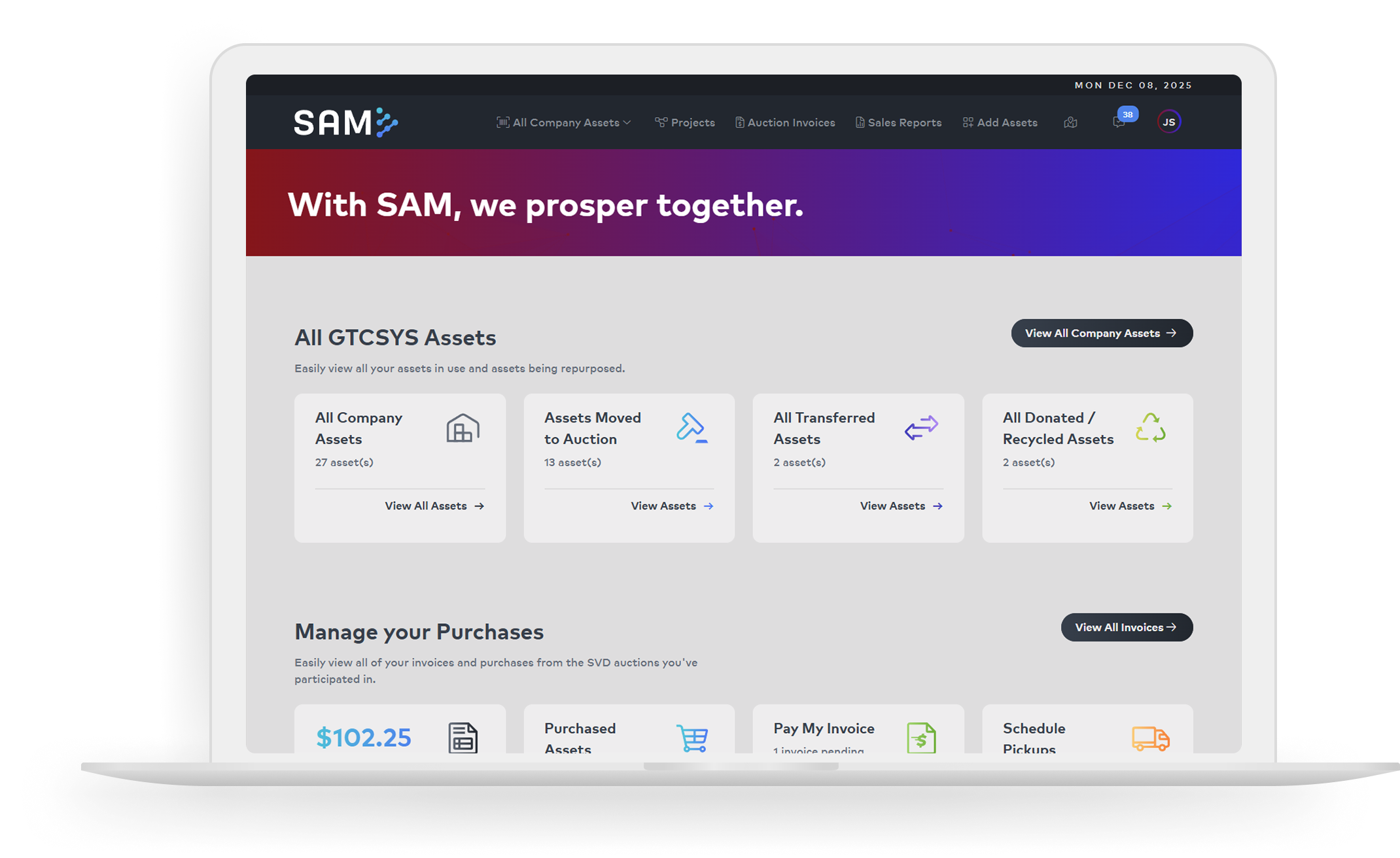
- Client portal with project dashboards, timelines, and asset catalog access
- Downloadable sales reports and inventory visibility — available on demand
- Approval workflows for move and hold requests, replacing email back-and-forth
- Direct messaging between clients and the SVD team, inside the platform
What changed
- Status calls dropped — clients could see project progress without asking
- Approvals moved faster with a structured workflow instead of email chains
- Enterprise clients trusted the relationship more because the work was visible in real time
Phase 5
Buyer Portal, Invoicing, and Pickup
Goal
Give enterprise clients real-time visibility into their projects — and reduce the operational overhead of keeping them updated.
The Problem
Close the loop on the buyer experience and remove the operational overhead that came with managing it manually.
What We Delivered
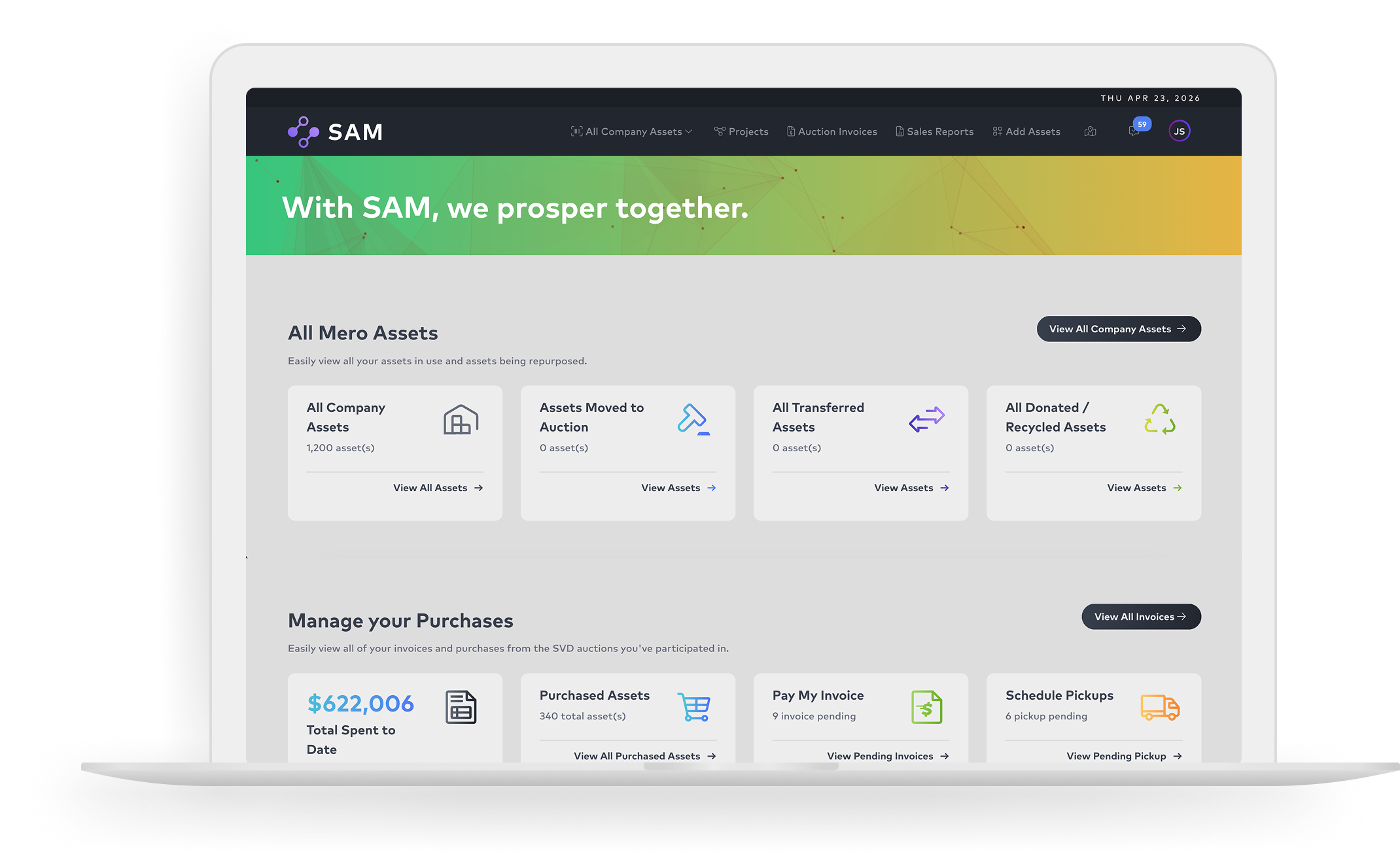
- Buyer data pipeline from AuctionFlex — consolidating identities, purchase history, and auction results into SAM
- Automated invoicing: generation, delivery, and tracking after every sale
- Buyer portal with invoices, payment status, purchase history, pickup details, and self-scheduled pickups
- Public onboarding flow from the marketing site for new buyers and sellers to register and be provisioned into SAM automatically
What changed
- Buyer support requests around invoices and pickups dropped significantly
- The team could focus on running auctions instead of answering repetitive questions
- New buyer and seller onboarding became self-serve, with no manual provisioning required
Phase 6
AI, Analytics, SEO, and Infrastructure
Goal
Turn ten years of accumulated data into a competitive advantage — and rebuild the platform's foundation to support the next phase of growth.
The Problem
SAM had become the single source of truth across operations, clients, and buyers. But the data it held was underutilized. Leadership still lacked cross-platform visibility. Asset pricing relied on individual judgment. Organic reach required manual marketing effort. And the infrastructure wasn’t built for the scale ahead.
What We Delivered
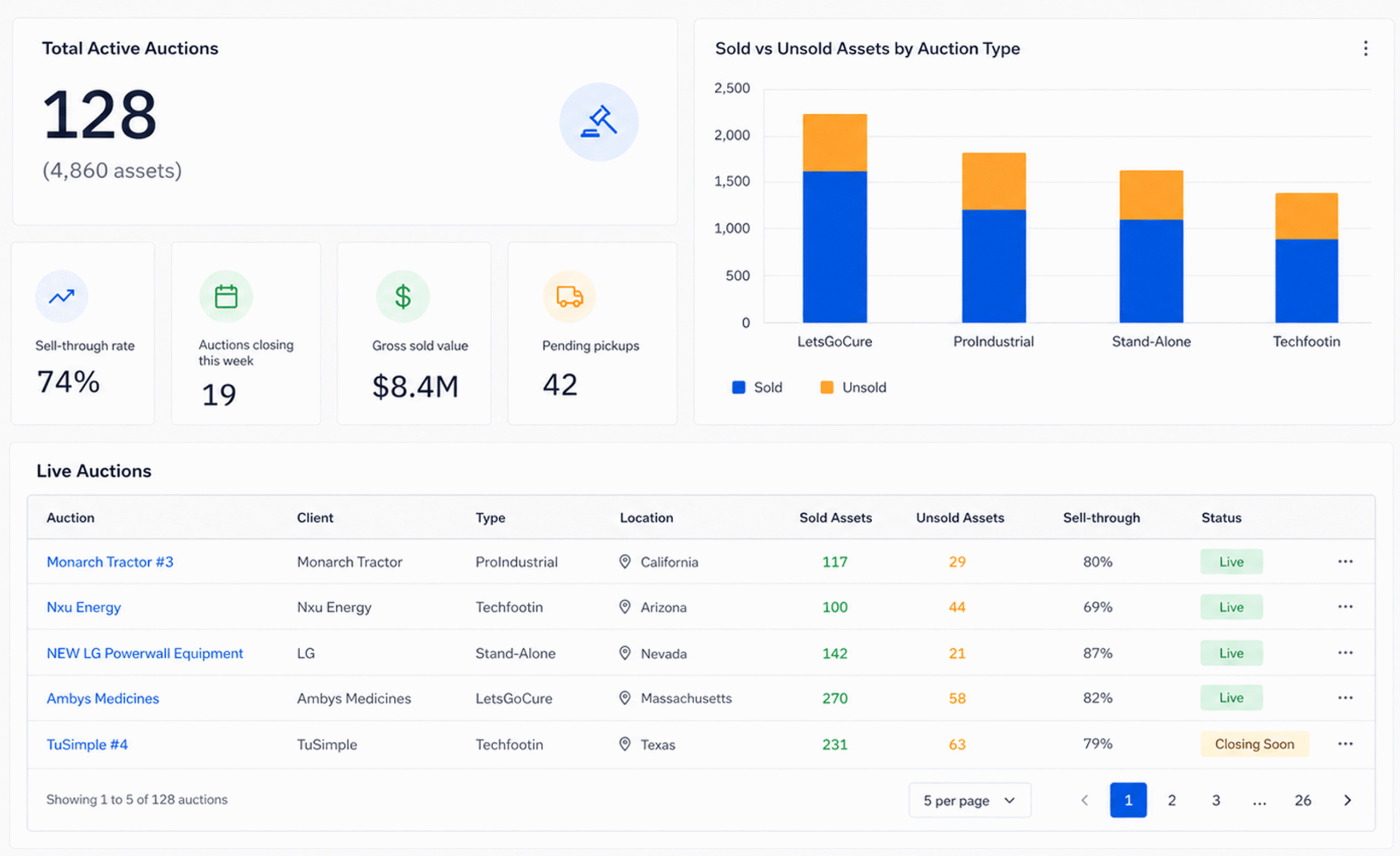
- Cross-platform analytics dashboards — operational, buyer, and marketing data unified, filterable by client, industry, asset category, region, and time period
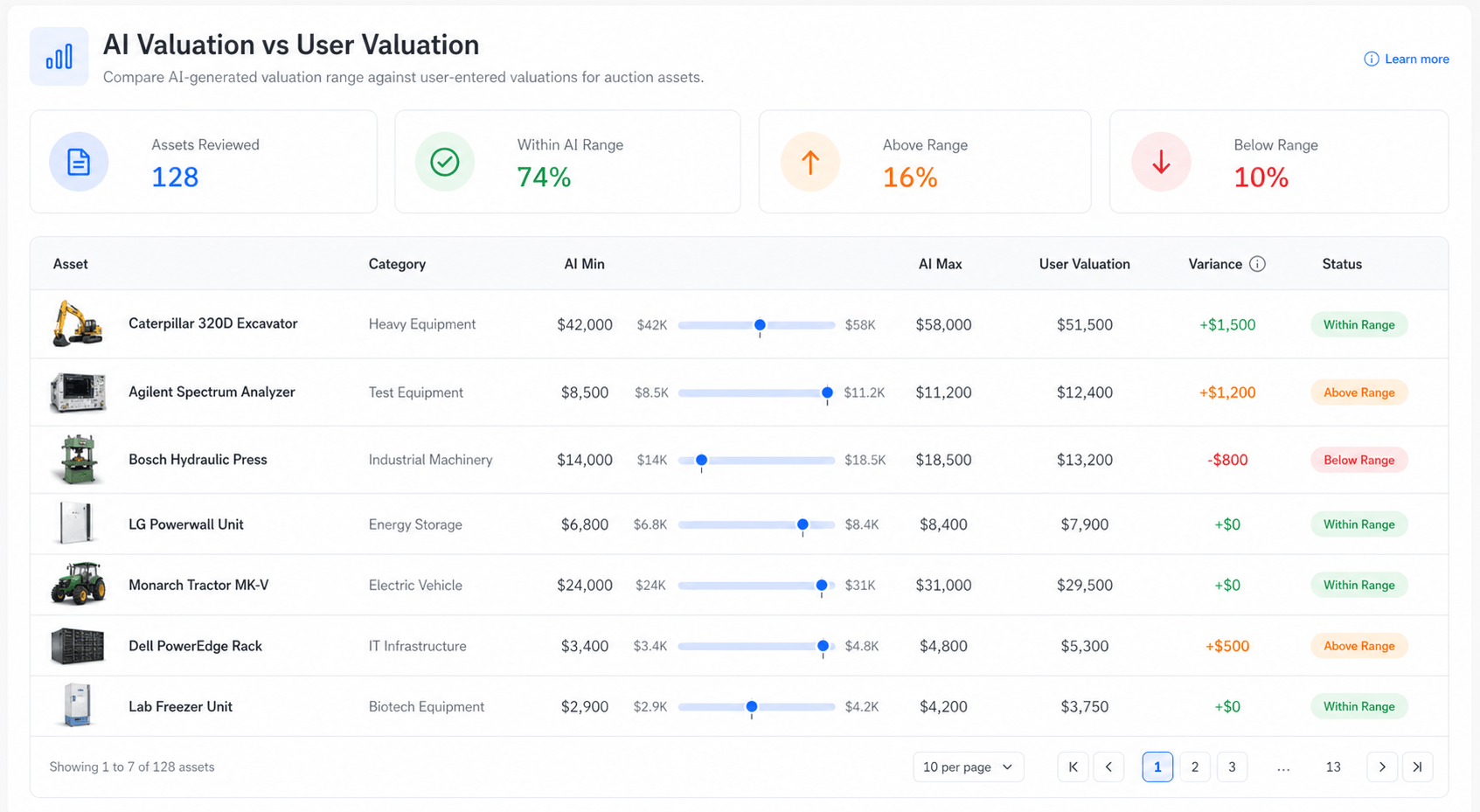
- AI-assisted valuation — pricing recommendations built on SAM’s historical auction data, surfaced directly inside the cataloging workflow
- SEO automation — structured, search-optimized asset and auction pages generated at scale from SAM’s own data, driving organic traffic without proportional spend
- Infrastructure re-architecture — SQS, ECS/Lambda, S3, OpenSearch, and autoscaling, built for the volume and traffic growth ahead
What changed
- Leadership could see full business performance in one place and act on it
- Admins had data-backed pricing guidance at the point of cataloging, not after the fact
- Organic reach grew substantially without a matching increase in marketing spend
- The platform was ready to scale — for a proprietary auction engine, mobile apps, and a multi-tenant SaaS future
Business Impact & Metrics
The numbers SVD/SAM tracks internally are their own, but the directional improvements across the platform are clear:

Up to 70–90% reduction in duplicate data entry
Cataloging in SAM and exporting once toAuctionFlex replaced the multi-stepmanual process.

50–70% faster catalog review cycles
Structured data, AI-assisted valuation, andintegrated client approvals compressed aprocess that once took days.

Reports in minutes, not hours
Final sales reports that previouslyrequired manual export-match-calculate cycles are now generateddirectly from SAM.

30–50%+ reduction in buyer support volume
The buyer portal absorbed the invoiceand pickup questions that previouslygenerated a constant stream of emails.

Real-time operational visibility
Project status, bottlenecks, andthroughput are visible across theorganization without anyone having tochase an update.

Competitive positioning
SAM’s portals, analytics and AIvaluation capability have helped themwin and retain larger enterpriserelationships in a market where mostcompetitors still run on spreadsheets.

Before SAM, marketing was always playing catch-up. We were manually pulling assets,building landing pages by hand, and launching campaigns with information that was alreadyout of date by the time it went live.
What GTCSYS built changed that completely. Our auction listings are structured, searchable,and published without us having to recreate anything. Campaign integrations connect backto real auction data. The SEO work they built into the platform has driven organic reach wecouldn’t have bought.
They understood that marketing can’t function in isolation from operations. That’s not acommon insight, and it’s what made the difference.
Manual Padilla
Creative + Marketing Director | SVD
How We Worked Together
A few principles shaped how this partnership held up over ten years:
- Embedded, not external. Our engineers and product teams worked inside SVD's operations during cataloging periods and live sale days. That proximity shortened feedback loops and built the kind of product empathy that can't come from a requirements document.
- Pilot first, then scale. Every major capability — AuctionFlex integration, client portal, buyer portal — started with a tightly scoped test on one real auction. We measured before we expanded.
- Workflows from observation, not assumption. We designed around what we saw people actually doing in the field and back office, not around what a process diagram said they should do. That's why adoption held.
- Data ownership as a non-negotiable. From Phase 1, the architecture was built so SAM — not AuctionFlex, not any third-party tool — owned the core data. Every later innovation in analytics, AI, and SEO was made possible by that early decision.
What's Next
With SAM embedded across operations, clients, and buyers, SVD/SAM and GTCSYS have defined the next phase of the roadmap:
- A proprietary SAM auction engine to replace AuctionFlex and give SVD full ownership of the bidding experience and buyer data.
- Mobile apps for buyers and field teams — on-the-go cataloging, approvals, bidding, and pickup management.
- Client-hosted auctions — capabilities that let SVD's enterprise clients run their own auctions through SAM, moving the platform toward a multi-tenant SaaS marketplace.
- Expanded AI across cataloging, recommendations, forecasting, and conversational tools for clients, buyers, and internal teams.
SAM started as a website upgrade. It’s now the foundation for SVD/SAM’s evolution from auction operator to technology-driven platform company.
This is how we work. Not just for SVD, but for every client we take on.
Who we are?
We are more than a software development firm; we are leaders in transforming technology into tangible value creation for your business, driving innovation and fuelling growth for both startups and enterprises worldwide.
Trusted by more than 140 businesses and their teams
We work with amazing companies








Leadership Team

Mukesh Lagadhir
Founder and CEO
Visionary CEO with 15+ years in technology consulting, product management, and software development, founded GTC in 2013. Under his leadership, GTC has excelled, delivering cutting-edge solutions and achieving consistent revenue growth well ahead of the market.

Uday Panchani
Operational Head
An accomplished IT professional with 18+ years of experience, plays a vital role in managing operations at the GTC. His dynamic leadership, strategic vision, and commitment to excellence have propelled the Company’s growth, expanded its customer base, and fostered a culture of innovation.

Ravi Modha
Principal Solution Architect
Principal Solution Architect at GTC with 15 years of industry expertise, leads software architecture design aligned with client needs. He collaborates with clients, provides technical leadership, manages technology stack selection, conducts code reviews, and identifies and mitigates potential risks.

Dharmesh Kanzariya
Technology Lead
Technology Lead with 12 years of experience building customized software solutions. He brings strong technical expertise, leadership, and problem-solving skills to drive outcomes. With a proven track record in strategy and execution, he helps businesses grow with reliable solutions.

Mukesh Lagadhir
Founder and CEO
Mukesh Lagadhir, a visionary CEO with 15+ years in technology consulting, product management, and software development, founded GTC in 2013. Under his leadership, GTC has excelled, delivering cutting-edge solutions and achieving consistent revenue growth well ahead of the market.

Uday Panchani
Operational Head
Uday Panchani, an accomplished IT professional with 17+ years of experience, plays a vital role in managing IT operations at the Company. His dynamic leadership, strategic vision, and commitment to excellence have propelled the Company’s growth, expanded its customer base, and fostered a culture of innovation.

Dharmesh Kanzariya
Tech Lead
Dharmesh is a Technology Lead with 11 years of experience in building innovative, customized software solutions. He brings a strong mix of technical expertise, leadership, and problem-solving skills to drive successful outcomes. With a proven track record in technology strategy and execution, he helps businesses grow with smart, reliable solutions.

Ravi Modha
Principal Solution Architect
Ravi, a Principal Solution Architect at GTC with 14 years of industry expertise, leads software architecture design aligned with client needs. He collaborates with clients, provides technical leadership, manages technology stack selection, conducts code reviews, and identifies and mitigates potential risks.
If you're building something similar
1
Map your operation honestly
Identify where data is duplicated, where visibility breaks down, and what your team is doing manually that a platform should handle.
2
Pick one phase to start
The biggest mistake is trying to build everything at once. Find the highest-friction gap, solve it well, and build from there.
3
Test on a real use case
Every phase of SAM was piloted on a live auction before rollout. Real conditions surface what requirements documents miss.
Let’s work together on your next best!
Our deep real estate expertise eliminates the learning curve, helping us move faster, design smarter systems, and deliver measurable business outcomes from day one.

Let’s work together on your next best!
Our deep real estate expertise eliminates the learning curve, helping us move faster, design smarter systems, and deliver measurable business outcomes from day one.